Showing posts with label Elsevier. Show all posts

Monday, August 19, 2019

MediaWeek (Vol 12, No 9): Amazon Juggernaut & Dilemma, Open Source Publishing, Digital Textbooks, Elsevier

The Amazon Publishing Juggernaut: What does the e-commerce giant want with the notoriously fickle world of publishing? To own your every reading decision. (Atlantic)

"Founded in 2009, Amazon Publishing is far from the tech giant’s best-known enterprise, but it is a quietly consequential piece of the company’s larger strategy to become a one-stop shop for all your consumer decisions. As Amazon Studios does with movies, Amazon Publishing feeds the content pipelines created by the tech giant’s online storefront and Amazon Prime membership program. At its most extreme, Amazon Publishing is a triumph of vertical engineering: If a reader buys one of its titles on a Kindle, Amazon receives a cut both as publisher and as bookseller—not to mention whatever markup it made on the device in the first place, as well as the amortized value of having created more content to draw people into its various book-subscription offerings. (One literary agent summed it up succinctly to The Wall Street Journal in January: “They aren’t gaming the system. They own the system.”)

The Amazon dilemma: how a tech powerhouse that fulfills our every consumer need still lets us down. Despite increasing criticism, Amazon refuses to acknowledge many of the unintended consequences its rise to dominance has spawned. (ReCode)

"Let’s start with Amazon’s power. Its roots can be traced back to a potent cocktail of vision, fortuitous timing, relentlessness, and a knack for exploiting loopholes — from state tax laws to a dearth of regulation that could have prevented it from acting simultaneously as retailer, retail platform, and consumer brand kingmaker."
Fake Journal publishers: OMICS, Publisher of Fake Journals, Makes Cosmetic Changes to Evade Detection. Following a public outcry over their proliferation, paralleled by a media exposé together with regulatory pressures in some countries, fake journals have appeared to be cleaning up their act. (TheWire)
Mind the Gap: The landscape of open-source publishing tools (report)
The number of open source (OS) online publishing platforms, i.e. production and hosting systems for scholarly books and journals, launched or in development, has proliferated in the last decade. Many of these publishing infrastructure initiatives are well-developed, stable, and supported by a small but vigorous distributed community of developers, but promising new ventures have also recently launched.
The notable increase in the number of OS platforms suggest that an infrastructure ‘ecology’ is emerging around these systems. Distinguishing between systems that may evolve along competitive lines and those that will resolve into a service ‘stack’ of related, complementary service technologies will help potential adopters understand how these platforms can or should interoperate.
Hummm, The radical transformation of the textbook (Wired)
“Digital text, digital work, is often engaged with at a lower level of attention. By moving everything online, it’s going to become even more decontextualized. Overall, I think there’s going to be less deeper learning going on,” Trakhman says. “I believe there’s a time and a place for digital, but educators need to be mindful of the time and place for using these resources. Rolling out these digital suites is not really the best for student learning.”
Battling Elsevier:  University of California’s showdown with the biggest academic publisher aims to change scholarly publishing for good (The Conversation)
The UC-Elsevier showdown made headlines because it’s symptomatic of the way the internet has failed to deliver on the promise to make knowledge easily accessible and shareable by anyone, anywhere in the world. It’s the latest in a succession of cracks in what is widely considered to be a failing system for sharing academic research. As the head of the research library at UC Davis, I see this development as a harbinger of a tectonic shift in how universities and their faculty share research, build reputations and preserve knowledge in the digital age.
Inclusive (textbook) access at the University of Arkansas (News) and at Austin Peay (News)


Read more articles on my Flipboard magazine:


*******

Are you considering an investment in new technology?  Check out my report on software and services providers.  (PubTech Report)
Michael Cairns is a business strategy consultant and executive.  He can be reached at michael.cairns@infomediapartners.com or (908) 938 4889 for project work or executive roles.

Friday, September 29, 2017

MediaWeek (Vol 10, No 3) : Pew research, Stanford University Press and Elsevier's open acces. September 28th 2017

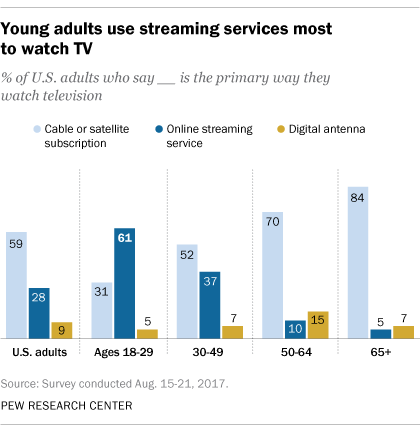
According to recent research by Pew, young adults are increasingly comfortable with decoupling "broadcast" television from legacy distribution models such as cable and satellite.  It is likely that as the population ages that over the web streaming will be the primary source of video content.  This could fracture the model for content distribution to consumers or perhaps - less optimistically - simply "move" the monopoly positions from cable/satellite companies to Google and Amazon.


Pew report


An interesting initiative from Stanford University Press to enable scholars to publish and peer-review the interactive content they have produced.
"The press was the first academic publishing group to offer scholars a way to publish and peer review academic research that involves digital tools not usually found in online journals. The idea for the program, launched last year with the help of a $1.2 million grant from the Andrew W. Mellon Foundation, came out of press director Alan Harvey’s desire to “break the box of publishing."
As is well known, the university press marketplace is very challenged with revenues down or (at best) flat for most but the largest presses and the increasing challenges on campus to justify their existence.  Like Stanford, other presses are seeking to encourage innovation in their publishing programs and looking to new market opportunities.  As the press report notes, this effort at Stanford builds on their core expertise but nevertheless required new methods established 'from scratch'.  That requires fortitude and assumes some risk but is the type of effort required to move legacy models to new market opportunities.

Article Link

Elsevier proposed last week a regional access model for open access as quoted in the Time Educational Supplement,
Gemma Hersh, Elsevier’s vice-president for policy and communications, says that universities and publishers “need to think creatively about how open access can be made to work in practice on a regional scale to cater to different paces and approaches to open access in different parts of the world”.
“In this way [of regional approaches], Europe could move forward to achieve its goals without waiting for international consensus,” Ms Hersh said. “And if this approach could be shown to deliver benefits to Europe, then it would create a persuasive evidence base from which to encourage other regions to follow Europe’s lead.
“At the same time, such a regional approach would have the advantage of enabling different parts of the world to move at their own pace and in line with their own needs.”
It seems this idea hasn't really been thought through and indeed the raised opposition not least because academic research is increasingly global in nature thus making access models on a regional basis a little problematic.   Here from Toby Green (@tobyABGreen) on Medium:
Your suggestion that a regional approach to gold open access might be a way forward pains me as much as Lucky’s soliloquy does the protagonists in the play. If there is one industry that is truly global in nature, it is scholarly publishing. This won’t be news to you, but if scientific articles are increasingly co-authored on an international basis and these papers tend to be more highly cited, then surely it is a nonsense that an article could be open in Europe but closed in Australia. A regional approach would also prolong inequality between the haves and haves not, which must be unacceptable at a time when digital has opened the way to bridging divides at almost no cost.

Sunday, May 20, 2012

MediaWeek (Vol 5, No 21): Internet Commons, Mass 'Professoriat", IP Markets, New ASCAP/BMI Model + More

In The Atlantic, Bill Davidow wonders whether like the sea, the internet will be 'over fished' (The Atlantic)
Free markets are the most efficient and best mechanism for managing most economic activity. But when they operate in arenas in which they can exploit the commons, the logic of the free market dictates that they will destroy it. Virtual retailers, for instance, live off their bricks-and-mortar brethren. They encourage customers to search for clothes that fit properly in retail stores that pay property taxes and other overhead costs, and then to buy them online. In the process, they get fat off the bricks-and-mortar commons.
One of the areas I see being chewed up at an alarming speed is privacy -- a vital aspect of our personal commons. We spend hours filtering out junk email, updating passwords, and worrying about stolen identity.
In the physical world, laws protect our privacy, and the cost of gaining access to us is high. (It costs a lot to send physical mail.) Physical spying is expensive. But in the virtual world, we have few property rights, few laws to protect us, and spying is almost free.
Give all the negative public relations that Elsevier has faced recently is a very different model on the horizon?  (The American Interest):
But the thought does occur to one: while it is relatively easy to see how public universities might want to support academic research in the natural sciences and economics, just how much do the taxpayers want to contribute toward the production of research of questionable utility in softer fields? And if the answer is, as I suspect it will increasingly be, that the taxpayers don’t want to shell out for these costs, how many fewer professors will our university systems employ?
It is much more fun to complain about the pirates of Elsevier than it is to think about the future of the mass professoriat, but I suspect that university faculties might soon find it necessary to adjust to a new set of public priorities. Fifteen years ago journalists thought that the internet wasn’t a serious issue for their field; today many of the journalists who once scoffed at the net are now unemployed.
A fascinating look at a new way to 'market' and trade intellectual property (Economist):
All of which makes this a good time to launch a new approach to trading intellectual property, says Gerard Pannekoek, the boss of IPXI, a new financial exchange that lets companies buy, sell and hedge patent rights, just like any other asset. The idea is to offer a patent or group of patents as “unit licence rights” (ULRs), which can be bought and sold like shares. A ULR grants a one-time right to use a particular technology in a single product: a new type of airbag sensor in a car, say. If a company wants to use the technology in 100,000 cars, it buys 100,000 ULRs at the market price. ULRs are also expected to be traded on secondary markets.
Capturing the 'data exhaust' from satellite transmissions to reinvent the way music royalties are made (WSJ):
So in 2009 , he and business partner and composer Chris Woods launched TuneSat, a startup that uses digital technology to monitor satellite TV signals from around the world and keep track of how music is being used in theme songs,  advertisements, background soundtracks and other broadcast situations. Schreer is CEO and Woods is COO of the company. The value of the new Big Data driven part of his business has the potential to eclipse revenue from the core business of composing and producing music.
Beyond that, they say TuneSat may help disrupt the performing rights business, an industry with $2 billion in revenue in U.S. and $9 billion worldwide, by putting powerful algorithms directly in the hands of copyright owners that allow them to scour and analyze the use of their work across the entire national TV market. A web-based application allows subscribers to access TuneSat’s servers and its proprietary analytic tools, in the process allowing them to bypass traditional royalty rights organizations, if they choose.
Stop sending free textbooks complains higher ed faculty (IHEd):
When I arrived at my office door one morning, arms full of books and lunch and workout clothes, and found my path blocked by an unsolicited box of books, the sales rep found my breaking point. I replied with a sharply but politely worded cease-and-desist message, making as clear as possible that I would disqualify unsolicited texts from consideration for adoption in our program because of my concern.

There are probably 50 pounds of never-requested and never-to-be-used textbooks in my office. I’d prefer 50 pounds of just about anything else. Fifty pounds of in-the-shell roasted peanuts to eat in my office; 50 pounds of water balloons to rain down on the heads of students who smoke under my frequently open office window.

Is the New York Public Library Seizing the Future or Renouncing Its Past?
Amazon consumer book reviews as reliable as media experts
University of British Columbia opts out of Access Copyright agreement  
Carlos Fuentes' Worldcat Identity page

Monday, April 09, 2012

MediaWeek (Vol 5, No 15): NYPublic remodels, Creative Thought, Gunter Grass, Pew eReader Study + More

The New York Public library is undergoing a renovation of sorts and will be moving a large segment of its' print collection to off-site storage.  Many large academic libraries (in particular) have or are under-going similar realignments among them the British Museum, Stanford, NYU and Ohio State.  Naturally, there are some who just don't like the idea (Guardian):
The removal of the books – some to a site underground in adjacent Bryant Park, the rest to a facility in suburban New Jersey that the NYPL shares with Princeton and Columbia universities – is part of a gargantuan $300m reorganisation aimed at lugging the central library into the 21st century.
Eight storeys of Carnegie steel stacks will be ripped from the central library building's interior to make room for a new public space designed by star architect Norman Foster, whose firm designed London's city hall and the reichstag in Berlin. The library has said that the books in the stacks are showing signs of environmental wear and will be better preserved elsewhere.
The sleek new interior space – two city blocks long, eight storeys high and a quarter of a block wide – will come equipped with banks of new computers and, for the first time in two generations, a lending library. It will give a dramatically more modern look and feel for the system's central branch.
"We are aiming to create the greatest library facility in the world," Anthony Marx, the library's CEO and president, told the Guardian. "And we are as committed as the scholarly community to ensure that it continues to be a great research facility."
Interesting article on the creative thought process (Guardian):
Every creative journey begins with a problem. It starts with a feeling of frustration, the dull ache of not being able to find the answer. When we tell one another stories about creativity, we tend to leave out this phase of the creative process. We neglect to mention those days when we wanted to quit, when we believed that our problems were impossible to solve. Instead, we skip straight to the breakthroughs. The danger of telling this narrative is that the feeling of frustration – the act of being stumped – is an essential part of the creative process. Before we can find the answer – before we probably even know the question – we must be immersed in disappointment, convinced that a solution is beyond our reach. It's often only at this point, after we've stopped searching for the answer, that the answer arrives. All of a sudden, the answer to the problem that seemed so daunting becomes incredibly obvious.
This is the clichéd moment of insight that people know so well from stories of Archimedes in the bathtub and Isaac Newton under the apple tree. When people think about creative breakthroughs, they tend to imagine them as incandescent flashes, like a light bulb going on inside the brain.
These tales of insight all share a few essential features that scientists use to define the "insight experience". The first stage is the impasse. If we're lucky, however, that hopelessness eventually gives way to a revelation. This is another essential feature of moments of insight: the feeling of certainty that accompanies the new idea. After Archimedes had his eureka moment – he realised that the displacement of water could be used to measure the volume of objects – he immediately leaped out of the bath and ran to tell the king about his solution. He arrived at the palace stark naked and dripping wet.
Gunter Grass in stepped in it again with a poem decrying the military first strike mentality specifically referencing Israel's supposed intention to bomb Iran's nuclear sites. (THR):
The poem is, to put it bluntly, morally obtuse and politically embarrassing. Having reversed the arrows of causation, Grass says nothing about the hatred of Israel that the Iranian regime has publicly expressed since 1979, about its specific threats to “wipe it off the map” in the past decade, or the vicious Jew-hatred that is a steady diet of its propaganda. Apparently he has not read the most recent reports of the International Atomic Energy Agency that confirm Iran’s efforts to build nuclear weapons. Nor does Grass understand that the purpose of missile-carrying submarines is to ensure the credibility of a second strike should Iran or any other power attack Israel first. These submarines are essential for a stable system of deterrence. No Israeli leader has spoken about delivering a first strike with nuclear weapons that would “extinguish” the Iranian people. All of this comes from a man who was “silent” for five decades of his very successful literary career about the fact that as a young man he was a member of the Waffen SS at the end of World War II.
The idea, put forward by Grass, that there is a taboo in German intellectual and political life about criticizing Israel and its policies has been a favorite theme of Israel’s critics since the 1960s. But the taboo does not exist. There has been no silence in Germany, especially in such places as Der Spiegel or the Süddeutsche Zeitung, not to mention among intellectual and political forces to their left, for many decades. On the contrary, hostility to both Israel and the United States, and the view that these two countries are the major threat to world peace, became embedded in the German left-wing and left-liberal mainstream many decades ago. In this sense, Grass’s diatribe is part of a long established conventional wisdom. It takes neither courage nor intelligence to run with the mob. Grass’s poem seeks to make the mob yell even louder.
Pew Study on e-Reading confirms some interesting trends.  Among them (Pew):
30% of those who read e-content say they now spend more time reading, and owners of tablets and e-book readers particularly stand out as reading more now. Some 41% of tablet owners and 35% of e-reading device owners said they are reading more since the advent of e-content. Fully 42% of readers of e-books said they are reading more now that long-form reading material is available in digital format. The longer people have owned an e-book reader or tablet, the more likely they are to say they are reading more: 41% of those who have owned either device for more than a year say they are reading more vs. 35% of those who have owned either device for less than six months who say they are reading more.

The average reader of e-books says she has read 24 books (the mean number) in the past 12 months, compared with an average of 15 books by a non-e-book consumer. Some 78% of those ages 16 and older say they read a book in the past 12 months. Those readers report they have read an average (or mean number) of 17 books in the past year and 8 books as a median (midpoint) number.

 
 Will Self takes a look at Twitter (New Statesman):
Is all this human twittering in any meaningful sense crazy? Not, I'd argue, if you see it for what it is - but if it's considered to be an advance of some kind in the sphere of human relatedness, that has to be nuts. I spent a great deal of the 1970s avoiding bores with slide carousels who wanted their holiday slides writ large on suburban walls - why on earth would I want to reacquaint myself with such tedium in the form of Facebook's petabytes of snapshots? I think it was the anthropologist Robin Dunbar - one of the proponents of the "social mind" conception of human cognitive evolution - who theorised that language developed as an outgrowth of the group cohesion that other great apes cement by picking parasites from each other's fur.
Speaking of which, from the twitter this week:

Essay defending the planned changes at New York Public Library Inside Higher Ed:

New post: My exciting new job at Elsevier: Inaugural editor-in-chief of The Journal of Applied Publishing Experiments:

Is making books social a good thing or a bad thing?

We've been giddy here in the PND sports department over the past month and it's looking like delirium in Salford and weeping in the City.  Man Utd are closing in on number 20 and the boss pays tribute to Paul Scholes (MEN)