Thursday, January 04, 2018

Collection of Media Predictions for 2018

I've collected some media predictions from a variety of sources again this year.  Not all of these are entirely relevant to academic, professional or educational publishing but nevertheless I think they are interesting.   Look out for my predictions in the week to come.


Mark Coker: 2018 Book Publishing Predictions

Kantar Millard Brown: Media & Digital Predictions provides marketers with a guide to the challenges and opportunities ahead in 2018.


Gentleman's Journal: 10 Predictions for 2018


Tuesday, November 07, 2017

PND Media Magazine: You Will Lose Your Job to a Robot

My flipboard PND magazine has a new set of stories this month including:

Academic journal publishing is headed for a day of reckoning - The Conversation

8 strategies for saving local newsrooms - Neiman Lab

You Will Lose Your Job to a Robot—and Sooner Than You Think - MotherJones

Amazon could be responsible for nearly half of U.S. e-commerce sales in 2017 - Recode

And many more.

View my Flipboard Magazine.

Wednesday, November 01, 2017

Publishing Software Market Map


How much publishers spend and where they spend it with respect to technology and services is a hard question to answer. If, like me, you've also been stumped by this set of questions you may have been looking to benchmark your technology expenses, estimate an addressable market size or to determine whether the way you manage your internal costs is best or worst in class - just to name a few. It's a conundrum that other industries seem to have solved with their regular bench marking studies and surveys regarding technology spending. With our industry facing significant transition with respect to the importance of the role of technology in our business success, I would expect senior management would be actively seeking more understanding of how effectively and efficiently they were addressing their technology spend.

I am attempting to determine if publishers are interested in learning more about technology spending in the industry and to understand whether publishers would be interested in participating in a benchmark study. If you are interested please email me: michael.cairns@outlook.com and we can set up time to discuss it. As a first step, I have created a draft of the software technology landscape and I am also interested in hearing about additions and corrections to this draft (via email)


Tuesday, October 17, 2017

True digital transformation requires a customer-first perspective


I was asked by trade mag Digital Content Next to write an article based on my Digital Transformation seminar.  Here is an excerpt:

Over the past 20 years, the “digital transformation” of the publishing industry has been—for the most part—a slow, incremental process. For too long, the publishing industry was mostly concerned with digital replicas, ebooks, and other superficial “transformation” efforts which, in fact, didn’t so much transform the business as copy legacy models in electronic form.
Suffice it to say that legacy media models are oriented around the process of producing a book, magazine, or newspaper and not necessarily based on the experience and circumstances of the digital consumer. As digital transformation enters a new, more advanced phase, many publishers are recognizing they have an opportunity to provide products that raise the value proposition to customers.
What does it all mean?
The term digital transformation can be defined as a multitude of activities and attitudes that a business could potentially pursue. But what digital transformation really requires is that business owners adopt the customer’s viewpoint and change their business philosophy accordingly – from a process orientation to one that is customer-centric.
Publishers in education, reference and professional segments are beginning to execute operational change which supports this evolving viewpoint. And of course, there are “born digital” media organizations that aren’t wedded to legacy models. However, some of the best examples come from sectors outside media. Amazon.com is frequently cited as a proponent of the customer-centric view and their willingness to continue to rethink their operations from the customer perspective results in initiatives such as ‘one-click’ ordering to their recently announced wireless checkout process. Payment is made automatically via the Amazon app as the customer leaves the store. And we’ve seen what Amazon-owner Jeff Bezos has done in terms of transforming processes at The Washington Post since he acquired it.

Read the rest of this article Here;

Monday, October 02, 2017

Digital transformation: A seminar for senior management


This presentation represents a full day workshop for senior executives designed to help define and execute digital transformation programs within their businesses.


Friday, September 29, 2017

MediaWeek (Vol 10, No 3) : Pew research, Stanford University Press and Elsevier's open acces. September 28th 2017

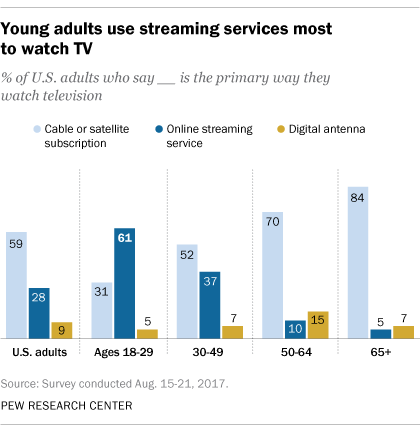
According to recent research by Pew, young adults are increasingly comfortable with decoupling "broadcast" television from legacy distribution models such as cable and satellite.  It is likely that as the population ages that over the web streaming will be the primary source of video content.  This could fracture the model for content distribution to consumers or perhaps - less optimistically - simply "move" the monopoly positions from cable/satellite companies to Google and Amazon.


Pew report


An interesting initiative from Stanford University Press to enable scholars to publish and peer-review the interactive content they have produced.
"The press was the first academic publishing group to offer scholars a way to publish and peer review academic research that involves digital tools not usually found in online journals. The idea for the program, launched last year with the help of a $1.2 million grant from the Andrew W. Mellon Foundation, came out of press director Alan Harvey’s desire to “break the box of publishing."
As is well known, the university press marketplace is very challenged with revenues down or (at best) flat for most but the largest presses and the increasing challenges on campus to justify their existence.  Like Stanford, other presses are seeking to encourage innovation in their publishing programs and looking to new market opportunities.  As the press report notes, this effort at Stanford builds on their core expertise but nevertheless required new methods established 'from scratch'.  That requires fortitude and assumes some risk but is the type of effort required to move legacy models to new market opportunities.

Article Link

Elsevier proposed last week a regional access model for open access as quoted in the Time Educational Supplement,
Gemma Hersh, Elsevier’s vice-president for policy and communications, says that universities and publishers “need to think creatively about how open access can be made to work in practice on a regional scale to cater to different paces and approaches to open access in different parts of the world”.
“In this way [of regional approaches], Europe could move forward to achieve its goals without waiting for international consensus,” Ms Hersh said. “And if this approach could be shown to deliver benefits to Europe, then it would create a persuasive evidence base from which to encourage other regions to follow Europe’s lead.
“At the same time, such a regional approach would have the advantage of enabling different parts of the world to move at their own pace and in line with their own needs.”
It seems this idea hasn't really been thought through and indeed the raised opposition not least because academic research is increasingly global in nature thus making access models on a regional basis a little problematic.   Here from Toby Green (@tobyABGreen) on Medium:
Your suggestion that a regional approach to gold open access might be a way forward pains me as much as Lucky’s soliloquy does the protagonists in the play. If there is one industry that is truly global in nature, it is scholarly publishing. This won’t be news to you, but if scientific articles are increasingly co-authored on an international basis and these papers tend to be more highly cited, then surely it is a nonsense that an article could be open in Europe but closed in Australia. A regional approach would also prolong inequality between the haves and haves not, which must be unacceptable at a time when digital has opened the way to bridging divides at almost no cost.

Wednesday, August 02, 2017

THE CEO’s First 100 Days – Plan to be Punched.

Jersey City Street Art - Michael Cairns
As Mike Tyson once said, “everybody has a plan until they get punched in the mouth.” His clever point was that, even with the best advance planning, you should be ready to adapt, modify, change and react based on real experience. Recently, I developed this 100-day on-boarding plan for a new senior role I was considering and set out a framework designed to encourage action and infuse a sense of purpose within his (new) company. (See slide deck below).

If you are ‘lucky’ as an incoming executive, you will gain useful insight during the interview process about the business and specific challenges you may face in the immediate term.  On the other hand, you might note, in a position I interviewed for several years ago, the board making the hiring decision had no understanding of the business challenges and therefore set completely inappropriate expectations for me as I undertook my new role.  So, having completed a 100-day plan for the board in advance, it became necessary to immediately revise this plan wholesale as I became aware of real (rather than assumed) situation.  Hat tip to Mike Tyson and the lessons of adaptation.

As I discussed with my client, I believe there are three phases which broadly describe the activities an executive should undertake during their first 100 days: knowledge learning, agenda setting and execution. It is worth noting that a plan of this type could be undertaken at any time during an executive’s tenure.  For example, it could be a 100-day plan for developing and launching a new product and undertaken in the third year of tenure. But, in this case, it reflects an on-boarding process for a new executive asked by their board to draft a plan.

Importantly, as the executive works through the plan, I would expect (and encourage) changes based on discovery and circumstances.  The board should also know that, from the outset, this 100-day plan is subject to change.  If the board expects a 100-day plan to be executed as defined at the start, I would expect the results to be sub-optimal.

The knowledge phase begins during the interview process, when the executive seeks as much information about the business as possible. The sources of that information are limited only by the ingenuity of the executive; however, the company is also likely to provide useful information such as plans and strategy documents.  Be aware that, the latter can be a double-edged sword: I was once given a strategic review document for reference, only to find out later in the interview cycle that the client didn’t think much of its conclusions.  Resist drawing premature conclusions, but use information gathering during the knowledge phase to support your baseline understanding of the business. Once you have arrived on site, this baseline allows you to better engage with your staff and team, learn more quickly and better assess the prospects and position of the company.

If possible, I encourage an incoming executive to meet their immediate direct reports before they start in the new role.  It’s very useful to casually get to know each other and begin setting the agenda for initial meetings.  During the first week of employment, an incoming executive will sit down with all their direct reports and, if they have met in person earlier, these meetings can be far more effective.  I like to set the agenda for these meetings in advance and this process is less ‘troublesome’ if everyone has already met beforehand.  Also, if an incoming executive can handle the administrative tasks of the on-boarding process in advance, this allows them to devote more time to real management activities in the first week.  Get these formalities out of the way before day one if possible.

In our planning, we viewed the knowledge phase as extending into the first 2-4 weeks of the executive’s term during which time the executive would spend most of their time interviewing, meeting with and listening to staff and customers. Additionally, once inside the company, the executive will gain access to documents and materials which will have been confidential during the interview process. If the executive is anything like me, they will also plan to devote time immediately to product training and to attending as many sales pitches as possible.
Obviously, meeting staff is critical and there is no better way of doing this then scheduling a company-wide meeting on day one.  If the board can introduce the executive to staff all the better, since that is an obvious validator.  In our plan, we also followed this introductory ‘all hands’ meeting with a full management meeting of direct reports.  The primary objective of this meeting is to introduce the team and to hold a (monthly) status meeting.  Again, in this case I would have pre-circulated an agenda for the meeting to assure maximum efficiency and productivity.

The intelligence gained in this initial stage will guide the executive in tailoring the agenda-setting phase, during which time the executive begins to engage at a deeper and more meaningful level with the senior team. For this engagement, we planned an “operational review” of the business quite early on – the theory being that there was plenty of time left in the fiscal year to materially improve full-year performance. (Notably, the executive wasn’t being held to the current year plan).  In my experience, ‘scripting’ or creating a detailed agenda for these meetings is essential to effectiveness. To that end, I circulate to my executive team a list of specific, targeted questions about the departments and operations they run, oriented around their operational targets, critical success factors and other criteria supporting their overall business objectives. The business information gathered during the knowledge phase is, thus, integral to documenting the most relevant agenda items for these meetings.

An important aspect of the operational review meetings is also to understand how cohesive and collaborative the existing team is in the way they work.  Are business objectives shared across department?  Are objectives aligned with overall business strategy?  Do executives actively manage their budgets and are they aware of the financial position of the business?  Sometimes, the answers to these questions will surprise.  At one business I was involved with, the targets the sales director was managing to fell significantly short of the revenue the company was supposed to deliver.  (Luckily, I did not inherit him once I became CEO).

During the agenda setting phase, the executive will continue to meet with customers, staff and other stakeholders (including board members). These meetings are opportunities for ‘give and take’ as the executive becomes more comfortable with the business. Staff (in particular, the rank and file) will expect to meet and hear from the new executive on a regular basis, and several methods of communication to all constituencies is built in to our planning. At the same time, the executive should also meet with customers and partners and, while they won’t be expected to offer detailed strategic objectives, all stakeholders will be impressed when the executive offers educated responses to their questions and concerns. That capability evolves in tandem with the executive’s proactive engagement and ‘agenda setting’ with their executive team and staff.

Lastly, comes the action phase whereby we set some short- and medium-term goals. I like to task each of my executive team members with a set of annual objectives comprising financial, operational task and personal development goals. If these are not already in place, the individual departmental and the operation review meetings become even more important. What is discussed in these meetings will provide the information needed to set meaningful objectives. In our case, we wanted to quickly establish measurable, attainable goals for the balance of the current year.

Establishing clear objectives each year creates a specific set of expectations for the executive team, the CEO and the board.  In my experience, making these objectives ‘public’ within the executive team also fosters a shared responsibility for achievement.  Firstly, the team is collectively responsible for achieving the financial goals of the business.  Secondly, as noted above each executive shall have specific task objectives but, importantly, some of these will be shared with one or more other executive team members (often also the CEO).  And, finally, during personnel review season the executive and I will determine some developmental goals (training) to be achieved during the coming year.  It is important to note that the circumstances of the business will dictate how much weight to apply to each of these areas.  For example, if your company is going broke (unfortunately, a circumstance I’ve experienced) the executive will probably weigh the financial objectives over any of the other criteria.  In a more stable environment, greater weight can be devoted to tasks that support medium-to long-term strategic objectives.

Many executives acknowledge the appeal of ‘quick wins’ but it is important to recognize that these are not specifically limited to financial wins. The executive must be alert to ‘if we could only do this…’ -type statements heard during their meetings. In my experience, there will be no difficulty identifying 5-10 items which can help to re-orient the business towards “action” immediately.  The sales team is sure to be a source of product improvements.  At one company, I undertook a rapid, 30-day evaluation of editorial processes and identified several technology improvements which could radically improve editorial workflow.  Executing on multiple ‘quick wins’ helps to kick-start the new executive’s success and may also encourage all staff to rethink what is possible in the new environment.

During the interview process, an engaged board will request an on-boarding plan (and if they don’t, that may be a warning sign). At this early stage, the incoming executive is not going to get everything right; but, assuming an aware board, any thoughtful plan can form the basis of a discussion. The board will want to understand how the executive thinks and how they process information. For the executive, the board is an important source of information about their expectations for the business and their priorities for the new executive.  A smart candidate will listen closely and, like Iron Mike suggests, think about how they will react after being hit on the chin. 

Using the framework described here (and in the deck) will ensure the incoming executive engages proactively with the business and sets the agenda for action and accountability over the balance of their tenure with the organization. The framework allows for progressive elaboration and flexibility and, in short, you'll be able to roll with the punches as they inevitably come your way.

Own it.


Friday, July 21, 2017

Moon Memory

Originally posted on 7/20/2009

Mom's caption on the back: Just look at the cloud color!
I always remembered the moon walk occurring during the daytime, and it wasn't until recently that Mrs. PND happened to recall 'staying up' to watch a couple of guys walk on the moon. My memory was captured in brilliant white sunshine and air conditioning because in their early twenties in mid 1968, my parents had packed up the family and moved to Thailand where my father took his first management role at Intercontinental. Out of England, Thailand was a magical place but also often fetid, smelly and unbearably hot; however, living at one of Bangkok's few luxury hotels - one also that had created a sort of garden oasis out of the surrounding slums - eased the transition considerably. I had the run of the place since both my brothers were much too young to get out by themselves and while I didn't get up to too much mischief I did have my moments.

My mode of transportation was my peddle car US Army issue Jimmy's Jeep (all green) in which I tooled around the open air corridors of the hotel. This was especially fun during the rainy season when the corridors became particularly conducive to skidding. As three blond haired kids, we were a somewhat unusual commodity to the Thai especially the women and whenever my youngest brother went out they always wanted to touch his blond hair. From my perspective this attention was often unwanted and one particular room service waiter teased me mercilessly, and I had just had enough when on one occasion he snuck up behind me and took my hat. When he refused in the face of my demand to give it back, I took a run at him in my Jeep and rammed him. Catastrophically, he was also carrying a lunch tray which went flying in a cascade of crockery, food and glass. I remember him looking at me half laughing while I was immediately mortified that my father would find out. Needless to say he never bothered me again and I got my hat back. No one ever mentioned it. I always wonder what he told HQ when he had to return with a tray full of debris to replace the order.

There were no televisions in the hotel rooms at that time mainly because there was only one state television station in Thailand which broadcast in Thai. On the morning of July 21st, 1969 (evening of July 20th on the east coast), my mother took me to the hotel lobby vowing to me this is something you will always remember. I suspect if we were still living in England that I would not have seen the moon walk live because of the time difference. As I recall, there were only a few people gathered around the TV which was sitting unceremoniously low to the floor on a chair. In contrast to the crowds gathered in public places in the US, I was left to recognize the importance of what I was witnessing without the collective endorsement of the crowd, but I am sure our little group clapped and sighed with relief just like everyone else. We also didn't have the benefit of Walter Cronkite's commentary and in the last several days having watched some of the CBS broadcast, he did indeed sum up the penultimate moment brilliantly when he takes off his glasses and just says 'Wow'.

In the forty years since the landing, I am indifferent to the manned space program and I don't see the value of spending billions just to prove we can do something that has no recurring benefit. The Apollo program was important but everything we do in space can be replicated down here and down here we have more than enough problems to contend with.  Nevertheless, walking on the moon was miraculous achievement.

Wednesday, July 19, 2017

Wiley Recent Investor Presentation

Wiley reports their fourth quater and also an investor presentation:
  • Full year revenue of $1,719 million, up 2% at constant currency and down 1% excluding the impacts of foreign exchange, shifting to time-based journal subscriptions, and contributions from acquisitions. GAAP revenue flat including a $43 million unfavorable foreign exchange impact.
  • Full year adjusted EPS of $3.00, up 13% at constant currency or up 1% (favorable to guidance of mid-single digit decline) excluding the impacts of foreign exchange, the journal subscription shift, dilution from acquisitions, and unusual charges and credits. GAAP EPS down 21% primarily due to an unfavorable tax decision in Germany.
  • Revenue from digital products and services now 68% of total revenue, up from 63% in the prior year.
  • Calendar year 2017 Journal Subscriptions up 1% on a constant currency basis with approximately 97% of targeted business under contract. 
Here is a link to the investor presentation 

Thursday, June 08, 2017

MediaWeek Report (Vol 10, No 2): PND Media news update - Subscriptions, Copyright and Acquisition News.

Solving the crossword puzzle: Rebuilding a print habit on digital devices
Sometimes, I’ve learned, you have to take opportunity where you least expect it. And in the end that’s what happened to us. Nieman Labs

Lack of copyright support in India may require radical publisher rethink:
Mr Bisht runs Delhi University’s photocopy shop, a crowded room crammed with photocopiers and computers where students queue to get their entire course material copied for a fraction of what it would cost to buy the books.   Following the decision in March of three international publishing companies — Oxford University Press, Cambridge University Press and Taylor & Francis — to drop their legal case against Mr Bisht, his business is functioning with impunity.  The trio claimed his photocopying business undermined their intellectual property, but the Delhi high court ruled that it was not in students’ interests to shut him down. The companies appealed but later dropped the case, citing “longer-term interests”. Executives say they had given up hope of winning, but believed they could still make money in the country long term.
FT
Global library cooperative OCLC has signed agreements with distinguished publishers from around the world to add metadata for high quality books, e-books, journals, databases and other materials that will make their content discoverable through WorldCat Discovery.
OCLC has agreements in place with 315 publishers and information providers to supply metadata to facilitate discovery and access to key resources relevant to researchers, faculty and students.
WorldCat Discovery provides over 2.8 billion records of electronic, digital and physical resources, including articles, books, dissertations and audiovisual materials in support of libraries and information seekers.   Metadata from many of these publishers will also be made available to users through other OCLC services based on individual agreements. Details about how this metadata may be used in library management workflows will be communicated to OCLC users as the data is available.  By providing metadata and other descriptive content, these partnerships help libraries represent their electronic and physical collections more completely and efficiently. More about WorldCat Discovery and OCLC partnerships is on the OCLC website.
Link to More
The New York Times Sees Record Newsletter Subscriptions and Open Rates.
Times free newsletters have always been popular with readers. However, growth remained fairly flat for a number of years. A team of newsroom editors, product managers, designers and engineers began taking a more systematic approach, including making better use of analytics, new tools and promotional strategies. The Times’s newsletter subscriptions have more than doubled to over 13 million in April 2017, from 6 million newsletter subscriptions in April 2014.
The Morning Briefing newsletter has more than 1.3 million newsletter subscriptions with a 60%+ open rate (an additional number of readers access the Briefing on Times apps and on the web). Other Times newsletters, including Today’s Headlines and Cooking, also boast more than a million newsletter subscriptions and many have especially high open rates: NYT Australia, Booming, Nicholas Kristof, California Today, Vietnam ‘67 and the Interpreter all have open rates of 80% or higher.
 New York Times
Academic publisher Taylor & Francis Group has acquired colwiz, an innovative, early stage digital research services firm, as part of its ongoing investment in technology and digital capabilities that support the use and discoverability of content. colwiz launched in 2013 from the University of Oxford's Isis Software Incubator.
colwiz launched in 2013 from the University of Oxford’s Isis Software Incubator. It provides interactive digital collaboration and reference management services for researchers in academia, industry and government around the world.
colwiz’s current suite of tools allows researchers to read and annotate PDF-based academic content wherever they are, manage and store research drafts, share citations and data and connect and collaborate within research groups around specialist content in an efficient and user-friendly way.
As part of the Taylor & Francis Group, the team from colwiz will in the first instance work on the launch of wizdom.ai, a cutting-edge and comprehensive proprietary research knowledge graph. wizdom.ai uses artificial intelligence and big data to generate continuously-updated analytics on scientific developments, delivering new insights into academic knowledge to inform how researchers advance their work.
More  
Sheridan, a provider of print, publishing services and technology solutions to publishers, has acquired PubFactory, the industry-lauded online publishing platform for journals, books, and reference works, from O'Reilly Media. PubFactory will continue to be based out of Boston, MA, and will blend seamlessly into the Sheridan stable of publisher technology products and services.
The PubFactory team has been developing and delivering scholarly publishing technologies since 1999. In 2010, the PubFactory platform officially launched with the deployment of several major Oxford University Press products. This was quickly followed by the International Monetary Fund’s eLibrary and De Gruyter’s journals, books, and database products launching in 2011. Notable publishers including Bloomsbury Publishing, Brill, Edward Elgar Publishing, Harvard University Press, Peter Lang, and others have since joined the growing list of PubFactory customers.
PubFactory’s configurable suite of front-end and back-end capabilities allows for optimal support across content types, making it a truly content agnostic platform that is host to 1400+ journals, 400,000+ books, and numerous database and reference work products.
“We are delighted to offer our journal and book publishers this proven and comprehensive hosting and publishing platform,” said Gary Kittredge, Managing Director of Sheridan Journal Services. “PubFactory will propel Sheridan into a new level of engagement with our customers as we extend our range of services from high-touch editorial production and print solutions to hosting our customers’ content – a complete package.”
More
Leading Companies, Trade Associations Launch Corporate Committee for Library Investment to Save Federal Library Funding (PR)
Many of America's leading information, software, publishing and other businesses as well as multiple national trade associations today unveiled the Corporate Committee for Library Investment to advocate for federal library funding.

As Congress turns to funding the government beyond next September, CCLI launches against the backdrop of Administration proposals to eliminate most federal library funding and the agency that distributes those funds to every state. Members of CCLI are united by the common belief that America's libraries are business-building, job-creating, workforce-preparing engines of the U.S. economy in every corner of the country. The group formed to tell that story to Congress and other federal policy makers who control library funding and to encourage every American business to do the same.

CCLI today delivered a letter, which remains open to signature by any business of any size, to all members of the United States Senate. (Eight companies made a similar delivery in their own names on May 11.) The letter expressly asks senators to sign two letters to their colleagues on the Appropriations Committee calling for $186.6 million in FY 2018 funding for programs under the Library Services and Technology Act (LSTA) and $27 million for the Innovative Approaches to Literacy program (IAL). LSTA funding goes primarily to a population-based matching grant program that puts states in charge of how federal funds are spent. IAL allows school libraries and non-profit groups to buy books and educational materials for the nation's neediest children.

CCLI also will work to: rapidly reauthorize the Museum and Library Services Act, which created LSTA; and assure that any infrastructure investments authorized by Congress both include library facilities and leverage the nation's 120,000 libraries to make high-speed broadband service available in every corner of America, especially in rural and other underserved communities.

CCLI was co-conceived by Gale, a Cengage company, and the American Library Association, which will provide logistical support for the group. Founding members include Baker & Taylor, bibliotheca, Candlewick Press, Corporate Graphics International, EBSCO Information Services, Encyclopedia Britannica, Findaway, Follett, Gale/Cengage, Information Today, Jamex, Mackin, Macmillan, ­­OverDrive, Peachtree Publishers, Pearson, Penguin Random House, Prendismo, ProQuest, Public Information Kiosk, The RoadRunner Press, Rosen Publishing, SirsiDynix, the American Booksellers Association and the Software and Information Industry Association.
Clarivate Analytics has announced the acquisition of Publons and its leading global platform for researchers to share, discuss and receive recognition for peer review and editing of academic research. The acquisition brings together the world's preeminent citation database and the world's largest researcher-facing peer-review data and recognition platform.
Clarivate is developing and delivering innovative analytics and workflow solutions that increase efficiencies across the entire research lifecycle; from idea to experiment, to peer review, to publication, dissemination and assessment. The acquisition of Publons, its platform and data, increase the value of multiple Clarivate Analytics products, while supporting researchers as they manage their careers and work across the ecosystem of funders, publishers and institutions.
"The Clarivate Analytics citation network and researcher tools, including flagship products like Web of Science, EndNote and ScholarOne, are some of the most widely used tools in research," said Andrew Preston, co-founder of Publons. "Daniel and I founded Publons with the core belief that peer review is at the heart of research. As the pressures on scientific publishing continue to grow, we see an opportunity for Publons to have an even greater positive impact on peer review. The global scale and impartial position of Clarivate Analytics, combined with Publons, will allow us to further develop the platform, creating the tools and services that the research community needs."
The combined strengths of Clarivate and Publons will address critical research challenges in the $1.7 trillion global research market, including fraudulent scientific research, inefficiencies in peer review that slow down research and identifying and understanding top research as funders increasingly demand demonstrable impact and proof of contributions to the research environment. Peer review is at the heart of solutions to these challenges and will drive future improvements across the research ecosystem.
More