Thursday, February 08, 2007

Thomson Learning: Let the Auction Begin

Now that the year end numbers are out of the way, expect to hear more frequent discussion about the sale of the Thomson Learning unit of Thomson. Full year results were summarized by Reuters and the Thomson web site has more detailed information. Once the Learning segment is sold it will be interesting to see where Thomson spends the expected $5.0billion proceeds. It just means more deals to come as the company already has free cash over $1.obillion. They should be able to splurge and we may see them to execute a rights issue if they find something especially expensive (Bloomberg for example).

The Learning segment has been classified under discontinued operations and the overview comments are as follows:
Thomson Learning accounted for the majority of results in Discontinued
operations, with revenues of $672 million in the fourth quarter and $2.4 billion
for the full year of 2006. Thomson Learning’s operating profit was $161
million in the fourth quarter and $383 million for the full year. The
majority of Learning’s results were generated by the higher education, careers
and library reference businesses as well as NETg and Prometric, which were
announced for sale in the fourth quarter of 2006.

In their executive presentation the detailed results for Learning show decent results as compared with industry leader Pearson. Top line gained 5% and Operating Profit of $359MM was 6% better than prior with a very slightly higher operating margin. Pearson which will report at the end of February has consistently grown a 1-2pts better than Thomson over the past five years and their operating margin has steadily improved over the same period. It will be interesting to see the comparison at the end of the month.

It would be a big surprise if Thomson Learning does not go to a private equity buyer; there has been a lot of interest thus far.

Space Oddity

Which was one headline yesterday, but I think the winner for funniest headline was "Dark Side of the Loon" printed by The New York Daily News. The Post had "Lust in Space." More confirmation to me that the space program is both pointless and crazy.

Wednesday, February 07, 2007

Blogging In Baghdad

From the NYT via the British Library here is an article about and link to a web diary about the National Library and Archive in Baghdad. A flavor,
Written in a flat, unemotional style, the entries relate the bombings,
blockades, shootings, threats, shortages and petty frustrations that make up
everyday life for the cadre of civil servants working at Iraq’s main cultural
and literary storehouse. A complaint that heating fuel prices are 40 times
higher than in the fall is followed by a report on the assassination of one of
the library’s bright young Web designers and the need to ask the government to
keep the electricity on.

Tuesday, February 06, 2007

Tuesday Trivia

There was a 'Super bowl' this weekend and I have to confess it wasn't until last wednesday that I knew who was playing (meanwhile my team keeps scoring goals some of which are spectacular).

Unless you live in the Arctic with a million penguins (and New York feels that way at the moment) you will have heard of the wikinovel idea launched last week. They are jumping on the wiki band wagon and you have to give them credit for the experiement but it is hard to see how anything coherent is going to come of this. The construct of the novel - some lone guy sitting naked in a room for months writing - doesn't travel far and certainly not to the collaborative mess that a wiki novel could create. That doesn't mean that creative expression that results in some type of novel-like work can't be done collaboratively just not the way we know it as yet. To me, it may end up like some weird combination of Penny Lane and Second Life.

With all my filters set to capture publishing related news and stuff the announcement from Library of Congress regarding a grant they recieved to digitize some text material seems to have slipped through. Thanks to the millionsblog for finding it. Millions also has a list with covers of all the Booker Prize long list books. (I've only read one of them).

In a similar vein, here is an article from BBC News looking at how governments could build libraries that preserve both digital and print versions of content. The article is a case study of the approach Canada has taken to begin preserving digital content.
Instead, the rules focus on online material that is considered to be in "publication" form......As part of the deposit process, publishers can choose between open access, which allows the public to view and download the publication through the internet, or restricted access, which limits public access to selected computer terminals at the LAC's main building in Ottawa. The LAC encourages publishers to select open access whenever possible.
I am not sure if this means anything, but in 1980 a hardback cost $14.00 and Levis 501's about $20. This year the Harry Potter book will be $35 and 501's cost $45. What's the problem? Here is a perspective from SeekingAlpha. (Oh and I still wear the same size).

From mediabistro here is a longer review of the recent NY Public Google fest. Nothing hugely new here:
On went the catchphrases at the one-day event, carefully designed to tell attending publishing industry types that if you're not moving with the digital times, you're just not a 21st Century publisher. And as the day wore on, it seemed as if the audience had been completely lulled into submission by the overly positive mood and the plentiful supply of food.
It was by many accounts quite the love-in. Was is Devo that said Are We Not Ludites?
And then, the moderator cut off questioning and the conference returned to its shiny, happy, artificial equilibrium. But for that single moment, the tension between Google and the publishing world was on display -– as well as the larger sense that there's no holding back the tide of change to an industry still struggling to understand what the digital age is all about. "The publishing industry has become increasingly irrelevant," said author and UnBound speaker Seth Godin in a recent telephone interview. "They need to stop thinking about selling paper, when the last big changes to that model took place over sixty years ago with popularization of the paperback."
Here is a link to Seth's new book. Not too good for him are we?

And here is a longer review of the new Amazon product wiki from O'Reilly.

Amapedia is very tag focused. They can be used for searching, navigating, and comparing. There are two different types of tags fact tags (very similar to Flickr's new machine tags - Radar Post) and category tags )such as Real-Time Strategy Games). The fact tags are name:value pairs such as Number of Factions. Most articles when only have a couple of category tags; they are supposed to answer the question "What is this?".

That's it for a while.

Gather Looking Like Prodigy?

When I was at Berlitz we struck a deal with an internet portal named Prodigy to manage their language section and have it branded with the Berlitz name. It was reasonably successful; not that we made much money, but we exposed the brand to a lot of new people. Prodigy lost out to AOL and is barely heard of but when I saw this news story about Gather.com I immediately thought of the comparison with Prodigy. Gather.com is growing rapidly in popularity and has chosen to focus on the older generation (myspace for pensioners). Funny, that if they hit their demo some of these people will have had Prodigy accounts. They have announced some content deals with Publishers' Weekly, Columbia House and McGraw Hill and I suspect more will be on the way.


The announcement states that Publishers' Weekly will:
In the books category, Publishers Weekly will offer a behind-the-scenes look at the publishing world, while getting feedback from avid readers. "On Gather.com, our experts will not only share what they discover, but learn about what book lovers think and want to know," said David Nudo, publisher of Publishers Weekly, in a statement. "This information is invaluable to us."

And,

Columbia, meanwhile, is developing a site for Gather.com's music channel to promote the label's new releases and artists like Beyonce, Bob Dylan and John
Mayer. The label's recording stars will join in online sessions with users as part of promotional efforts around new records.


Currently the interface to books looks like this:


but I suspect they are going to have to change it to accomodate the new partners and give them brand space.

Perhaps more interesting to me will be the possible impact this alliance will have on Publishers' Weekly which has stuggled somewhat with their internet forays over the years and haven't effectively created a consumer profile for the brand. Their reviews program is the BIG exception to this. Meanwhile the significant B2B segment of their business has been diminishing which has place significant pressure on the company. If they are able to channel consumer interest, information, content, etc and extend their brand with consumers but also importantly creating new value for their B2B (Publishers, Booksellers) then they will really have accomplished something.

Friday, February 02, 2007

It's not Mr.Dewey's Search Engine Anymore

Read/WriteWeb is an excellent blog dedicated to all things web 2.0ish. You could spend a lot of time here catching up with whats new in web development, new companies and new approaches. Here is their description:
Read/WriteWeb is a popular weblog that provides Web Technology news, reviews and analysis. It began publishing on April 20, 2003 and is now one of the most widely read and respected Web 2.0 blogs. Read/WriteWeb is ranked among Technorati’s Top 100 blogs in the world. The site is edited by Richard MacManus, a recognized thought leader in the Internet industry.

I say check it out. And specifically look at this recent article on search engines - that is the other 100. It is facinating to look at some of the examples he links to and I recommend MsDewey (who is significantly more attractive than you might imagine) and LivePlasma. If you get to MsDewey search for book or books several times in a row and see what happens. It is facinating. (Note: I just went back to MsDewey is seemed to get stumped; regardless, a benefit is to remain transfixed on MsDewey).

Thursday, February 01, 2007

Feedburner

I am attempting to consolidate RSS feeds of this site to Feedburner.

Here is the new RSS url:

http://feeds.feedburner.com/Personanondata

If you are using MS Explorer you may also be able to see two RSS choices clicking on the RSS icon on your nav bar. Please switch over from the .atom feed to Feedburner

Thanks,

Wednesday, January 31, 2007

Jimmy Wales Discusses Wikia Search

Against the back drop of a very friendly audience Jimmy Wales gave his first public talk this evening about his new search project. In fairness, given his work with wikipedia it would be difficult to image a non-friendly audience at any occasion, and when the topic is basically giving stuff of real value away for free then its unlikely there will be too many boos and groans. Jimmy wasn’t particularly controversial; he is on a quest to make search transparent, participatory and free. (Nice picture of someone's head - sorry).

The meeting at NYU was both a official class meeting and a hosted meeting of the FreeCulture society. Purely by chance, I found out about it by glancing at a copy of AM New York this morning as I came back from a breakfast meeting. This is the great thing about New York that these types of things go on all the time like no other place on earth. (I will have another post tomorrow about another meeting I attended earlier in the week).


Wales suggested that he was taken aback by the attention given by the media world on this initiative and he claims that he accidentally dropped the hint about it at the end of last year. I have some doubts about the story. As he explained the search ‘tool’ will become a legitimate competitor to the commercial providers particularly Google and Yahoo. He even suggested that some second tier search providers have approached him to offer assistance and support and he reasons that these companies recognize that a legitimate competitor to Google et al is good for all the non-major players. He didn’t directly state that an objective is to make basic search a commodity but this does seem to be the central objective of the initiative. Value-added services then would ride along or on top of basic search thereby providing unique business offerings.

With respect to the three core criteria he views as essential to the initiative all algorithms will be published, testable and researchable which supports his transparency goal. Establishing a participatory environment will be dependent on the relevancy and usefulness of the engine. As one student suggested, if the tool sucks then no-one will participate to which Wales noted that he is in the process of hiring the best researchers in search technology and is well aware that the first release has to be impressive. He also went on to say that they want to include the best elements of wikipedia participation coupled with the trusted network of key participants. Within wikipedia there is a core group of 1000-2000 contributors who are unlike gatekeepers and more like collaborators. Lastly, the search tool will be free which he defined by reciting the four freedoms of software. These are the ability to copy, modify, redistribute and redistribute with modifications.


Other than the fact that I was in a room full of under-graduates and feeling very old this was a very interesting discussion. Questions towards the end reflected concern over privacy issues and why Google and the other services are not ‘free’. I was curious about why the wikipedia model hasn’t yet transferred well to the world of educational publishing and journal publishing because so far those initiatives appear indifferent but I didn’t get the chance to ask.

Tuesday, January 30, 2007

Google TV: Is it for real? UPDATED

Update:

I think the following YouTube video from the same source as the GoogleTV episode proves GoogleTV is a hoax. This video is about recharging alkaline batteries and to quote "it is called electrical tape because it conducts electricity."

Well it was fun to think about....

In the run up to the law suit by US publishers against Google, an article was circulated (and I forget where it was published) to all of us on the AAP board which described a meeting between Google execs and NBC in Los Angeles. Apparently, Google had been storing the NBC feed for months and presented their proud new ideas for TV over the internet. NBC were not similarly impressed and the idea was buried.

Now comes word of GoogleTV which if true could be the resolution of this earlier idea to deliver on-demand television to your computer. How cool will that be. Just think in six months you can use your browser on your new iPhone to watch the program of your choice when and where ever you want. Extending that your iPhone becomes the distribution device for your own tv, radio/music, movie channel. The YOU channel.

Again it could all be a well constructed hoax. It could also be a hoax but very close to the truth.

Here are links:

http://www.youtube.com/watch?v=wNjlGm-YIKg

http://www.youtube.com/watch?v=7MulSMSJV-U

http://www.youtube.com/watch?v=N-eCO5L9wXQ

Thursday, January 25, 2007

Joining the Network

Ebay and Amazon.com are network level applications. What defines them as network level applications is that they raise to the level of a platform fundamental processes, data pools and transaction information that previously existed at a local user or store level. In doing so they achieve radical economies of scale which is made available to all comers. Their benefit in doing so is to create a market place from which they receive transaction fees and charges across a huge network. Participants (vendors) benefit because they get access to state of the art applications, databases and the marketplace itself for a fraction of the cost of developing these assets themselves.

Ebay and Amazon are the most obvious network level players but others are becoming increasingly prevalent and increasingly have at their core a set of integrated web service applications. Google, for example is known mostly as a search platform; however, they are investing in many types of applications from calendar functions, to spreadsheets, to blog software that in effect creates a potential network level desktop. It is entirely possible in the Google environment to become completely untethered from your traditional 'physical' desktop and increasingly this will be the way people work. As a consequence of the developing Google network we will benefit from more integration of communication - calendars, email, blogging, - between users. Who knows the level of integration that may result once browser type, hardware, productivity application don't matter.

The beauty of the Network level application is that it can function as a component of work flow or as the work flow itself. The applications are built to standard specifications and are interchangeable, upgradeable and reusable. Web services applications are the most common facility by which modular component software applications are brought together to produce a work flow application. By definition, these web service applications are not tied to any specific operating system or programming language.

Amazon.com has aggressively promoted (and was an early adopter) of web services. Most online booksellers would face much higher monthly operating expenses and would also not have access to other seller tools (comparative pricing, availability information, etc.) were it not for Amazons web services. Simple cover art is available to all online retailers via the Amazon web services widget. It would be difficult and time consuming for a small book retailer to scan and upload cover art and the fact that this and many other functions have been removed from the local store level to the network is an example of a network effect. Anyone who has sold on Ebay over the past ten years will recognize how the process gets easier and easier as Ebay has added content, applications and services that the average garage sale seller could never develop by themselves. As Amazon has done, they to have developed web services applications that others can use on their own auction or retail sales sites.

The Network effect is coming to the library, publisher and bookseller market. (There is still some opportunity in book selling despite Amazon). It is interesting to think further about the Network effect on publishing but I think that we are seeing the first stages of a radical change in publishing with the development of self-publishing houses (AuthorHouse, Lulu, iUniverse), publishing applications (Blurb, Picaboo) and blogging tools (wetpaint, Wordpress, Blogger) all of which represent a very different way of publishing. I think it is the beginning of the death of publishing as we know it but by no means the death of publishing.

Similarly, in the library community software vendors sell expensive software implementations for local catalogs (OPAC) which are proprietary and often islands of information with only minimal integration with the outside world. More often than not the applications themselves are filled with features and gee wiz stuff that no one needs or uses. Rise up to the network level all of this functionality and the libraries is able select the applications they want as components parts and assemble them as they please. Due to the increasing strength and decreasing cost of communications and bandwidth the library can run the critical tools they need via a set of network level applications. Importantly they do this without a large expensive investment in hardware or software and they get continual access to software development improvements.

It is an interesting time and I think I will think more about the network-level impact on book selling and libraries.

Wednesday, January 24, 2007

Spooky Cry for Help? All the books Art Garfunkel has read

Unfairly a part of me thinks this is the work of a troubled mind. On the other hand, I am having difficulty remembering what books I read back in the 1970s and if I had been this diligent then I wouldn't be having this problem. He presaged Librarything by decades.

Interestingly, 52 people have tagged this web page in delicious. I think most are in awe.

A new take on personal cataloging of books etc is gurulib which I have yet to test out but it has a similar purpose to Librarything. We all need a little competition. This site is free for the moment although Librarything was hardly expensive.

Tuesday, January 23, 2007

Google News and Other News

The Sunday Times reports that Google is looking a developing 'a system' to allow e-book downloads to laptops and PDAs. Hummm. Not too revolutionary other than if they put their weight behind it will it blast e-books into the stratosphere?

Pearson were cagey all year about their results suggesting that the second half of the year would be much harder. Well they are on target for record earnings. Their stock declined.

Here are the Edgar Award nominees.

The French apparently love James Bond.

There was a Google love in at the New York Public Library last week. Predictably publishers are wrong and Google is right.

If you see the local Barnes & Noble windows filled with Chocolate in a few weeks you will know why. In these competitions they never say where the people who live in New York get to go if they win. I guess the presumption is we get to go to Omaha. It's just not fair.

Monday, January 22, 2007

Archiving Special Collections.

Visit the British Library web site and page through some amazing texts coupled with an audio recording about the work. It is very cool.

As more and more libraries start to digitize their 'special' collections (and not via Google either) it will be interesting to see how they 'display' these collections in the on-line context. I believe small thriving businesses will be developed that help libraries create on-line or electronic shows. The online version of the material that typically shows up in the glass display cases in the library lobby.

It is great to have all this 'special' collection material available for research and access but for the casual library patron some filtering and explanation/analysis is important for enjoyment and value. This is why I think you will find digital archivists selling their services to libraries to create these representative packages or shows of the material. These digital archivists will present the best parts of the collection and 'design' or curate these online shows. Viewers will be able to access the material via the web but perhaps they could also view the material in the library via web enabled kiosks.

There is so much of this material coming on-line. (OCLC has three different programs designed to collect this material). I think only a small percentage of stuff has thus far been digitised and we run the risk of having a glut of material that if not organized and presented to the typical patron may never be seen. This would be akin to the local public library collection that sits undisturbed in the special viewing room that isn't open to the public.

The need to create logical presentations of this valuable material does draw attention to the importance of the local librarian in selecting or editing this material. The process also creates new opportunities to add to the material in ways that perhaps was discouraged or difficult. This is especially the case with oral histories. Creating a visual respresenation of the material in a special collection and then encouraging some long lived local patrons to add their vocal history to the presentation would add significantly to the relevance and importance of the collection.

As I said, I think this is coming because I think there is an obvious need for services to support this type of activity.

Friday, January 19, 2007

Private Equity Deals

If you have the cash to invest in publishing company why not go for the best one. Which in my opinion would be Pearson.

With Thomson Education on the market, Houghton Mifflin sold, Wiley purchasing Blackwell Publishing, Wolters Kluwer Education for sale, there is a lot on offer and this week the rumors were flying around Pearson. Pearson has made no public comments regarding selling any of the company yet the PE bankers and the equity analysts think something is a foot. The Pearson stock closed at a four year high today (CNN). No doubt this is very pleasing to all the management options holders.

Last week, Reed Elsevier was also touted as a non-too-obvious PE candidate and it would seem you are not worth your salt as an equity analyst in the media industry if you don't declare one of these conglomerates as an ideal candidate for Private Equity players. Reed have a complicated ownership structure which, while simpler than when Reed and Elsevier were put together, seems to be a concern. When (or if) it comes down to it I doubt this will be an issue. As with Pearson, I suspect that the managers with options will be very happy with the stock price escalation. Last week the stock was at 600p now it is at 611p. When I was at Reed in 2000, the stock was over 700p and this was before they purchased Harcourt and the significant slump in advertising revenues that hit their trade publications business. Point is, I wonder if a valuation will push the share price up a lot higher?

In recent years Pearson has been chastised for under-managing a collection of valuable publishing assets but this died down a little over the past 12 months. Their financial results and forecasts have been on target and results in the Education group have been particularly strong. This is especially true when Pearson education is compared to Thomson in terms of acquisitions made, growth rate and operating margin. In Thomson's defence, I am sure that it has been difficult operating in within the Thomson corporate environment when reservations may have been expressed about Education for a while. Thomson relative to Pearson has probably lost momentum which a sale will quickly fix and we will see a renewed Thomson Education as a result.

Currently, the PE bankers see an opportunity to buy a large 'holding company' put some lipstick on it and sell parts off in short order. In selling the parts - The Financial Times, Pearson Education - they would expect to make a killing. (Pearson Education could be split into College and School). Management is clearly not happy with the current debate but if an offer is made then they obviously need to consider it. What may result is some appeasement resulting in the sale of one of the tastier chunks. As I predicted for 2007: Murdoch will buy The Financial Times.

Thursday, January 18, 2007

News From Australia

SYDNEY(AP) - A seven-year-old boy was at the centre of a Parramatta, NSW courtroom drama yesterday when he challenged a court ruling over who should have custody of him. The boy had a history of being beaten by his parents and the judge initially awarded custody to his aunt, in keeping with child custody law and regulations requiring that family unity be maintained to the degree possible. The boy surprised the court when he proclaimed that his aunt beat him more than his parents and he adamantly refused to live with her.

When the judge then suggested that he live with his grandparents, the boy cried out that they also beat him. After considering the remainder of the immediate family and learning that domestic violence was apparently a way of life among them, the judge took the unprecedented
step of allowing the boy to propose who should have custody of him.

After two recesses to check legal references and confer with child welfare officials, the judge granted temporary custody to the English Cricket Team, whom the boy firmly believes are not capable of beating anyone.


Mr. Charkin had a recent post along the same lines. Dispair.

Spare a thought for my parents who have taken to spending the English winter in Australia but this year they got torential rains on Christmas Day, the Cricket team sucked and this week brush fires caused a power outage in Melbourne. Oh well...

Tuesday, January 16, 2007

Worst Cover Award & Australia Week

I don't spend much time watching Martha Stewart but this morning I happened to catch her interview view Aussie chef Neil Perry, author of The Food I Love (Atria, $50, 0743292450). Here is the cover:


And I think that is prettty ordinary. I think they are selling linens not excellent Aussie food. And using the light green lettering means you can barely make out his name against the grey background.

Incidentally, it is Australia week here in New York; who knew? Many events but no book related ones and doesn't that figure. With a little concentration you could just about see that table top display of Aussie authored books at the Union Square Barnes & Noble. I guess not...

More thoughts on book covers generally visit http://nytimesbooks.blogspot.com/index.html.

Monday, January 15, 2007

Monday Whip Round

By way of an update to the story last week about the New Jersey public library which has elected to close after school hours in order to reduce the child minding activities of its librarians, the New York Times had an editorial in Sunday's paper. Here is a sample,

One can certainly understand the librarians’ frustrations; after all, they are trained to assist patrons in locating library material and doing research, not to be disciplinarians. But the idea of closing a library during prime hours was an inappropriately heavy-handed way to react to a problem that many libraries across the country have been dealing with for generations.
As I recall, this was not a unilateral response or action and indeed the library had spent significant time trying to establish a code of conduct that would help manage the situation. The article goes on to suggest that it is always a challenge to get children into libraries (to read) and that denying access to a library especially in the face of (supposed) interest is an especially bad idea. But that it really not what is happening here. The kids - some of whom most likely do value the time and do make use of the access and behave appropriately - are there because they have no where else to go during those hours.

Also in The Times this morning was an article about Ayn Rands' The Fountainhead. It may soon actually make it to the movie screen. One quote from the article suggests it is the finest 20th century novel never to make it into a film. Is that true? I confess to enjoying both The Fountainhead and Atlas Shrugged but in the case of the former, I think I recall skipping ahead through the famous 60page, 10,000 word John Galt speech that caps the book. It is hard to see how they will get this into a two hour movie. Apparently, Rand was never happy with the movie version of The Fountainhead because someone had the gaul to drop one line from the script she had agreed. No pleasing some people.

Apparently both books continue to sell well and Penguin should be happy if it makes it to the silver screen. The novel ends in an apolcalyse which is presumably where Coramc McCarthy's The Road takes over.

As I am sure many of you will know, Borders has forged an agreement with Gather.com which is a social networking site set up last year targeted at old people like me. Also involved in the partnership is Simon & Schuster. The three will launch a competition to find a new unpublished author based on submissions via the gather.com web site. There are other tie-ins with Borders as well including in-store promotion and mailings to the Borders frequent buyers club.

Under that partnership, Borders will promote the Gather.com online community to its more than 15 million Borders' reward members who receive weekly emails. Visitors to the site will find author-related content and events and have the change to earn Gather Points redeemable for Borders gift cards. Borders also will promote the First Chapters competition via these emails.

Borders will also be the official book store for Gather.com but here is the fun part, Borders don't have a web site. They gave this over to Amazon.com in what has been a largely unsatisfactory arrangement a number of years ago when they were in dire straights internet wise. I will go out on a short limb here and suggest they are going to have their own Borders.com web site quite soon

In today's San Francisco Chronicle (via The Washington Post) is an article about publisher Prosper Assouline who not only creates and publishes beautiful books he especially likes to smell them as well. (There must be a name for that).

Assouline focuses on fashion and other subjects that lend themselves to striking pictures and the absence of words. He does not have an aversion to literature. (The last book he read, he says, was Gabriel García Márquez's "One Hundred Years of Solitude.") But his plan since starting the company 11 years ago was to build a global luxury brand whose products can seamlessly cross borders. Having to translate pages of words into French, Italian and other languages only complicates matters. So far, the company has published about 700 titles.


It would take a lot more than 100 Years of Solitude to put me off reading. I assume from this comment that he read it when it came out rather than last week which wouldn't be so bad. While we are on this, apparently Márquez' and Mario Vargas Llosa have patched things up - just in case you were concerned.

Earlier this year there was controversy in Paris regarding book awards. Apparently, money and other things may have been changing hands - everyone was shocked and horrified. At least those that cared. Now comes word from The Sunday Times that good old Boris Pasternak may have had some help from the CIA and James Bond in winning The Nobel prize. Surely more interesting about this is the apparent success of the operation....

Lastly, in my predictions for 2007 I suggested that Skype would be sold by Ebay. Who knows but they haven't done what they said they would do with it which is integrate it into the auction process. Meanwhile Skype has continued to do well as this article details.

Friday, January 12, 2007

Harpercollins Buys Piece of Libre DIgital

In 2005, Harpercollins like many other major trade houses was looking for a digital content and distribution option. They penned an RFP and the best response came from Newstand, Inc which for many years had been digitizing and distributing electronic copies of newspapers on a worldwide basis. Newstand established a new business unit named LibreDigital and Harpercollins became its first customer. From the press release last August is a description of what they can do:
The new LibreDigital Warehouse service enables leading publishers, such as HarperCollins Publishers, to quickly and easily bring top titles to the web, where consumers can search the entire content of a book and preview a percentage of its text and illustrations. This book publishing milestone is made possible using the ASP-based LibreDigital Warehouse solution, a one-stop-shop for publishers looking to simplify the complexities of Internet distribution and partner management, while providing secure, controlled online content to help sell books to millions of consumers.

Yesterday Harpercollins announced that they had purchased a stake in the LibreDigital divison of Newstand, Inc and that Brian Murray would serve on its board. From the release,
Publishers around the world have asked us to include their books in our digital warehouse and to make those titles available with our Browse Inside application," said Murray. "By applying the lessons we have learned with our first 10,000 digitized titles, HarperCollins and NewsStand have developed a turn-key digital solution to manage the digital publishing process from editorial to consumer. In the 21st century, we believe that all publishers must develop this capability, either in-house or through out-sourcing, to stay competitive and to reach the digital consumer.

This is an interesting entre into third party distribution for electronic content and I think a welcome one. As a publisher, there may be some initial doubts about working as a client publisher for such a large trade house but this will quickly be dispelled as irrational. While the content form is different there is not much difference between an 'hosting and distribution' deal for e-content and a third party distribution deal for physical content. This deal by Harpercollins could represent a long term win since I suspect once a publisher begins using the LibreDigital system it may be hard to switch to a competitive product later on. LibreDigital is likely to begin competing aggressively with Ingram Digital and some of the other minor players in the market.

Thursday, January 11, 2007

Beckham: The Third Coming

First Pele came to the Cosmos, then Bestie came to San Jose and now Becks is to play for the LA Galaxy. Can Beckham save North American soccer? I wonder.

Both Pele and even Best had a very experienced supporting cast but that may not be the case with Beckham and his team. After all the LA team is one which not so long ago fielded a player who was also an actor on Melrose Place. (He has since disappeared from both acting and soccer). I believe there is still some great football left in David Beckham and it is a shame that we will not see him contend at the highest level in Europe.

It should be noted that The LA Galaxy are run by Alexi Lalas and he might be their best asset. The current team is coach by Frank Yallop who has coached the Canadian national team and played for Ipswich Town. An interesting dynamic will be the player coach relationship here. Becks has worked for the best in the business; Ferguson, Capello, Erikson....

With this move it is highly unlikely that he will ever play for England again - the chances were slight in any case despite England's dismal performances since he was dropped from the team after the World Cup. The deal which could bring him as much as $250mm is astonishing money and he would be a total mug not to accept the deal. So he is blameless. I can only hope that he maintains his fitness and plays at the highest level he can and not turn into the pale reflection of himself that George Best did when he was in the US. I wouldn't be surprized to see more big European stars signed under the so called Beckham rule. How about Zinedine for the Metrostars?

BTW - Harpercollins published his 'autobiography' a few years ago and I suspect there will be a second updated edition sometime soon.

Wednesday, January 10, 2007

Apple IPhone


I wonder if there was a much excitment generated when the cotton gin, or the steam engine was launched...

It does look cool and they have priced it at a premium so it will be a big earner for Apple Computer. Yesterday, Apple Computer also changed their name to Apple, Inc. That should make all the difference.

Monday, January 08, 2007

Monday Round-up: Deals News, Blurb.com, E-Books

There were reports on Friday that some or all of Reed Elsevier was in play. The stock price moved a little on the London exchange. With so much private equity money looking for a place to go it is not surprising that Reed is mentioned in the same category as Thomson Learning, Wolters Kluwer Education (who made it official today that the unit is for sale) and VNU. The reports indicated that perhaps there may be some type of asset swap in the works between Wolters Kluwer and RE. The stock was back down today but the market was off as well.

Reuters reports on the LA Times predictions for 2007 and focuses on the prediction that Murdoch will buy the WSJ - which was one of my predictions for 2007. (Check out the brown nosing comment). In the interests of full disclosure, I must state that I started my media career selling one of the Murdoch families first newspapers The Herald in Melbourne Australia. It was an afternoon paper and this was my first real job at 14 and I retain some unresolved issues with said Digger. In the middle of my first year he raised the newspaper price from eight cents to ten cents which severly cut into my take home tips: 2 cents extra on almost every newspaper can add up!

Teleread is a blog new to me and it was this article with the provocative title of Do The Big Publishers Really Want E-Books to Succeed which got my attention. The site appears to be dedicated to promoting all things e-Book and I plan to continue to visit the site. (Coincidentally, here is a letter to the editor of Computerworld regarding the same subject).

I have spoken about Blurb.com a few times and here is a CNET article (reported in The New York Times) about the company and its benefits. The depiction as described mimics my experience. In summary, using Blurb.com means you don't have to do this:

She spent $14,000 of her own money and went $60,000 in debt, had to do her own distribution, and still stores boxes of Drama in the Desert: The Sights and Sounds of Burning Man in her friend's basement.
But you have more flexibility to do this:

Today, she could create the book herself online, order as few as one copy of the 144-page hardbound book for $39.95 or get a volume discount, and sell her book for whatever price she wants without having to do any shipping or handling, all through Blurb.com.

Also, you can create new versions of your existing titles - adding pages, more images, etc. and you don't have to start over. The company continues to add functionality and as these come available you can apply them to the titles you have already produced to do something different or more advanced. And, you never have to worry about obsolete copies because you can order one at a time.

The Belfast Herald is not a paper I read every day but this article (which maybe a reprint) popped up in my news feed today about Hot Reads for 2007. Why The Bookseller thinks Classic Literature will be hot in 2007 is hard for me to fathom and I must have missed the explosion in paranormal romance novels (presumably novels) here in the US last year which they think is going to flow over to Europe. On another note, you do have to wonder where Pete Doherty is going to get the time to write his memoirs what with being in and out of jail.

If any one can explain this story to me from Detroit I would be eternally grateful. Apparently, one Roger Dale Anklam of Cadillac, MI. has been charged with "two counts of uttering and publishing." I wasn't aware it was possible. Go figure.

If you have ever wondered how the BBC news reporters pronouce all those funny names like Ahmadinejhad then worry no more. The BBC is publishing their secret guide to pronunciation. Perhaps it will be the sleeper hit of the season something like Eats, Shoots and Leaves. It is a running joke in our family that no one in the United States can pronounce our family name and while this won't help us perhaps those "news" readers over at Fox News could learn from it.

Eoin Purcell has some additional comments related to my Publisher Futurist post from last week.

    Thursday, January 04, 2007

    To fight the horde, singing and crying: Valhalla, I am coming!

    Which is why Maplewood Public Library has instituted a lock down between 2:30pm and 5.00pm. Apparently, the hordes of well off Maplewood students rampaging through the Maplewood library is too much for the librarians and they have had to close the library. I bet I know the Maplewood kids in the middle of this...

    Naturally, the local news channels jumped on this one and the images of the students coming out of the public school across the street and pouring in to the library were almost comical. You would be forgiven for thinking reading was the new cool thing because it seemed like every student at school wanted a piece. Hidden among the silliness however, is a very serious issue that in many localities the public library is a defacto day care center. Librarians are wet-nursing the students who for whatever reason are unable to or can't go home.

    From the New York Times:
    Some study quietly, others, library officials say, fight, urinate on the bathroom floor, scrawl graffiti on the walls, talk back to librarians or refuse to leave when asked. One recently threatened to burn down the branch library. Librarians call the police, sometimes twice a day.
    Obviously, it is unfair to expect librarians (or anyone - other patrons) to put up with this type of behavior and personally I think shutting the doors is a perfectly reasonable approach. Putting the librarians in the position of having to administer punishment and deterrents is beyond the call. The article goes on to mention other local libraries that have similar issues and have reacted in the same way.

    Wednesday, January 03, 2007

    WorldCat Special Delivery

    OCLC announced recently that they are starting a direct to home delivery pilot. The pilot began in July 2006 with a group of libraries in Montana. The service pilot is designed to see how patrons would use a direct to their home capability. Assuming this pilot is rolled out, library patrons will be able to step beyond simply reserving copies to actually receiving the book in question which doesn't necessarily have to come from their local library. An additional aspect of the pilot is to determine how interoperabitity between library systems will work with direct to home. It costs about $24.00 to move a book from one point to another; obviously far in access of the physical cost and purchase price which is a glaring inefficiency in interlibrary loan. If any movement from one point to the other is eliminated from the process it 'avoids' approximately $24.00 in cost. Some have suggested that it doesn't make a lot of sense to have the patron return the book because a replacement could be had from a vendor for less actual cost. That last point is still a little radical.

    UPDATE: In today's WSJ, there is a discussion about how libraries are managing change and specifically how they are using circulation date supplied by SIRSI/Dynix to aggressively manage their collections. The article notes that in one Fairfax county library Hemingway's For Whom the Bell Tolls was not checked out over a two year period and presumably will be 'culled' to make room for titles that do circulate more frequently.

    UPDATE (2). Lorcan Dempsey at OCLC has a more rounded commentary on the strangely high number of newspaper articles this week on changing processes and functions at Washington area libraries and what it all means.

    Tuesday, January 02, 2007

    New Year Begins

    Naturally a slow period for the past two very pleasant weeks. The weather in the northeast continues to be warm enough to run in shorts and to have the window open at night. There were a number of stories which caught my eye and here are links to some of them.

    Noting the release of the latest James Bond movie Casino Royale, the December issue of Rare Book Review included a spread on first editions of all the James Bond books. Collecting true first editions of the set is likely to set you back $150,000. (Sniff...time for that raise). What is useful about the article is that each edition is described so that should you come across one of these at a local thrift store you will know what to look out for.

    The New York times had a not too surprising article of some serious hobbyists who have turned their love of The Beatles into self-publishing programs. Many seminar organizers, self-help professionals, consultants and the like have used self-publishing programs to bolster their core businesses by effectively re-packaging their educational programs and self-help seminars into books. The books are then sold to the attendees at the events which these people organize. The books themselves are not designed to be sold in traditional retail stores, and the flexibility of self-publishing and POD serves these people well. In the Times article, they interviewed a number of Beatles fans who have created published products out of the research they have done as a result of their keen interest in specific areas of The Beatles career. The authors have commercialism their books by publicizing them though the huge number of websites devoted to Beatles material as well as via word of mouth. A number of things have come together to serve this particular outpost on the long tail; easy internet access to web research, email and networked communications, self-publishing programs, low cost print on demand technology and web/wiki/social networking. Reasons to be cheerful about the prospects for publishing.

    I am not one for ocean going cruises at the best of times and I still vividly re-call an English Channel crossing in 1990 which I thought would never end. So, it is unlikely I will ever willing get on a book cruise but many people are finding these cruises interesting and worthwhile as this article in The New York Times describes. Filling libraries on cruise boats was a great little business and the notion of drawing new customers to cruising via author presentations and general interaction is looking promising for cruise operators. If it gets more people reading it can't be too be bad.

    Sam Tanenhaus the Editor of The New York Times book review answers reader questions here.

    From Prospect magazine, here is there listing of their most over-rated and under-rated books from 2006. Along those lines, I finished The Emperor's Children a few days ago and while it was interesting it left me kinda empty. I may have some more thoughts on this later. Claire Messud is however a fine writer.

    The Future of the Book website has created an interactive book reader that is very interesting. They have taken the Iraq Study Group report and loaded into their 'reader' and as a reader you can review comments others have made to specific parts of the text and you can add your own comments. This 'reader' was created for use in creating a collaborative book authoring tool. Here is the original version.

    Scholarpedia also represents a collective approach to creating an authorative publishing product. It represents a peer reviewed approach to the creation of an encyclopedia but it entirely open to public submissions which are subject to review by an expert editorial team. There are obvious similarities with wikipedia but according to their web site they differ from wikipedia in three important ways:
      1. Each article is written by an expert (invited or elected by the public).
      2. Each article is anonymously peer reviewed to ensure accurate and reliable information.
      3. Each article has a curator - typically its author -- who is responsible for its content.
        Any modification of the article needs to be approved by the curator before it appears in the final, approved version.

    The format encourages and it is the intention of Scholarpedia is to maintain content currency so that changes and new information is routinely added to the articles. So far, content is restricted to a few very specific subject areas but it will be interesting to see how this program develops.

    In libraryland (it is very quiet there) Sirsi/Dynix was purchased by a private equity group and so joins ExLibris as a private equity owned business. The library automation business is a difficult one and I can only think that these two are going to aggressively mop up business from the other three or four major players. No doubt the appeal of this market has to be the annuity value of the system sales to libraries. The stronger players will steel businesses from the others as new generation products are being bought to market and then ride the annuity for 10-20 years - that is, if the model continues to work the way it has in the past. As in other business sectors the opportunity to offer networked solutions - asp like models - exists here which could break the back of some of the weaker library automation vendors. Interestingly (to me), Francisco Partners who own ExLibris also own the old General Electric EDI business named GXS - I am not sure what this means if anything.

    Thursday, December 28, 2006

    Deja Vu All Over Again: Updates on some items

    Here are some of the items I was particularly interested in during the first six months of this blog and where applicable I have also looked to supply an update. Among my interests are Blurb.com, a few book announcements, newspapers, publishing supply chain, educational publishing and Steve McQueen.

    The Automated Content Access Protocol (ACAP) made its debut at the Frankfurt bookfair. ACAP is a protocol that is intended to transmit permissions information to be read by search engines. There were supposed to be pilots announced for by the end of 2006 but so far nothing.

    I found Blurb.com in August and thought the model too good to be true. How to print a photo book of up to 240 pages for less than $100. I have now done two books and also finally made the switch to a digital camera so I expect to do many more. Blurb continue to add new features. In my informal tests with people I show the books to, no one has come within $100 of the actual cost and most are several hundred dollars higher. Blurb.com is just one of the companies that represent the individualistic future of publishing.

    Book information - specifically book bibliographic data - becomes easier and easier to access without subscribing to a branded product and in August, OCLC launched OpenWorldcat.org in beta. The traffic to local library collections funneling through this search box represents excellent news for any local library looking for further exposure of their collection. Who wouldn't want that?

    No recent word on John Cleese's History of Comedy that he spoke about in June.


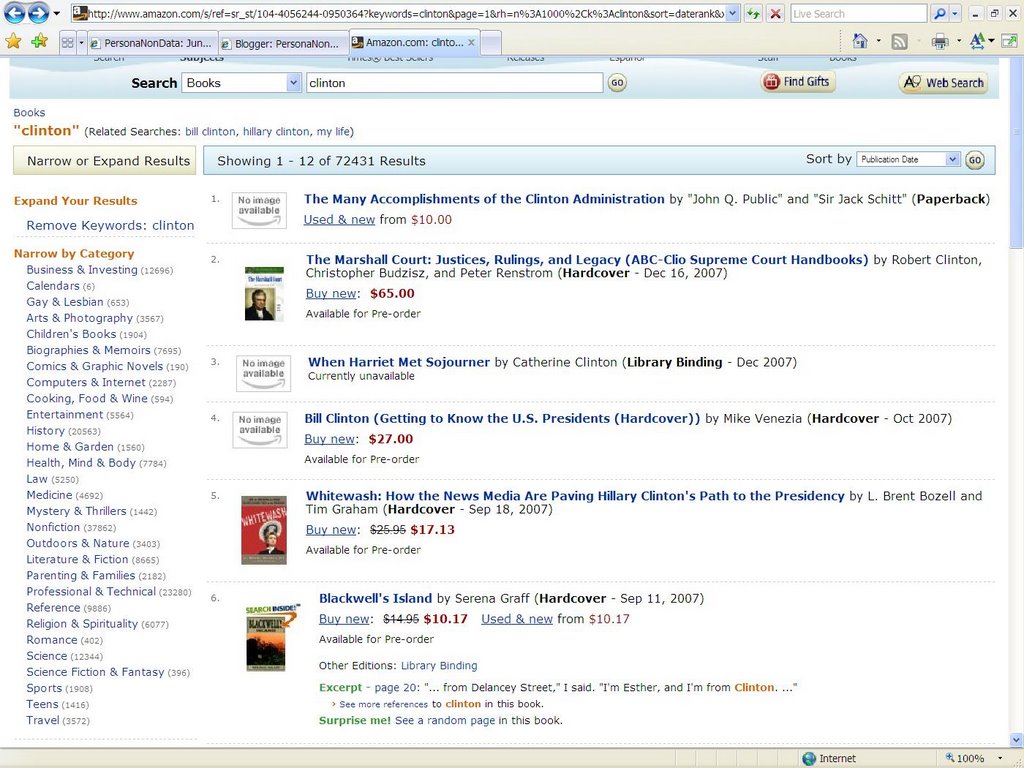
    Random House announced that President Bill Clinton would release a new book towards the end of 2007. I find no current reference to the title on Amazon.com although I was amused to see what title did come up on the list at number one (Left).

    Rodale also announced that Chuck Schumer would release a new book in early 2007 and sure enough it will be released in late January. Good timing for him.

    In June, I wrote that newspapers were the wave of the future. In the intervening months there has been significant upheaval in the newspaper world with the end of Knight Ridder and McClatchy, Philadelphia Inquirer, Los Angeles Times, Chicago Sun Times and others all trying to sort it out. I still think newspapers have a significant future as media outlets. The New York Times were represented in my predictions for 2007.

    Gary Rautenstrauch was appointed CEO of AMS in May 2007 with the company under SEC investigation. At the time the OTC stock was trading at $4.00 and is now at $2.60 and no new filings have been made that shed 'official' light on the financial irregularities that came to light before Rautenstrauch joined the company. Recent announcements have included notification of an annual meeting scheduled for January 27, 2007 and the appointment of Rautenstrauch and dissident shareholder Robbotti to the board. The same PR also noted the conclusion of a anticipated proxy battle that Robbotti was to have launched at the annual meeting. (And an update 12/29 - AMS announced a bankruptcy filing. I must be clairvoyant).

    Lordi, the Finnish winners of the Eurovision Song Fest have gone on to apparent ubiquitous name recognition throughout Europe with their 'monster' pyrotechnic shows. What made this winner unique was their material was not the typical bubbly pop music of old rather some hard core satanic inspired metal. In seeming contradiction to their image however, they had to cancel most of their late summer tour of Spain because some of the band members got the sniffles.

    In May the New York times published an article about recently found diaries and a script by Steve McQueen. These will now form the basis of a movie written by Steven McQueen. The movie is produced by his son and god son. Yucatan is scheduled for release sometime in 2007. I can find no word on whether his son will publish any of the material created my McQueen.

    During the year, I thought a little about supply chain issues and publishing:

    Also, a little about educational publishing:

    In November, I set myself a reading challenge; hoping to read five books between November and the end of January. By late December, I have completed The Road, The Emperors Children and The Power of the Dog. The Road was incredible. The Emperor's Children was slow to start but I enjoyed it. The Power of the Dog should have been 100 pages shorter. It was OK but not great.

    In November, I also voted for the first time ever.

    Friday, December 22, 2006

    Proof Bibliographic Data Can Be Fun!

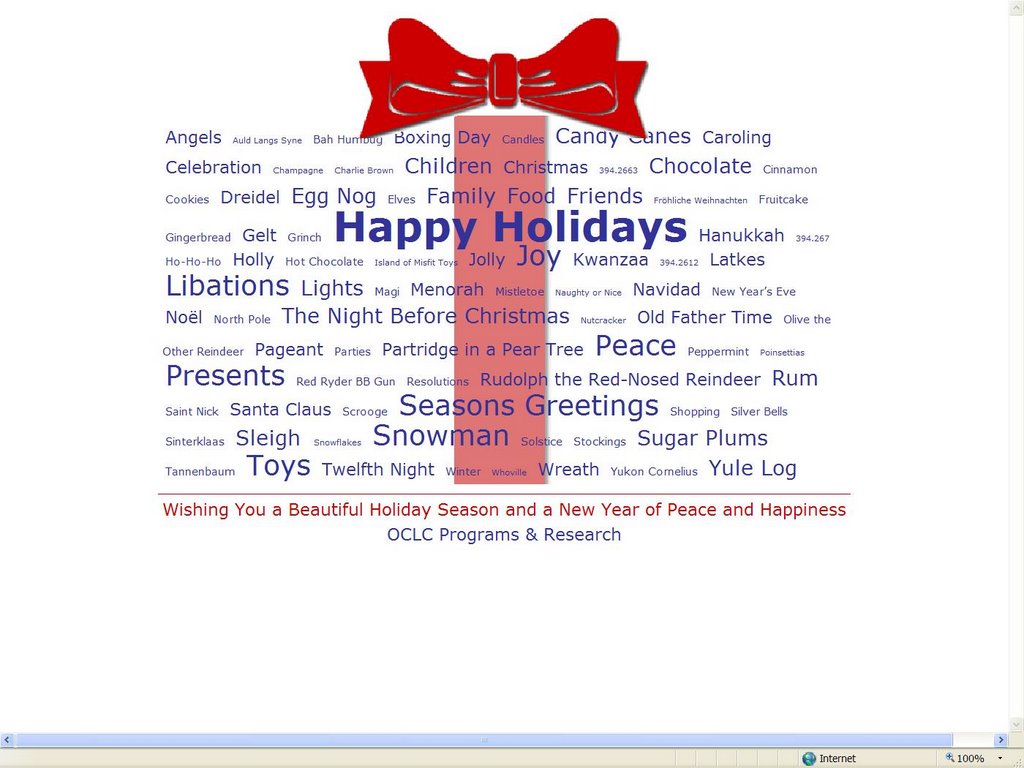
    From my OCLC friends, an example of leveraging your assets to new advantage, and in the process proving that bib data can be fun.

    Here is the link. For some reason I was drawn immediately to the Island of Misfit Toys - but that is a story for another time. Merry Christmas.

    Wednesday, December 20, 2006

    Jack the Ripper

    No, I haven't solved it but I did think it funny that on the NBC news on Monday, Brian Williams reported on the UK prostitute murder case by saying the crime wave 'conjured up memories of Jack the Ripper'. Now I don't know about you, but I'm thinking that there can't be too many people left who can remember Jack the Ripper. And even if there arem have they been interviewed? Regardless, it is always good when England makes the network news over here since it is generally about something we are really proud of like a good series of murders, football hooligans, cravs, Nazi attired members of the royal family (this one is not that frequent it must be said) and the puppy prime minister.

    Monday, December 18, 2006

    Predictions for 2007

    There are any number of people offering media predictions for 2007 and it is a fun exercise which can also be a useful tool for strategic planning. Consultants use a tactic called ‘scenario planning’ to generate discussion and thought focused on issues impacting a business. In sessions I have managed, I have placed up to ten ‘scenarios’ or predictions on the walls of a conference room where each member of the group is given instructions to vote on the likelihood of each scenario without speaking to the other participants. The scenarios reflect a combination of the existing status-quo and an extrapolation or exaggeration of anticipated market change. Each scenario should be plausible and represent a challenging future environment in order to generate legitimate discussion.

    A red dot placed on the scenario means it will never happen and green means the participant agrees it will happen. The scenarios can be anything that the facilitator decides could be relevant to the company but should be done in consultation with someone at the company. (The scenarios are not shared before the meeting). Additionally, they can be absolute; ‘this will happen’ or more general ‘over the next five years…’

    As the group completes the ‘voting’ the facilitator has the group examine each scenario in detail and will encourage the group to think about the implications of each scenario in a few dimensions; technology, human resources, competitors, etc. The outcome of this exercise is a better understanding of the company’s challenges and an understanding of the company's possible weaknesses (or strengths) relative to the scenarios the group thinks most likely. A document should be prepared from this seminar session and this document can become a material part of the development of a strategic plan. Even discussion of those scenarios the group does not believe are likely can be useful in challenging the executives to closely examine their assumptions.

    This is an exceptional exercise in encouraging senior management to examine, understand and interpret what is going on in the wider world as a fundamental requirement of their daily responsibilities. It can be the case that management develops a bunker mentality and is subsequently blindsided by events that they should have anticipated.

    My predictions below are not fully thought out scenarios for a number of reasons – they are not specific for one thing – but nevertheless they are fun to think about. As an editorial comment, I emphasize that I have no inside information on the veracity of any of these.


    Predictions for 2007:

    • NYTimes will eliminate the Saturday print edition of the newspaper. It will also create local web news sites for every major metropolitan city in the US and will stream video from their owned broadcast television stations, classified advertising will be free. The company will also launch a citizen’s paper: The New World Times. NYT will create suite of news gathering tools – web services – and make available to ‘citizen journalists’ content and research traditionally only available to professional journalists.
    • YouTube tv: Just like America’s funniest home videos we will see a TV show based on original YouTube video content. It will win its’ night by 10% and will be turned into a weekly Saturday night talent show.
    • Using cell phones’ camera as a barcode reader will lead to an explosion of mobile in-context/ in situ mobile advertising – followed in 2008 by RFID based in-store advertising (with software for cell phones). Mobile advertising will surpass 5% of all ad dollars spent by agencies by end 2007. (Web currently at 20%)
    • Google launches product placement advertising program. Based on similar key word algorithms advertisers will bid for placement in movies, television, other broadcast, sports, etc. prior to production and/or live telecast. Program will represent 10% of all fall 2007 upfront spend.
    • FCC will hold hearings on standards related to product placement advertising in late 2007 as the market explodes.
    • Apple will think about buying Disney and Electronic Arts but will buy Tivo and SlingBox. Apple will also launch a Beatles version of the I-Pod including the entire Beatles catalog plus video/movies. The Beatles I-Pod will retain the tradition Apple artwork (Green apple front, cut away apple on the back).
    • Yahoo will by EA and within six months launch a social network gaming site based on EA content.
    • No-one will buy Netflix
    • Social Media in Education: Several major US colleges will teach various social science coursed entirely in simulation. The courses will not be taught in traditional lecture form but entirely within the software simulation.
    • News Corp will buy Dow Jones and Financial Times and sell Harpercollins and Hachette will by Harpercollins.
    • EBay will by Linden Labs (Second Life). Within six months they will integrate Ebay selling tools into SecondLife enabling virtual store fronts, sales assistance and virtual trading. Will launch program with major retailers and create first Second Life mega-mall in cooperation with Westfield. Ebay also launches SecondLife media placement agency to handle all media inventory on SecondLife.
    • T Mobile buys Skype from Ebay.
    • Linden dollars will be included in the Feds M1 currency calculation.
    • Neil Young’s Living with War wins the Grammy for best Rock Album.

    Saturday, December 16, 2006

    Judith Regan Fired

    Well I can't say I expected this; my immediate reaction was where will she end up? Which publishing house will hire her to bring her special type of salacious - but profitable - publishing to their bottom line. Perhaps no company will since the OJ affair and recent news about an apparently grotesque novalization of Mikey Mantle's life have irreparably savaged her reputation. America is replete with second acts and I am sure she will show up some where. Nevertheless, for the short term she is evidence of the adage 'if you give someone enough rope they will hang themselves.' The word on the street was that she didn't really report to anyone after she moved out to LA.
    LA Times

    Friday, December 15, 2006

    Friday Round-Up

    From Grumpy Old Bookman here is a blog article discussing a book by one Steve Webber The Home Based Bookstore. GOB gives the book a ringing endorsement and I link to the blog because it relates somewhat to my blog of last week about charity bookstores. In my blog, I noted that some people have made a living out of setting up online bookstore with Alibris, Amazon and ABE and this book will tell you exactly how to do this and make money. That is, if you have the time and inclination.


    Over at institute for the Future of the Book, they note an interview with Harvard University Press and then go on to ask some questions about the 'evolution of authorship'. Here is a quote from their article:

    ...the immediacy that the Internet provides facilitates collaboration in a way
    no meeting of minds in a cafe or railroad apartment ever had. This facilitates a
    communality that approaches that of the oral tradition, now we have a system
    that allows for true universality. To make this work requires action,
    organization, clarity of purpose, and yes, a new rhetoric. New ways of
    collaboration entail a novel approach.

    You may have noticed that many book related bloggers are putting together their lists of books read in 2007 blogs. Here is an exceptionally well written one from The Millions. In keeping with the blog name, he also reflects on just how many books you could read in a life-time and this calculation becomes depressing when thought of in the context of how many books there are in print. The Bowker Global Books In Print product has 15mm titles (predominantly English) of which more than 50% would be in-print. In the last few weeks, I have been adding to my librarything collection all the books I have read but don't currently have copies of. I am quite depressed that I am only at about 500 titles. I can't believe that I have not read more books than this especially since - as The Millions suggests - I began reading big people books at 13 (Wilbur Smith, Alistair McLean, Ian Fleming).

    A lot of people are doing predictions for 2007 and this is how rumors get started. Google buys a publisher - I think not.

    This short article in New York magazine about Walter Mosley caught my eye because Mrs. PND has many times commented to me that to all the young girls in the gym I am the creepy old guy. That's nice; I guess that makes her Mrs Creepy Old Guy.

    Thursday, December 14, 2006

    Divergent Activity

    What Kind of Reader Are You?
    Your Result: Dedicated Reader

    You are always trying to find the time to get back to your book. You are convinced that the world would be a much better place if only everyone read more.

    Literate Good Citizen
    Obsessive-Compulsive Bookworm
    Book Snob
    Fad Reader
    Non-Reader
    What Kind of Reader Are You?
    Create Your Own Quiz


    Thanks to Ted's Thoughts for the link.

    Tuesday, December 12, 2006

    Lost News

    In my very first post on this blog I commented on the vast difference in reporting on the US network's national news broadcasts and the BBC. Last night, I sat minding my own business with NBC on in the background when all of a sudden the BBC news came on and it was like I was in a different universe. Yesterday was the day that Kofi Annan decided to present his last speech as UN Secretary General. He chose to deliver this speech in Independence, MO. Why, because that is the birth place of President Truman and the location of his library. Truman was a strong supporter of the United Nations.

    In his speech, Annan strongly rebuked the policies of the United States saying "no nation can make itself secure by seeking supremacy over all others." In his comments afterward, he denied that the speech was directed at President Bush but it is clear from the rest of his speech that this was a justifiable conclusion. Annan wants the US to own up to its position as a world leader and be true to its own ideals which in the past five years we have selectively ignored. It was a damning speech but it wasn't on NBC. As I have stated before, I believe the network news shows should proffer an international view that leads to greater understanding and comprehension of international issues. It doesn't look like NBC even sent a reporter.

    Just when I thought the contrast couldn't be any worse, the next story on BBC was about the startling lack of basic knowledge of key congressional leaders regarding international facts and issues. The story is titled, "Al-Qaeda Confuses US Congressman" which is worrying enough. The editor of Congressional Quarterly had occasion to ask certain members things like, who is Sunni and who is Shiite, what is the difference, what is Hezbollah and a number of other things. He specifically mentioned Silvestre Reyes who is the incoming House Intelligence Committee chair. You may say he is just gearing up, but in fact he has been on the committee for many years. Perhaps, NBC doesn't think this is a story however, when there is so much wrong information circulating about our foreign affair forays - Saddam supported 9/11 terrorists for example - one would think that NBC and others should jump on this story as evidence that even our leadership isn't sufficiently educated about the facts. That being the case how can we expect the electorate to know what's going on?

    Monday, December 11, 2006

    Monday Whip Round: Litblogs, Morality, Aggregators

    This is an excellent article from The Australian newspaper in guess where. The author Genevieve Tucker takes a long look at the development of lit blogs and reflects - just a little - on activity in Australia. She sees the development of lit blogs as reflecting the desire of readers and book lovers generally to converse about their reading experiences and notes that declines in traditional media attention (newspapers) has sped the growth of these blog sites. In conclusion she says the following:

    Above all, readers of books who also enjoy reading blogs are conscious that they are drawn to the most highly powered technology in their homes and offices to talk about the simplest cultural technology there is, one that can be picked up, kept for many years on a shelf, borrowed and lent and returned to at will without needing to be refreshed or substantially remodeled. It is this poignant attachment to old technology, together with a well-balanced sense of the rich possibilities offered by new media, that is probably closest to the heart of blogging about books and writing.
    In this article about moving the traditional publishing model into the 21st century we hear of a new approach from a company named thefrontlist.com.


    The process is straightforward: After posting an extract from a completed work on The Front List, a writer is allocated five works to critique while his or her extract is, in turn, read and annotated by five other authors. Marks are given out of 50 - based on five set criteria, which vary according to genre.
    The purpose is to provide real feedback to authors wishing to have their books published by a traditional publishing house. thefrontlist.com is attempting to bridge a gap between publishers who do not accept unsolicited manuscripts and agents that are inundated with so many submissions there is little chance they can offer constructive feedback. As most realistic and unemotional publishing practitioners know, the odds are heavily stacked against a first time author. In my view this experiment with not work mainly because I think they will find that the 'population' that may make use of this type of site can't edit. (I also found Mrs Dalloway dull).

    Speaking of Virginia Woolf; Book World is reading her dairies and she can't put them down!


    Here is a magazine you don't skim every day; American Thinker (no comments!). This article reflects on the morality of current publishing given the O.J. Simpson, James Frey and Kaavya Viswanathan issues of the past 12 months. The author leaves us with this rather damning comment:


    And therein lies the dilemma faced by the contemporary book publishing industry: where a Maxwell Perkins could nurture, cajole, develop, and protect his stable of writers, and do so with the intention of adding valuable intellectual products to the culture, publishers today have been forced - both by the interest and tastes of the marketplace of readers and the uncertainties of publishing economics - to go in directions earlier editors and publishers might have thought untenable and inappropriate. They have been forced to transform the profession of publishing from one in which ideas were generated and preserved for society's good into a process where the pursuit of profits overshadows this primary, seemingly nobler purpose. That tension shows no sign of subsiding, which means that the hard choice between "culture and mammon" will no doubt continue to have repercussions on the business of bringing books to life.

    I guess we have a lot of work to do - or perhaps we continue to cater to what the audience want or expects....


    Since I read this article by Scott Karp I have been thinking about it a lot. I don't agree with all of it but it a very interested view point on data/content aggregators and content creators. There is a under current of negativity associated with the 'aggregator' business model which I don't agree with. Here is his opening paragraph:

    Can anyone think of a content business meaning a company that produces original content that has scaled dramatically in recent years? I can't. Look at the businesses that have scaled Google, MySpace, YouTube all platforms for content, but not producers of content. Compare those to original content businesses like Weblogs, Inc., Gawker, TechCrunch, Paid Content they are successful at their scale, but that scale is still tiny compared to the scale of the aggregation businesses. Even portals like AOL and Yahoo are much more aggregators of content than original producers of content.
    It is worth a read and I might attempt my own view at some point.


    Lastly I hesitate to comment on the Ashes test other than to link to thiarticleaticle about a job offer for a "waitress" to help fetch and carry for a bunch of English blokes at the Melbourne test in a few weeks. It will all be over by then and this waitress is going to be a very tired girl.

    Tuesday, December 05, 2006

    USS Intrepid


    Despite the tow line, the USS Intrepid looked pretty magnificent floating down the Hudson this morning. For those who don't know, the ship has functioned as a private Museum for twenty four years on the West side of Manhattan. It is going south to New Jersey for a refurbishment and will make the return journey in two years. The ship saw action in WWII, survived kamakazi attacks and served in Korea and Vietnam but it was the river mud that almost had it beat. The first attempt to move the ship last month failed but they got it right this time. Nice day today; just a bit cold.

    Monday, December 04, 2006

    Monday Round-up

    I liked this blog post by Tomassina at Book Info.net. I mentioned sports books in my last post and here she looks at the big advances paid to some celebrity 'authors' for their life stories. (I like the sound of 'comeuppance'). Notably they include books by sports stars. On top of this, she also reflects on the comprehension level of some of today's popular titles. Apparently, Mitch Ablom's book could be read with ease by a 9 year old. Humm...is that why is does so well at Starbucks.

    Martha Stewart has too large a role in our house for my comfort but she does seem to have done well on the web. The company announced that over 30% of company revenues are internet related.

    Over at Eoin Purcell's blog he notes that Penguin are allowing punters to design their own covers for some Penguin classics titles. Interesting and innovative.

    Debate continues over the accuracy of Wikipedia and comparative studies on this subject are occasional. In this blog article from The Future of the Book, I think the authors strike the right note. The 'accuracy' debate is not a simple one and many other factors are at play. Not least the fact that most wikipedia entries are collective and as such may not compare well with a single perhaps better organized and edited view point. As the article points out in the soft sciences where opinion and interpretation play a significant role the collective can provide a challenge to (perhaps) the more dogmatic or prevailing view. Does this make the wikipedia entry wrong...the debate continues.

    Saturday, December 02, 2006

    England: Rugby and The Ashes

    With the week spent in England, I was able to witness first hand the first Ashes test and the England South Africa game at Twicks. The Ashes has been highly anticipated; the Assies are full of bravardo and brio as is typical and every English fan knows we are going to get our ass kicked. As the game went on we all knew when Petersen was out in the second innings what little hope we collectively held was vaporized. .....but wait, I go to bed last night with England at 330/3 and this morning they have declared at 550 and got on Assie wicket. Dare we believe?

    I have sat in the stands at the Melbourne Cricket Ground (MCG) many times which is were my father is going to be on December 26th. Back in 1975, I sat with my cousin with a Denis Amiss sign drapped over the rail in front of us. I have no idea why we picked Denis but he was a fine English batsman. We had painted the sign in big black letters on a sheet which when we lifted it off the patio had left an imprint of AMISS in the stone. Certain adults were not amused and it was a bugger to get out.

    England's world cup victory ranks as one of the best sporting events I have ever witnessed. (MU over Beyern Munich in the 1999 Champions League final is number one). I have never been a rugby fan and I only remember playing it once when I got whacked in the teeth and immediately thought this is not for me. Watching this team in the last two years had been painful and the South Africa match was a good example. They snatched defeat from the jaws of victory late in the first half when they were in control a few minutes from the half and a fumbled catch gave the initiative to SA and they never scored another point. South Africa are not a particularly strong team. The coach had to go and he is now out. (BTW, I can't beleive he is two years younger than me. See, that's what Rugby does to you).

    Along the sporting line, I heard of a book award program I had not been familar with. William Hill sponsors this award program and this year it was won by Gary Imlach for 'My Father And Other Working Class Football Heroes'.
    The book features the story of Imlach's attempts to secure for his late father,
    Stewart - who played in the 1958 World Cup finals and was an FA Cup winner with
    Nottingham Forest in 1959 - the official cap from the Scottish FA to which
    Imlach believes he is entitled but which he never received and is still being
    refused.

    Other nominated titles included books about Marco Pantini, Abebe Bikila, The Berlin Olympics and Chelsea FC.

    Not unsurprizingly, there are no sports 'biographies' nominated.