In July 1981 I warily plodded down to my local post office (Kihei, Maui) to register for the draft. As a non-citizen green card holder I was required to do so just like every other kid I knew because of the bill the Reagan Administration had passed earlier that year. Since that day I was never sure that the paper work was ever completed -that the post office hadn't lost it: the whole process seemed completely ad hoc. Nevertheless, no less than 25 years later I was sitting in an immigration hearing answering questions for my citizenship application and there sure enough was the notation regarding my registration for the draft on July 10th, 1981.
So, in the intervening years I could drink legally, work, be arrested (I wasn't) deported, pay my taxes, go to war as a draftee but I couldn't vote for the candidate of my choice. Up until today I have never voted anywhere. Having gone through the byzantine citizen process - which is another story - I am finally enfranchised and just at the right time. In retrospect, I should have done this sooner, but my silly notion that I would be somehow giving up my Englishness if I became a US citizen is wholly selfish and irresponsible and I wish that I had done this sooner.
It is interesting to contrast 1980 with 2006 because the current President believes himself to be the successor to Ronny. Ron Reagan the President's son was on The Colbert Report recently and couldn't control is disdain for this idea and pointedly poked fun at the idea even suggesting that he had learned to ride a horse any by a ranch to emulate The Great Communicator. Ronald Reagan was the right choice for America in 1980 as much as George Bush is the wrong choice today. Regrettably, as Neil Young said "... we had our chance to change our mind... but we went with what we knew..." I think if voters could do the 2004 election over they would think differently. Today the electorate gets to exhibit their dissatisfaction with the state of events over the past six years and will present the democrats with a chance to define themselves while in the leadership in the run up to 2008. Do I think the Democrats will blow it? All evidence today seems to indicate they haven't won this election as much as the Republicans have lost it and that should be very worrisome to the dems.
This election today appears to be the most widely voted mid-term election since 1946 with an expected 48% of voters participating. I am finally happy and proud to be one of them. If anyone doubts the true state of affairs I recommend reading Frank Rich's piece in the NYT from this weekend.
Tuesday, November 07, 2006


Monday, November 06, 2006
Books In Different colors
There was a front page article in The New Times last week that didn't deserve to be there. Honestly, The Times' coverage of the publishing industry has eroded substantially since Geraldine Fabricant moved to other things and this article is no different than most of the other recent weak stories. The NYT treated the news that books are now available in Home Depot, Anthopologie and other non-bookstores as a shocking surprise. The only real surprise in my mind is their lack of imagination in suggesting that more of this non-traditional placement should occur and that they should have examined why publishers are being led by (supposedly) innovative retailers who place yellow covered titles with yellow pull-overs. I mean really how brainless is that.
This weekend in the same paper Eleanor Randolph composed a rebuttal which included the notion that if books are considered a fashion accessory then perhaps publishers could cover them in some chameleon like material that matches its' surroundings thereby perfectly blending into its environment. I think she strikes the right absurd note.
I recently read a quote from Todd Wager (who founded Broadcast.com with Marc Cuban) who stated that it is "dangerous to assume your customers will be interested in your products in five months". His research confirmed that half of movie goers leaving a cinema said they’d buy the DVD which is an impulse buy opportunity. So, the strong implication is to place the DVD in the movie theatre so the patrons can buy the books, err... the DVDs. Wagner's new company does sell DVDs to patrons in the movie theatre. MJ Rose recently tried to solicit other ideas as to book/store match-ups from this entry. Harlequin Romance with Victoria Secret.... the notion is positively sacrilegious.
This weekend in the same paper Eleanor Randolph composed a rebuttal which included the notion that if books are considered a fashion accessory then perhaps publishers could cover them in some chameleon like material that matches its' surroundings thereby perfectly blending into its environment. I think she strikes the right absurd note.
I recently read a quote from Todd Wager (who founded Broadcast.com with Marc Cuban) who stated that it is "dangerous to assume your customers will be interested in your products in five months". His research confirmed that half of movie goers leaving a cinema said they’d buy the DVD which is an impulse buy opportunity. So, the strong implication is to place the DVD in the movie theatre so the patrons can buy the books, err... the DVDs. Wagner's new company does sell DVDs to patrons in the movie theatre. MJ Rose recently tried to solicit other ideas as to book/store match-ups from this entry. Harlequin Romance with Victoria Secret.... the notion is positively sacrilegious.
Friday, November 03, 2006
Have You Heard of Crowdsourcing?
A post on Lorcan Dempsey's site a few weeks ago caught my attention. He drew attention to a concept defined by Wired Magazine writers Jeff Howe and Mark Robinson called crowdsourcing (Article). They defined the concept (to paraphrase from wikipedia) as activity traditionally completed by selectively hired, trained and managed workforces migrating to low paid or un-paid amateurs. These people use their knowledge and spare time to complete tasks, share ideas and solve problems. The obvious question is why don't you get what you pay for? The answer seems to be that to work well there needs to be a strong and widely held common purpose. The 'crowdsourcing' moniker is evidence that the idea is growing mainstream (and is itself a result of increasing wide-spread access to networks). As some have pointed out the Linux and Firefox development projects have been early examples of this concept.
The wikipedia site also lists some additional examples from mainstream companies such as Proctor and Gamble and Amazon. Recently, The Economist wrote about an Australian mining company that made available their prospecting documents under the guise of a competition. Interested 3rd parties could identify areas where they believed the company could mine for gold. Apparently the participating companies identified over 110 target sites of which 50 were new to the company. The benefit for the mining company was a significant reduction in time and expense to find these new targets and they also got access to new prospecting technology and processes.
Jeff Howe has a blog related to this topic named unsurprisingly crowdsourcing.com. The article in Wired is fascinating as it points to how business models have to change in some of the least likely businesses. Who would have thought that the stock photo business could collapse because we all have digital cameras and loads of images we can now share or license. Suddenly 'good enough' content exists in substantial amounts and the market is becoming over supplied - at least from the perspective of the stock photo agencies. The article points to istockphoto.com as examples of the above and in the same vein scoopt.com exists to enable anyone who witnesses a newsworthy event to upload their photos for distribution and licensing.
Coincident with my reading Lorcan's blog entry about crowdsourcing I also witnessed an incredible example of this idea on the librarything.com site. A few weeks ago, they decided that they wanted to translate their pages so that they could appeal to foreign language speakers. Instead of finding a language speaker in each of the target languages to slog through all the pages and translate them into F, I, G, S etc. they opened up the site to allow iterative translation. To my mind the results were astounding because they had for example 75% of the German translation done inside a day. To date, about a month after they started the project, they have 100% of the site translated into German, French, Dutch, Spanish and Portuguese. Here is the hit parade. As they (Tim) point out, adding a league table of translators seemed to incite some competition. There have been a number of blog entries on this topic but here is an early one.
Crowdsourcing is powerful, and yes we can argue it isn't that new, but the enablers are now more prevalent which is better and closer computing power, easier access to networking and rapid adoption of virtual social networks. My characterization of 'good enough' above was purposeful; one of the tenets of crowdsourcing is that the power of the network will outstrip that of a small group of experienced professionals. This is the real danger for publishers and others who have built silos of expensive (to develop and sell) content. As a database publisher I could point out the blemishes in 'good enough' products that I competed against. What happens when I can't do that. Witness the EB versus wikipedia debate earlier this year.
The wikipedia site also lists some additional examples from mainstream companies such as Proctor and Gamble and Amazon. Recently, The Economist wrote about an Australian mining company that made available their prospecting documents under the guise of a competition. Interested 3rd parties could identify areas where they believed the company could mine for gold. Apparently the participating companies identified over 110 target sites of which 50 were new to the company. The benefit for the mining company was a significant reduction in time and expense to find these new targets and they also got access to new prospecting technology and processes.
Jeff Howe has a blog related to this topic named unsurprisingly crowdsourcing.com. The article in Wired is fascinating as it points to how business models have to change in some of the least likely businesses. Who would have thought that the stock photo business could collapse because we all have digital cameras and loads of images we can now share or license. Suddenly 'good enough' content exists in substantial amounts and the market is becoming over supplied - at least from the perspective of the stock photo agencies. The article points to istockphoto.com as examples of the above and in the same vein scoopt.com exists to enable anyone who witnesses a newsworthy event to upload their photos for distribution and licensing.
Coincident with my reading Lorcan's blog entry about crowdsourcing I also witnessed an incredible example of this idea on the librarything.com site. A few weeks ago, they decided that they wanted to translate their pages so that they could appeal to foreign language speakers. Instead of finding a language speaker in each of the target languages to slog through all the pages and translate them into F, I, G, S etc. they opened up the site to allow iterative translation. To my mind the results were astounding because they had for example 75% of the German translation done inside a day. To date, about a month after they started the project, they have 100% of the site translated into German, French, Dutch, Spanish and Portuguese. Here is the hit parade. As they (Tim) point out, adding a league table of translators seemed to incite some competition. There have been a number of blog entries on this topic but here is an early one.
Crowdsourcing is powerful, and yes we can argue it isn't that new, but the enablers are now more prevalent which is better and closer computing power, easier access to networking and rapid adoption of virtual social networks. My characterization of 'good enough' above was purposeful; one of the tenets of crowdsourcing is that the power of the network will outstrip that of a small group of experienced professionals. This is the real danger for publishers and others who have built silos of expensive (to develop and sell) content. As a database publisher I could point out the blemishes in 'good enough' products that I competed against. What happens when I can't do that. Witness the EB versus wikipedia debate earlier this year.
Wednesday, November 01, 2006
William Styron
William Styron has passed away and his obit in The New York Times is here. Sophie's Choice is the only title I have read which still resonates with me having read it when I was 16. William Styron wasn't afraid of courting controversy - perhaps he didn't set out to do that - but he knew what he knew and he wanted to tell people about it. Sophie's Choice was a powerful novel that in my case drew me in and told me about the holocaust in a way a history book never could.
Penguin Blog
I typed penguin blog into google today and this is what came up first. Predictable really... I don't believe a Penguin can do its own shopping. For the record, I was looking for the book publisher.
While I am on this, while I was in Graduate school some friends of mine wanted to set up an all boys club named after Penguins (The Penguin Club) on the basis that (apparently) Penguins only mate once a year. Happily, I was able to decline my charter membership.
Lorcan Dempsey (who may not like the intro to this link) has some thoughts on the design of the Penguin paperbacks here.
While I am on this, while I was in Graduate school some friends of mine wanted to set up an all boys club named after Penguins (The Penguin Club) on the basis that (apparently) Penguins only mate once a year. Happily, I was able to decline my charter membership.
Lorcan Dempsey (who may not like the intro to this link) has some thoughts on the design of the Penguin paperbacks here.
Monday, October 30, 2006
The Big Deal Returns
I was lamenting recently that there hadn't been too many mega publishing deals this year and all of a sudden they are numerous.
In June, I mentioned that CEO Richard Harrington had been quoted in the FT regarding Thomson's willingness to part with their educational division. They rapidly back tracked and in truth the context of his comments were along the lines of "...if someone offers us a good price, we can put the money to good use on the legal and regulatory and financial segments of our business." Clearly, they have had a think about this and last week publicly stated their intention to divest the business unit. I suspect it will go to a financial buyer; this is not a particularly integrated operating unit and I think a buyer could exact some significant expense savings in aggressively consolidating these business units and product lines. Once that is done the group could be resold or sold in parts to other educational publishers.
(Toronto Star, Bloomberg)
Further interest in education from an Irish based educational technology company (The Learning Company and Edusoft-not this one -my error) which is interested in purchasing Houghton Mifflin from the financial buyers who have owned the company for only a few years. Houghton Mifflin is a venerable old line educational publisher which has gone through some hairy times as a public company, Vivendi (and collapse thereof), and then a buyout. Riverdeep will likely bring some long term stability.
(Boston Globe, FinFacts Ireland) Also here is a jealousy inducing analysis of the ownership structure of the merged entity.
Springer Science and Business Media has launched a $5bill bid for Informa which is itself a recent result of a large merger of Taylor and Francis and Informa. Apparently, Informa wanted to buy Springer Science rather than the other way around. Oopps.
Media Ownership laws have recently been changed in Australia and pundits were anticipating a surge in new deals. Irishman Tony O'Reilly who owns a media empire (and was head of Heinz) has offered to buy APN the forth largest newspaper publisher in OZ. The same article also lists some of the other recent media deals in Australia including Murdoch's purchase of 7% of Fairfax the publisher of the Sydney Morning Herald.
And for other pending deals?
Publisher's Lunch reported on the pop that B&N stock received this week when Barron's reported that private equity would find the company an attractive investment. The Riggios (majority owners) announced earlier this year that they were buying back stock and the share price is sharply up this year even without the Barron's article. In my view, it is difficult to see the value to the majority owners of a private equity play.
Reuters has been struggling - I wonder if Thomson would see this as an interesting addition to their portfolio. The company has been in the process of remodeling itself over the past several years and are still working through this. They are not out of the woods yet.
Bloomberg. The NYC mayor has said this week that he is not going to sell the company but it is not clear if he will return to manage it. He has consistently indicated that he wants to concentrate on his charitable and foundation work once his term in office is completed. Again, a potential match for Thomson once they have the war chest.
Reed Elsevier - could they go the way of VNU and be purchased by a PE firm? Undoubtedly, all the bigger players have been looking for new targets and Reed has strong branding and positioning in trade magazines, legal and education.
In June, I mentioned that CEO Richard Harrington had been quoted in the FT regarding Thomson's willingness to part with their educational division. They rapidly back tracked and in truth the context of his comments were along the lines of "...if someone offers us a good price, we can put the money to good use on the legal and regulatory and financial segments of our business." Clearly, they have had a think about this and last week publicly stated their intention to divest the business unit. I suspect it will go to a financial buyer; this is not a particularly integrated operating unit and I think a buyer could exact some significant expense savings in aggressively consolidating these business units and product lines. Once that is done the group could be resold or sold in parts to other educational publishers.
(Toronto Star, Bloomberg)
Further interest in education from an Irish based educational technology company (The Learning Company and Edusoft-not this one -my error) which is interested in purchasing Houghton Mifflin from the financial buyers who have owned the company for only a few years. Houghton Mifflin is a venerable old line educational publisher which has gone through some hairy times as a public company, Vivendi (and collapse thereof), and then a buyout. Riverdeep will likely bring some long term stability.
(Boston Globe, FinFacts Ireland) Also here is a jealousy inducing analysis of the ownership structure of the merged entity.
Springer Science and Business Media has launched a $5bill bid for Informa which is itself a recent result of a large merger of Taylor and Francis and Informa. Apparently, Informa wanted to buy Springer Science rather than the other way around. Oopps.
Media Ownership laws have recently been changed in Australia and pundits were anticipating a surge in new deals. Irishman Tony O'Reilly who owns a media empire (and was head of Heinz) has offered to buy APN the forth largest newspaper publisher in OZ. The same article also lists some of the other recent media deals in Australia including Murdoch's purchase of 7% of Fairfax the publisher of the Sydney Morning Herald.
And for other pending deals?
Publisher's Lunch reported on the pop that B&N stock received this week when Barron's reported that private equity would find the company an attractive investment. The Riggios (majority owners) announced earlier this year that they were buying back stock and the share price is sharply up this year even without the Barron's article. In my view, it is difficult to see the value to the majority owners of a private equity play.
Reuters has been struggling - I wonder if Thomson would see this as an interesting addition to their portfolio. The company has been in the process of remodeling itself over the past several years and are still working through this. They are not out of the woods yet.
Bloomberg. The NYC mayor has said this week that he is not going to sell the company but it is not clear if he will return to manage it. He has consistently indicated that he wants to concentrate on his charitable and foundation work once his term in office is completed. Again, a potential match for Thomson once they have the war chest.
Reed Elsevier - could they go the way of VNU and be purchased by a PE firm? Undoubtedly, all the bigger players have been looking for new targets and Reed has strong branding and positioning in trade magazines, legal and education.
Sunday, October 29, 2006
Returned to Reality
Mrs PND and I spent the last week or so in Costa Rica and had a wonderful time. Between the two of us we read eleven novels and I consider that a success. As it turned out I ended up reading only one of the books I intended to read (leaving The God Delusion, The Road and The Emperors Children behind). One of the books I read was kingdom of Shadows by Alan Furst. He is an exceptional writer of suspense and espionage novels set in the 1930s. I have now read three of this novels and have enjoyed them immensely. His evocation of settings and characters is so realistic that having read this novel which ends on the eve of the German invasion of Poland, I caught myself two days later wondering what was happening to the characters as though the story hadn't ended. Furst lives on Long Island but you wouldn't know it since he writes like he lived through this time in Europe.
The book I did plan to take with me was Philip Roth's The Plot Against America which I couldn't put down. The whole idea of interlacing some of his family history in this 'What if' story was remarkable. My experience of Roth only extends to Portnoy's Complaint which I read in High School for a English paper. I kinda wasn't that crazy about the book which colored my view of his more recent releases. The 'what if' concept is what it is, but I had a constant troubling sense all through this book that I could see how this could happen. In someways it suggests that society is always finely balanced but one slight push one way or the other has the capacity to send things into an accelerating tail spin to the detriment of particular segments of society.
Having returned I have vowed to spend more time reading and all the talk about an excess of big titles coming out in the fall had me wondering how many books I currently have that I haven't read. I wish I hadn't done this: I rearranged my book shelves so that I now have one shelf dedicated to unread titles. I have 34. I could probably clear that if I were on vacation for 12 months and short of winning the lottery that is not going to happen. It made me a little depressed. There are some excellent titles in this group and they range from biographies of John Adams, Christopher Wren, John Lennon to the above mentioned titles and Dennis Lehane, Don Winslow, John LeCarre and George Pellecanos. It is the non-fiction that I have a hard time with since they are hard to finish unless you can read a reasonable amount at each sitting. Fifteen minutes before lights out doesn't cut it.
Now it is back to an intense period of work for me. I start planning for the next vacation post haste.
The book I did plan to take with me was Philip Roth's The Plot Against America which I couldn't put down. The whole idea of interlacing some of his family history in this 'What if' story was remarkable. My experience of Roth only extends to Portnoy's Complaint which I read in High School for a English paper. I kinda wasn't that crazy about the book which colored my view of his more recent releases. The 'what if' concept is what it is, but I had a constant troubling sense all through this book that I could see how this could happen. In someways it suggests that society is always finely balanced but one slight push one way or the other has the capacity to send things into an accelerating tail spin to the detriment of particular segments of society.
Having returned I have vowed to spend more time reading and all the talk about an excess of big titles coming out in the fall had me wondering how many books I currently have that I haven't read. I wish I hadn't done this: I rearranged my book shelves so that I now have one shelf dedicated to unread titles. I have 34. I could probably clear that if I were on vacation for 12 months and short of winning the lottery that is not going to happen. It made me a little depressed. There are some excellent titles in this group and they range from biographies of John Adams, Christopher Wren, John Lennon to the above mentioned titles and Dennis Lehane, Don Winslow, John LeCarre and George Pellecanos. It is the non-fiction that I have a hard time with since they are hard to finish unless you can read a reasonable amount at each sitting. Fifteen minutes before lights out doesn't cut it.
Now it is back to an intense period of work for me. I start planning for the next vacation post haste.
Tuesday, October 17, 2006
Off on Vacation
And looking forward to catching up on some reading.
Here is something from the Colbert Report last week that I found amusing: I love you Fonda!
Here is something from the Colbert Report last week that I found amusing: I love you Fonda!
Sunday, October 15, 2006
Monday Update with Links
Small Retailers: On the back of last weeks announcement that Coliseum Books was to close the AP published two reports on independent retailing. There are success stories in independent book retailing but the market is very difficult and the retailer has to be very creative in not relying on the books to produce an income. One of the retailers mentioned in the following articles refers to being 'fractional' in how he approaches his market. Basically, a little bit here a little bit there and it all adds up. Genre Booksellers and Independent Booksellers as reported by the Associated Press.
Personal Libraries: I wrote last week about libraries, but here is a far more lucid reflection by author Alberto Manguel, excerpted from The Library at Night by Knopf.
I spent some misguided time over the past few weeks looking for new links and came across a few new sites. Here is a sample:
Fifth Estate is the child of the authors and editors at Press Books. I came across the site this week and am impressed with their blogs/articles and will visit frequently. There is a link to the right of my blog. Here is a recent post about bookfinder.com.
Book Info.net has all kinds of interesting articles from someone named Tomasina. It was this recent article on the amount of new titles to be released over the next several weeks that drew me in originally. I am not sure I agree with some who think we will be overburdened by choice. For the most part, the books are purchased and are read in the less fertile periods of the year. Buzz, Balls and Hype had a similar post penned by Jason Pinter discussing the same thing. Also, if you scroll down the home page you will see they are running a 'contest' to see what the best tie-in or cross promotion idea is. This came from an earlier post about Mitch Albom's book on sale at Starbucks.
Another publisher web site I have started looking at is Elephant Walk by Overlook Press. (Overlook is the home of Peter Mayer who was at Penguin UK for many years). They are publishing a book purported to be a history of the Funerary Violin. No one is quite sure if this book is a fake or not. Overlook are Mum: here.
More next week.
Personal Libraries: I wrote last week about libraries, but here is a far more lucid reflection by author Alberto Manguel, excerpted from The Library at Night by Knopf.
I spent some misguided time over the past few weeks looking for new links and came across a few new sites. Here is a sample:
Fifth Estate is the child of the authors and editors at Press Books. I came across the site this week and am impressed with their blogs/articles and will visit frequently. There is a link to the right of my blog. Here is a recent post about bookfinder.com.
Book Info.net has all kinds of interesting articles from someone named Tomasina. It was this recent article on the amount of new titles to be released over the next several weeks that drew me in originally. I am not sure I agree with some who think we will be overburdened by choice. For the most part, the books are purchased and are read in the less fertile periods of the year. Buzz, Balls and Hype had a similar post penned by Jason Pinter discussing the same thing. Also, if you scroll down the home page you will see they are running a 'contest' to see what the best tie-in or cross promotion idea is. This came from an earlier post about Mitch Albom's book on sale at Starbucks.
Another publisher web site I have started looking at is Elephant Walk by Overlook Press. (Overlook is the home of Peter Mayer who was at Penguin UK for many years). They are publishing a book purported to be a history of the Funerary Violin. No one is quite sure if this book is a fake or not. Overlook are Mum: here.
More next week.
Wednesday, October 11, 2006
See you in Church on Sunday
An article in The Register (heretofore unheard of) reports that, blogging is now 'un-christian' at least according to the Reformed Church of God. (Presumably, as simply the 'Church of God' they were mad bloggers). These evengelicals just take the fun out of everything.
Thanks to MobuzzTV. for the link.
Thanks to MobuzzTV. for the link.
Tuesday, October 10, 2006
Frankfurt and Travel
As I departed for the airport this past Sunday afternoon it was for the first time all year that I have shortened my weekend for business travel. Over the past several years I may have done this as many as 20 times a year. Virtually all of these departures were a prelude to an over night transactlantic trip with the promise of a full days work on Monday. I missed Frankfurt for the first time in eight years last week and this was often a two week trip. In 2003, I did a round the world three week trip with the last three days on the stand in Hall 8.0. Such is my ambition. I won't do that again.
The interesting thing at Frankfurt are the people you meet. It is a great place to meet international customers but you are also likely to bump into the senior level publishing people. It seems to happen more regularly at Frankfurt for some reason. I remember my first show when I met an Egyptian licensor of our content on our stand and he presented me with a highly decorated cigar (ash) tray. I felt horrible. I don't smoke and I didn't have anything for him. In October 2001, traffic was sparse and as I walked around the English hall 8.0 I envisioned a large bullseye on the roof. That year in remembrance the entire fair came to a halt on one of the days for a few minutes of total quiet.
Frankfurt is hectic, hot and smoky but it can be rewarding to showcase your products to a very large audience. I have always looked forward to it and when I am invariably traveling to the airport on Saturday morning I think if only I had more time to look around more.
What I started to say regarding traveling is that I am doing less of it but more of it at the same time. This year no more international travel but lots of tribulations traveling domestically. At the moment I am suffering a three hour delay on the way home. I will make tier level the hard way via segments and not miles. Mrs PND looked coolly at me as I left on Sunday but it really hasn't been so bad this year. We persevere.
Postscript: Seven hour commute home (norm is 4hrs). I did catch Letterman and saw Bob Woodward and listened to what is now becoming his stump speech. News yesterday that they are reprinting State of Denial and there will be 1mm in print. Also, while I was stuck in an airport at least I wasn't at the Quills awards.
The interesting thing at Frankfurt are the people you meet. It is a great place to meet international customers but you are also likely to bump into the senior level publishing people. It seems to happen more regularly at Frankfurt for some reason. I remember my first show when I met an Egyptian licensor of our content on our stand and he presented me with a highly decorated cigar (ash) tray. I felt horrible. I don't smoke and I didn't have anything for him. In October 2001, traffic was sparse and as I walked around the English hall 8.0 I envisioned a large bullseye on the roof. That year in remembrance the entire fair came to a halt on one of the days for a few minutes of total quiet.
Frankfurt is hectic, hot and smoky but it can be rewarding to showcase your products to a very large audience. I have always looked forward to it and when I am invariably traveling to the airport on Saturday morning I think if only I had more time to look around more.
What I started to say regarding traveling is that I am doing less of it but more of it at the same time. This year no more international travel but lots of tribulations traveling domestically. At the moment I am suffering a three hour delay on the way home. I will make tier level the hard way via segments and not miles. Mrs PND looked coolly at me as I left on Sunday but it really hasn't been so bad this year. We persevere.
Postscript: Seven hour commute home (norm is 4hrs). I did catch Letterman and saw Bob Woodward and listened to what is now becoming his stump speech. News yesterday that they are reprinting State of Denial and there will be 1mm in print. Also, while I was stuck in an airport at least I wasn't at the Quills awards.
Monday, October 09, 2006
Synchronisity Again, The Road, Harlequin, St.Martin's, Publishing News. AbeBooks,
Synchronisity plays a part in my reading again. I recently purchased a copy of Letters from London by Julian Barnes (signed) at The Strand in NYC. Among numerous topics it covers the leadership challenge to Margaret Thatcher. Earlier in 2006, I also plowed through Heseltine's biography and it was interesting to recall his version of events during this time. Anyway, given the current state of the Labor party's convulsions over their leadership issues I thought the following quote from Barnes' book was interesting.
What of Gordon Brown? Personally, I think they should both go and Labor should take the next year to re-establish a relationship with the electorate with new leadership. It is hard to see Brown elected in his own right.
I purchased Cormac MacCarthy's book The Road last week and there was another positive review in the NYT Book review. While it is bleak, I am looking forward to reading it. Bob Woodward was with Tim Russert yesterday. The administration knives have been out, but the damage has been done. Apparently they produced a list of 'inaccuracies' all of which have been proven out. Meaning Woodward was correct. Russert asked him about Kissenger and he stated Kissenger confirmed that the President speaks with him regularly. The massive ego even suggested it was more frequently than Woodward had in the book; information which was provided by Chaney. Apparently, Chaney called Woodward personally, argued with him and told him 'Bullshit' that his comments were not on the record and hung up on him! How adult. I haven't decided to buy his book yet. It reminds me of the All the President's Men which is one of the best books I recall reading as a teenager. Just the combination of incompetence and arrogance is breathtaking.
News last week from Harlequin and as I have said before it must represent some level of incompetence to allow this company to falter so much. It strains credibility that a company with such a loyal base of customers and potentially large electronic distribution opportunities is laying off staff. Someone needs to buy this company.
Time magazine - which in truth I rarely read - has an article this week about publishers of 'streetlit titles' and their promotional activities designed to reach 'non-traditional' markets. The article makes note of St.Martins Press which is publishing K'wan who has over 400,000 units sold of titles such as Gangsta, Road Dawgz and his latest, Hood Rat. I remember reading about K'wan last year and he is quite the entrepreneur having built his publishing empire by literally hand selling his titles on the street, in barber shops and on street vendor tabletops. Other authors are mentioned in the article. It reminds me of Basquat - spray painting subway cars on his way to making millions as an avant guard artist.
Interesting news in the area of publishing trade magazines. Publishing News (UK) and AuthorLink (US) have created an alliance to "broaden the two entities news and features coverage across the globe." I can't say I am familiar with AuthorLink but I will have to check it out. In the US, Publisher's Weekly has been wandering the proverbial desert attempting with limited success to re-define itself as a trade title with appeal to consumers. Hopeless. Facing declining ad revenue and subscribers - not a healthy combination - they are reinserting some of the trade oriented sections (but not calling them sections) and have also hired a new Publisher. They have also decided to offer the title to retailers for free. That is a big risk - it will be very hard to reconsider that decision. Other subscribers, particularly libraries are likely to be unhappy with their exclusion from this offer.
ABEbooks - which has a stake in LibraryThing.com - announced that the number of titles available for sale on their site has now exceeded 100million. I don't believe this means unique titles but impressive nevertheless.
I am surprised that more hasn't been said about the Automated Content Access Protocol which I discussed last week. Here is a blog entry from searchenginewatch.com that explains all there is to know about it thusfar.
Mrs Thatcher had been removed because enough members of her thought that her domineering dogmatism had become electorially counterproductive. On the other hand, Mr. Major has been the candidate of the outgoing leader and the diehard Thatcherites. So he had to keep the 'Business as Usual' sign in the window while redecorating the place and updating the stock: instead of barbed wire and rifles, the family store would in future sell chocolate bars and liniment.
What of Gordon Brown? Personally, I think they should both go and Labor should take the next year to re-establish a relationship with the electorate with new leadership. It is hard to see Brown elected in his own right.
I purchased Cormac MacCarthy's book The Road last week and there was another positive review in the NYT Book review. While it is bleak, I am looking forward to reading it. Bob Woodward was with Tim Russert yesterday. The administration knives have been out, but the damage has been done. Apparently they produced a list of 'inaccuracies' all of which have been proven out. Meaning Woodward was correct. Russert asked him about Kissenger and he stated Kissenger confirmed that the President speaks with him regularly. The massive ego even suggested it was more frequently than Woodward had in the book; information which was provided by Chaney. Apparently, Chaney called Woodward personally, argued with him and told him 'Bullshit' that his comments were not on the record and hung up on him! How adult. I haven't decided to buy his book yet. It reminds me of the All the President's Men which is one of the best books I recall reading as a teenager. Just the combination of incompetence and arrogance is breathtaking.
News last week from Harlequin and as I have said before it must represent some level of incompetence to allow this company to falter so much. It strains credibility that a company with such a loyal base of customers and potentially large electronic distribution opportunities is laying off staff. Someone needs to buy this company.
Time magazine - which in truth I rarely read - has an article this week about publishers of 'streetlit titles' and their promotional activities designed to reach 'non-traditional' markets. The article makes note of St.Martins Press which is publishing K'wan who has over 400,000 units sold of titles such as Gangsta, Road Dawgz and his latest, Hood Rat. I remember reading about K'wan last year and he is quite the entrepreneur having built his publishing empire by literally hand selling his titles on the street, in barber shops and on street vendor tabletops. Other authors are mentioned in the article. It reminds me of Basquat - spray painting subway cars on his way to making millions as an avant guard artist.
Interesting news in the area of publishing trade magazines. Publishing News (UK) and AuthorLink (US) have created an alliance to "broaden the two entities news and features coverage across the globe." I can't say I am familiar with AuthorLink but I will have to check it out. In the US, Publisher's Weekly has been wandering the proverbial desert attempting with limited success to re-define itself as a trade title with appeal to consumers. Hopeless. Facing declining ad revenue and subscribers - not a healthy combination - they are reinserting some of the trade oriented sections (but not calling them sections) and have also hired a new Publisher. They have also decided to offer the title to retailers for free. That is a big risk - it will be very hard to reconsider that decision. Other subscribers, particularly libraries are likely to be unhappy with their exclusion from this offer.
ABEbooks - which has a stake in LibraryThing.com - announced that the number of titles available for sale on their site has now exceeded 100million. I don't believe this means unique titles but impressive nevertheless.
I am surprised that more hasn't been said about the Automated Content Access Protocol which I discussed last week. Here is a blog entry from searchenginewatch.com that explains all there is to know about it thusfar.
Thursday, October 05, 2006
Embargoed Books
Those of us who care about bibliographic data - and I do - have been a little amused to read the summary reviews that the NYT has done in the past two weeks about State of Denial (Bob Woodward) and Carly Fiorina's biopic released on Monday. That is...next Monday. The Times has been able to purchase both of these titles in advance of their official release date. Why is this a bibliographic data issue: well, because publishers and retailers have spent considerable time defining pub date, lay down date, street date, and other dates so that no one in the supply chain is disadvantaged. In the past several years the ONIX data format has consumed significant time and effort by publishers, retailers, bibliographic agencies ses (Nielsen, Bowker) and wholesalers and this has been all to the good. Data is now more uniform and consistent and the entire effort has concentrated publishers attention on the value of good data. Nevertheless issues clearly remain in how this data is used and how processes can break down.
There is no good reason why a store should be selling these books before the publisher has told them they can. Marketing and promotional spending, author appearances, buy-in commitments and other activities are all predicated on the official on-sale date. Stores that hold these titles off the floor are disadvantaged if they are available at other stores. The industry has toyed with the idea of an specific release day of the week to focus attention on all books released during a week (Music companies do this on Tuesdays). This tactic would be pointless if retailers ignored the timetable.
The physical nature of book distribution requires that books be shipped well in advance of release date which is where the process tends to break down. Spare a thought for the bookstore which recieves shipments everyday and they can't afford the time and effort to segregate the titles which they have to hold. Most stores will have little storage space in the first place and a limited amount of time to check in boxes of books. The tendency then will be to open everything and get it out on the floor as soon as possible. That doesn't make this right but it is a reality. Limited staff time and knowledge at the recieving point results in the carefully laid plans of the sales and marketing department to fail.
If publishers care about this issue - and they must do otherwise why have embargoes in the first place - they should address this issue with an understanding of the bookseller's situation. And publishers should treat all books equally if they want to be serious about on-sale dates. It would be pointess and confusing to selectively monitor this process only for the 'important' titles.
There is no good reason why a store should be selling these books before the publisher has told them they can. Marketing and promotional spending, author appearances, buy-in commitments and other activities are all predicated on the official on-sale date. Stores that hold these titles off the floor are disadvantaged if they are available at other stores. The industry has toyed with the idea of an specific release day of the week to focus attention on all books released during a week (Music companies do this on Tuesdays). This tactic would be pointless if retailers ignored the timetable.
The physical nature of book distribution requires that books be shipped well in advance of release date which is where the process tends to break down. Spare a thought for the bookstore which recieves shipments everyday and they can't afford the time and effort to segregate the titles which they have to hold. Most stores will have little storage space in the first place and a limited amount of time to check in boxes of books. The tendency then will be to open everything and get it out on the floor as soon as possible. That doesn't make this right but it is a reality. Limited staff time and knowledge at the recieving point results in the carefully laid plans of the sales and marketing department to fail.
If publishers care about this issue - and they must do otherwise why have embargoes in the first place - they should address this issue with an understanding of the bookseller's situation. And publishers should treat all books equally if they want to be serious about on-sale dates. It would be pointess and confusing to selectively monitor this process only for the 'important' titles.
Monday, October 02, 2006
The God Delusion
The new book by Richard Dawkins, The God Delusion has caught my eye and it is getting significant play from a number of reputable sources. This weekend The Guardian (Joan Blackwell) reviewed the book. It was also reviewed in last weeks Economist here.
It was The Economist where I first came across the book; the sub-head as follows: "Richard Dawkins has long trumpeted the rationale of science. Now, at 65, he has finally marshalled a lifetime's arguments against believing in God." The reviewer goes on to characterize the book as irreverent - which I think is somewhat the point. Real believers are not going to read this book; however, look for a raft of bible bashers on thier soap boxes denouncing the book nevertheless. If this happens of course it will indeed lead to more attention paid to the book and a higher Amazon sales rank. My best part of the review is the reference in the book to his contention that fervent religious indoctrination given to children amounts to child abuse.
In the Guardian, Blackwell touches on some of his social commentary regarding the encrochment of religion into social policy (in the UK and US) such that "many of us who might want to stay outside theological debate can't afford to when it is influencing social policy." In the US of course this is seen increasingly in many areas and are too numerous to mention. In our publishing world this is seen in text books that must present 'intelligent design' as though it is a scientific option while at the same time describing evolution as a mere 'therory.' Blackwell writes that Dawson reserves his best arguments for why religion has persisted.
Here is the book on Amazon.com. The initial reviews are all positive but in the forum section at the bottom things are starting to hot up. At the moment it is number five on the Amazon.com sellers list.
It was The Economist where I first came across the book; the sub-head as follows: "Richard Dawkins has long trumpeted the rationale of science. Now, at 65, he has finally marshalled a lifetime's arguments against believing in God." The reviewer goes on to characterize the book as irreverent - which I think is somewhat the point. Real believers are not going to read this book; however, look for a raft of bible bashers on thier soap boxes denouncing the book nevertheless. If this happens of course it will indeed lead to more attention paid to the book and a higher Amazon sales rank. My best part of the review is the reference in the book to his contention that fervent religious indoctrination given to children amounts to child abuse.
In the Guardian, Blackwell touches on some of his social commentary regarding the encrochment of religion into social policy (in the UK and US) such that "many of us who might want to stay outside theological debate can't afford to when it is influencing social policy." In the US of course this is seen increasingly in many areas and are too numerous to mention. In our publishing world this is seen in text books that must present 'intelligent design' as though it is a scientific option while at the same time describing evolution as a mere 'therory.' Blackwell writes that Dawson reserves his best arguments for why religion has persisted.
He cites his own concept, the meme, the social equivalent of the gene, as the way ideas are spread and handed down. As a Darwinian he is keen to understand what is so beneficial about religion that makes it eligible for survival. He has an interesting theory - exemplified by the moth being attracted to the flame and thus to its death - that an arcane survival mechanism is operating in grossly distorted circumstancesRegretably, our world is increasingly becoming defined by religion and over the next 100 years our biggest conflicts will be oriented around religion. The question is whether secularism will rise as a force strong enough to counter this train wreak - I have my doubts.
Here is the book on Amazon.com. The initial reviews are all positive but in the forum section at the bottom things are starting to hot up. At the moment it is number five on the Amazon.com sellers list.
Blogger Issues
Blogger has consumed 30mins of my time this morning to fix the RSS feed. Lesson: don't compose in Word and paste into Blogger. Feedburner refuses to work since some hidden code is transferred in the process. The RSS feed still isn't working correctly but it is at least working. Inexplicably, it has re-dated a post I did last week on Supply Chain and is ignoring a post I made in the middle of last week. All are displaying correctly on the blogger site however.
Frustration reigns. Apologies.
Frustration reigns. Apologies.
Sunday, October 01, 2006
All for the Apocalypse
In a strange synchronicity, I just finished a novel by first time novelist Alex Berenson named The Faithful Spy about a deep undercover CIA operative who ultimately saves Times Square (that's about 1.5miles from me) from vaporization. It was an enjoyable book. In last weeks' New York magazine (here), Kurt Andersen describes how all 'the apocalyse thing' has become de rigeur. Apparently, 2012 is the year. Savy New Yorkers are buying Nova Scotia real estate mainly for investment purposes but also on the off chance they can escape to it should the worst happen.
I have always wondered about disaster plans; I mean if something terrible happens to New York it isn't going to be convenient. I am not going to be able to get to my stash of currency, or water or wind-up electric radio. I am going to be stuck on the number 7 between Grand Central and Times Square. So what if I have prepared if I can't travel anywhere. And of course, I won't be with any of my immediate family either so how are we to know what to do?
Andersen narrows in on Cormac McCarthy's The Road which in his description of the book it reminded me of Stephen Kings' The Stand. (I read this when I was sixteen and thought my mom would like it - ooops.) On this theme he says "...Millions of people -Christian millenarians, jhadists, psychedelized Burning Men - are straight-out wishful about The End." McCarthy's novel is about "..a transcendentally bleak, apparently post-nuclear-war-ravaged American of the future." Excellent. I am thinking why read the "historic" The Emperors Children about post 9/11 over vacation when I can read about the future.
And if you thought this was good - read my next post.
I have always wondered about disaster plans; I mean if something terrible happens to New York it isn't going to be convenient. I am not going to be able to get to my stash of currency, or water or wind-up electric radio. I am going to be stuck on the number 7 between Grand Central and Times Square. So what if I have prepared if I can't travel anywhere. And of course, I won't be with any of my immediate family either so how are we to know what to do?
Andersen narrows in on Cormac McCarthy's The Road which in his description of the book it reminded me of Stephen Kings' The Stand. (I read this when I was sixteen and thought my mom would like it - ooops.) On this theme he says "...Millions of people -Christian millenarians, jhadists, psychedelized Burning Men - are straight-out wishful about The End." McCarthy's novel is about "..a transcendentally bleak, apparently post-nuclear-war-ravaged American of the future." Excellent. I am thinking why read the "historic" The Emperors Children about post 9/11 over vacation when I can read about the future.
And if you thought this was good - read my next post.
Friday, September 29, 2006
Publishing Week in Review
It was banned books week this week (Sponsored by ALA). Here is a list of the most challenged books from 2005. No word yet on 2006 but I expect to see perennial favorite Catcher in the Rye on the list again. Pretty much any children's or young adult book that deals with sex education, dangly bits, and snogging is guaranteed at least an honorable mention. Throw in Why do I have two daddies? and you will have cracked it.
Litlove had a recent post about two new mystery writers she has started reading. Both Reginald Hill and Susan Hill produce great stories but as she points out in the case of Reg that the characters have been hijacked by TV script writers. I am not sure I like this trend which also happened with Morse and is now happening with Inspector Linley. The 'ghost' written stories don't seem to have the same substance of those that come from the authors books.
Many years ago I attended a conference given by Stanford University and Guy Kawasaki was the dinner speaker - it was a small affair. He was at Apple in the early days and is now a VC among a number of other things. His blog is very interesting and he had this recent post on 'distribution' which does sound boring but he has an interesting view point. Additionally, he also published a post at the end of last year which if you are a frequent user (and abuser) of Powerpoint you will want to read. Lastly, from a traffic and design stand point you can see how he has taken a particular approach to the way he creates the content for his blog that results in maximum attention. If you are interested in this - and who wouldn't be - here is an article.
Here is a little more on the Google decision made by the Belgium court that I commented on earlier this week. Google clearly did not like the requirement to post the judgment and replied very strongly to the court on this issue. There is another hearing in November where they are likely to rely on industry practice that enables any web site to effectively close itself off to spidering. In this case had this technology been invoked by the plaintiff would have avoided the law suit. But then, where's the fun in that?
Eoin Purcell had a post on comics and beat me to a reference from the New York Times article on same. There have been a few other articles that I have noted over the past several weeks in addition to this one. Firstly, the 9/11 Report is being published in a comic book version. Interesting...I am not sure the point, but perhaps comprehension and reading ability has something to do with it or maybe it is a "...let's see if we could do this.." kind of thing. As the article points out it is a little hard to generate the gravitas of two aircraft slamming into the WTC with a simple ...KABOOM!! Here also is an article from the Houston Chronicle about Comic book Bibles. (I just report the stuff I don't believe it). Comics are of course huge business and a number of large US publishing houses have undertaken publishing programs or distribution deals for comics or Manga.
Finally, I haven't had a link to The Daily Show for a while but Hugo Chavez was such great comedy that it has to be referenced. Oh and Norm Chomsky - assuming he earned out his advance - running all the way to the bank.
Litlove had a recent post about two new mystery writers she has started reading. Both Reginald Hill and Susan Hill produce great stories but as she points out in the case of Reg that the characters have been hijacked by TV script writers. I am not sure I like this trend which also happened with Morse and is now happening with Inspector Linley. The 'ghost' written stories don't seem to have the same substance of those that come from the authors books.
Many years ago I attended a conference given by Stanford University and Guy Kawasaki was the dinner speaker - it was a small affair. He was at Apple in the early days and is now a VC among a number of other things. His blog is very interesting and he had this recent post on 'distribution' which does sound boring but he has an interesting view point. Additionally, he also published a post at the end of last year which if you are a frequent user (and abuser) of Powerpoint you will want to read. Lastly, from a traffic and design stand point you can see how he has taken a particular approach to the way he creates the content for his blog that results in maximum attention. If you are interested in this - and who wouldn't be - here is an article.
Here is a little more on the Google decision made by the Belgium court that I commented on earlier this week. Google clearly did not like the requirement to post the judgment and replied very strongly to the court on this issue. There is another hearing in November where they are likely to rely on industry practice that enables any web site to effectively close itself off to spidering. In this case had this technology been invoked by the plaintiff would have avoided the law suit. But then, where's the fun in that?
Eoin Purcell had a post on comics and beat me to a reference from the New York Times article on same. There have been a few other articles that I have noted over the past several weeks in addition to this one. Firstly, the 9/11 Report is being published in a comic book version. Interesting...I am not sure the point, but perhaps comprehension and reading ability has something to do with it or maybe it is a "...let's see if we could do this.." kind of thing. As the article points out it is a little hard to generate the gravitas of two aircraft slamming into the WTC with a simple ...KABOOM!! Here also is an article from the Houston Chronicle about Comic book Bibles. (I just report the stuff I don't believe it). Comics are of course huge business and a number of large US publishing houses have undertaken publishing programs or distribution deals for comics or Manga.
Finally, I haven't had a link to The Daily Show for a while but Hugo Chavez was such great comedy that it has to be referenced. Oh and Norm Chomsky - assuming he earned out his advance - running all the way to the bank.
Tuesday, September 26, 2006
Publishers Fight Back
Some of you will be aware that Google lost a copyright case in Belgium last week that ruled that Google infringed on German and French newspapers copyright by reproducing article snippets in search results. Publishers everywhere will probably feel somewhat emboldened by this ruling. Google on the other hand were very sulky in their response; they initially refused to place the ruling on their web site as required by the court. I haven't heard that they plan to appeal but I would think this is not the last we will hear of this.
This story was interesting to me but not particularly earth shattering until I read this report in Silicon.com which discussed a publishing industry initiative named the Automated Content Access Protocol (ACAP). Once implemented a search engine will be able to recognize the content owners' access and permissions use rights. Rather than shut down their sites publishers will be able to manage the indexing that search engines conduct and tell search engines under what terms the content may be used. The World Association of Newspapers produced a briefing paper on this initiative.
Gavin O'Reilly the current President of the WAN had the following comment: "Importantly, ACAP is an enabling solution that will ensure that published content will be accessible to all and will encourage publication of increasing amounts of high-value content online," he said. "This industry-wide initiative positively answers the growing frustration of publishers, who continue to invest heavily in generating content for online dissemination and use."
Clearly, the briefing paper makes clear that the content owners are not looking to restrict the use of their content but I wonder how this fits with the recent announcement by some major US newspaper publishers. Perhaps there is no impact and this merely 'automates' what these newspapers have set out in their legal agreements with Google.
The WAN are not the only participants in this initiative and the International Publishers Association are also sponsors. This is the international association that most national publishing associations are members (AAP, PA, APA). Jens Bammel, the director of IPA is quoted in the Silicon article in support of the initiative. Here is another article that appeared in CNET.
This initiative does represent an interesting aspect since not only are companies within these associations cooperating and funding this program but associations across industries are cooperating. Interesting what is possible when the stakes are so high: publishers and content owners recognising that their content is being used without permission to create value for an entity that had no hand in its creation. But before you rush to judge that statement, we will also continue to see proven the reality that content owners need the search engines to enable content users to find and use the content.
This story was interesting to me but not particularly earth shattering until I read this report in Silicon.com which discussed a publishing industry initiative named the Automated Content Access Protocol (ACAP). Once implemented a search engine will be able to recognize the content owners' access and permissions use rights. Rather than shut down their sites publishers will be able to manage the indexing that search engines conduct and tell search engines under what terms the content may be used. The World Association of Newspapers produced a briefing paper on this initiative.
Gavin O'Reilly the current President of the WAN had the following comment: "Importantly, ACAP is an enabling solution that will ensure that published content will be accessible to all and will encourage publication of increasing amounts of high-value content online," he said. "This industry-wide initiative positively answers the growing frustration of publishers, who continue to invest heavily in generating content for online dissemination and use."
Clearly, the briefing paper makes clear that the content owners are not looking to restrict the use of their content but I wonder how this fits with the recent announcement by some major US newspaper publishers. Perhaps there is no impact and this merely 'automates' what these newspapers have set out in their legal agreements with Google.
The WAN are not the only participants in this initiative and the International Publishers Association are also sponsors. This is the international association that most national publishing associations are members (AAP, PA, APA). Jens Bammel, the director of IPA is quoted in the Silicon article in support of the initiative. Here is another article that appeared in CNET.
This initiative does represent an interesting aspect since not only are companies within these associations cooperating and funding this program but associations across industries are cooperating. Interesting what is possible when the stakes are so high: publishers and content owners recognising that their content is being used without permission to create value for an entity that had no hand in its creation. But before you rush to judge that statement, we will also continue to see proven the reality that content owners need the search engines to enable content users to find and use the content.
Monday, September 25, 2006
The Publishing Supply Chain
A number of years ago I was asked to speak at a conference on the future of the book. I did not take this title literally and decided to examine the inherent inefficiency of the publishing supply chain. Importantly, I believed the future of the book had as much to do with profitability and efficiency as it did with creativity.
Since that meeting, I have presented the themes of this post on a number of occasions. As I noted earlier this month an old colleague of mine, Michael Healy has been named BISG Executive Director and he joins BISG with a mandate to address the inefficiencies that are endemic to our industry. Many other industries have successfully addressed supply chain issues and have significantly improved all major functional areas in their organizations; some have created competitive advantage from their attention to these supply chain issues. The publishing industry on the other hand is still characterized by vertically constituted monolithic organizations which rarely share information and rarely collaborate with their supply chain partners to common advantage.
In my presentations, I proposed a structure named The Intelligent Publishing Supply Network (IPSN) which would be dependent on the sharing of information regarding activities in their market. It is information that increases speed and improves productivity, enables better and faster decision making and supports an environment suitable for innovation and development. Time and effort is not distracted with non-productive activity.
The most obvious information limitation publishers and retailers have is accurate sell-through and channel data. Without real time or near time access to information about what is happening – and notice I use the present tense - in the supply chain most publishing industry participants are forced to make ill-informed decisions. Large levels of inventory, sales promotions that sell-out before their sale period ends and uneven product distribution are but a few of the examples of our inefficient supply chain.
Both BISG and BIC (UK) must address the supply chain issues our industry faces and become advocates for improvements similar to those supported by GS1. GS1 is the leading global organization dedicated to the design and implementation of global standards and solutions to improve the efficiency and visibility of supply and demand chains. This organization grew out of the grocery and food business but now spans many industry groups. It may be a viable strategy to integrate some of the publishing supply chain programs of BISG with those of GS1. Not surprisingly they are far more advanced in their programs and there is no sense reinventing the wheel.
Over the next several weeks, I will expand further and update some of the ideas I have presented over the past few years. What is readily apparent however, is that there is a willingness from retailers, wholesalers and publishers to cooperate more to improve efficiencies in the publishing market. BISG will become more relevant in this context.
Since that meeting, I have presented the themes of this post on a number of occasions. As I noted earlier this month an old colleague of mine, Michael Healy has been named BISG Executive Director and he joins BISG with a mandate to address the inefficiencies that are endemic to our industry. Many other industries have successfully addressed supply chain issues and have significantly improved all major functional areas in their organizations; some have created competitive advantage from their attention to these supply chain issues. The publishing industry on the other hand is still characterized by vertically constituted monolithic organizations which rarely share information and rarely collaborate with their supply chain partners to common advantage.
In my presentations, I proposed a structure named The Intelligent Publishing Supply Network (IPSN) which would be dependent on the sharing of information regarding activities in their market. It is information that increases speed and improves productivity, enables better and faster decision making and supports an environment suitable for innovation and development. Time and effort is not distracted with non-productive activity.
The most obvious information limitation publishers and retailers have is accurate sell-through and channel data. Without real time or near time access to information about what is happening – and notice I use the present tense - in the supply chain most publishing industry participants are forced to make ill-informed decisions. Large levels of inventory, sales promotions that sell-out before their sale period ends and uneven product distribution are but a few of the examples of our inefficient supply chain.
Both BISG and BIC (UK) must address the supply chain issues our industry faces and become advocates for improvements similar to those supported by GS1. GS1 is the leading global organization dedicated to the design and implementation of global standards and solutions to improve the efficiency and visibility of supply and demand chains. This organization grew out of the grocery and food business but now spans many industry groups. It may be a viable strategy to integrate some of the publishing supply chain programs of BISG with those of GS1. Not surprisingly they are far more advanced in their programs and there is no sense reinventing the wheel.
Over the next several weeks, I will expand further and update some of the ideas I have presented over the past few years. What is readily apparent however, is that there is a willingness from retailers, wholesalers and publishers to cooperate more to improve efficiencies in the publishing market. BISG will become more relevant in this context.
Friday, September 22, 2006
How to Read A Book
Bill Grimes in the New York Times this morning looks at a number of books that have recently come out that examine the meaning of books, their changing impact on readers over time and books different people feel impacted their lives. It is an interesting article. It is a sad reflection on life that speed to finish is a component I take into account when picking up a new book. As is noted in the article, prison and vacation make good readers and while I am thankfully unfamiliar with the former I am regrettably infrequently familiar with the latter. Vacation does represent the opportunity to make a big dent in the backlog and also to pick books that require a degree of concentration that 10 minutes before I nod off each night really can't support. But I still need to choose carefully, a few years ago I started Gotham which is a history of New York to 1900, and got through the first 600 pages but once I returned to real life it took me six months to finish the book.
We are about to go on vacation and I am currently honing my list. The Emperors Children or Jonathan Strange and Mr. Morrell (see backlog!) will probably be on the list but I also thought I would re-read The Good Soldier (Ford Maddox Ford) a book I haven't read for a long time. Happy readings.
We are about to go on vacation and I am currently honing my list. The Emperors Children or Jonathan Strange and Mr. Morrell (see backlog!) will probably be on the list but I also thought I would re-read The Good Soldier (Ford Maddox Ford) a book I haven't read for a long time. Happy readings.
Wednesday, September 20, 2006
Simon & Schuster
There hasn't been too much M&A activity in publishing this year (TWBG/Hachette) and when we think about what might happen we routinely think of S&S which is stuck like some coelacanth in the belly of big media giant Viacom/CBS. Well, the boss Les Moonves says there are still synergies to be had but not many - actually he said "few". As reported by MediaPost from a Goldman Sachs investor conference yesterday S&S is not currently on the block. In fact CBS has "no plans to do anything with it" a comment which hopefully sounds more negative than he really meant...
No doubt, CBS will be getting a few calls from the usual suspects and I would suspect 'fire sale or no" that a deal will be made either with PE or with a house other than Harpercollins or Random House.
No doubt, CBS will be getting a few calls from the usual suspects and I would suspect 'fire sale or no" that a deal will be made either with PE or with a house other than Harpercollins or Random House.
New York Times Bookstore
It won't happen often but I picked up on this story a few months ago regarding a partnership agreement between Paradies retail group and the NYT. I am happy to report that PaidContent.org has just reported that the companies have agreed that the Delta Terminal at La Guadia will be their second store. Here is my post from July.
The post was about renting a book which you can do at a fairly large number of airport stores managed by Paradies. When I first noticed this offering at the Columbus, OHIO airport (where I have spent way too much time) the promotional material was all over the place. When I was there last week (suffering another two hour delay) there was far less promotion of this offer. Either the store management isn't getting the floor staff to do their jobs correctly or the promotion isn't that important.
Incidentally, I am always shocked and amazed that anyone would get on a plane with absolutely nothing to read and I see this happening all the time. When these people sit next to me they get a very quiet seat mate. These people will thumb through the in-flight magazine which will take all of 10 mins, maybe sneak a look at my computer screen or try to engage in conversation. These people won't be renting books because they don't read. People who read probably don't need the motivation of knowing that they can return a book (i.e.; rent it) in order for them to buy at the airport store. So, my theory is that renting a book is a mere promotional concept and generally speaking wouldn't materially impact store sales.
The post was about renting a book which you can do at a fairly large number of airport stores managed by Paradies. When I first noticed this offering at the Columbus, OHIO airport (where I have spent way too much time) the promotional material was all over the place. When I was there last week (suffering another two hour delay) there was far less promotion of this offer. Either the store management isn't getting the floor staff to do their jobs correctly or the promotion isn't that important.
Incidentally, I am always shocked and amazed that anyone would get on a plane with absolutely nothing to read and I see this happening all the time. When these people sit next to me they get a very quiet seat mate. These people will thumb through the in-flight magazine which will take all of 10 mins, maybe sneak a look at my computer screen or try to engage in conversation. These people won't be renting books because they don't read. People who read probably don't need the motivation of knowing that they can return a book (i.e.; rent it) in order for them to buy at the airport store. So, my theory is that renting a book is a mere promotional concept and generally speaking wouldn't materially impact store sales.
Monday, September 18, 2006
The Who
The Who play Madison Garden tonight and tomorrow and I was really torn whether to go or not. Sitting miles away from the stage is not my idea of fun so it was floor seats or nothing for me (and the wife). Seats in the second section from the stage just a little beyond half court were going for $300 a piece last week. It is a lot of dosh but I was tempted since we saw them the last time - when I thought the whole thing was going to be cancelled since John E snuffed it in Vegas. Tempted because the concert was possibly the best I have ever been to especially since Pete and Roger are my parents age. Still, I suspect they will be back. Regrettably, I have no stories of seeing them (or really anyone of note) in a small bar before they were famous and the only other time I saw them was at the Kingdome in Seattle (which as the name suggests was fucking huge - since demolished). Strangely, MSG can actually be a decent place to see a concert. We saw McCartney there last year and while we weren't on the floor it wasn't too bad at all.
As they embarked on their US tour, Pete reflected on the upcoming tour and some aspects remind me of how I feel about an upcoming long business trip. He says "I’m not going to pretend I’m looking forward to being away from home, but neither am I going to pretend I’m not looking forward to the tour." I have been lucky enough to manage businesses around the world and this entailed a lot of travel over the years; it gets old after a while leaving but there can be benefits to meeting and experiencing how other markets work and understanding your overseas managers is critical to managing them from a long distance. I don't go to Frankfurt this year and I will miss the experience. My reflections don't have much to do with what Pete experiences but if there wasn't reward in it - beyond the money - he wouldn't be doing it. Here is the link to his 'diary' which he suggests will be the last entry for a while.
As they embarked on their US tour, Pete reflected on the upcoming tour and some aspects remind me of how I feel about an upcoming long business trip. He says "I’m not going to pretend I’m looking forward to being away from home, but neither am I going to pretend I’m not looking forward to the tour." I have been lucky enough to manage businesses around the world and this entailed a lot of travel over the years; it gets old after a while leaving but there can be benefits to meeting and experiencing how other markets work and understanding your overseas managers is critical to managing them from a long distance. I don't go to Frankfurt this year and I will miss the experience. My reflections don't have much to do with what Pete experiences but if there wasn't reward in it - beyond the money - he wouldn't be doing it. Here is the link to his 'diary' which he suggests will be the last entry for a while.
Friday, September 15, 2006
Frey: Covered in Candy Sprinkles
Many thanks to Steven Colbert for this evisceration of James Frey and others unnamed. Possibly not fair on Barry Manilow...but he gets in several great shots on many others.
Atlas of Fiction
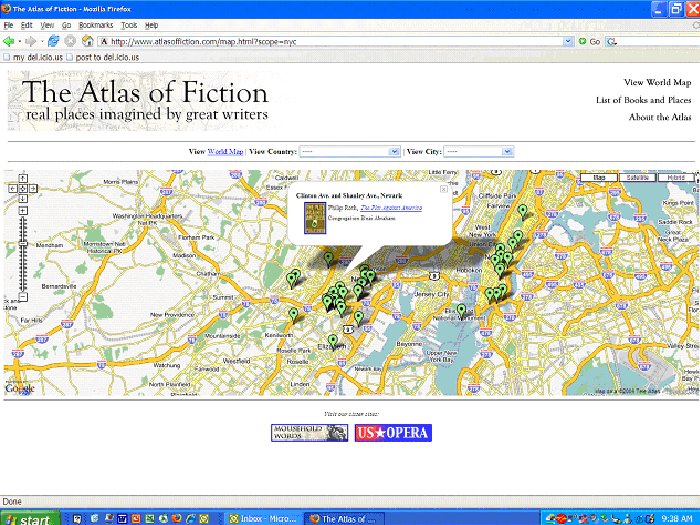 What I would think would be interesting is some combination with LibraryThing.com and sites like this where users have identified the settings of the titles they have read. This information would provide a boost to Atlas in establishing a large body of data on locations. The granularity of the location information in Atlas is to the street level so you can pin point exact locations for specific action in each story and annotate the location with a summary of what happened at each location.
Some novels could lend themselves to an entirely new way of reading or engaging in the book. For example, and obvious title would be Ulysses where as a reader you could follow the story on a map of Dublin going from geographic point to point with the narrative changing as you move a cursor from place to place. Intertwine images (still or low-res video) and perhaps sounds as background and you would have a new way of interacting with the novel. This could be particularly interesting if archival pictures and sounds are used.
It would be great to see publishers start to use some of these types of tools as part of their readers guide 'products' often understanding the neighborhoods and locations in which titles are set is highly important to understanding the dimensions of the title and characters. (At least that's what I was told in English lit).
Note: For some reason, Atlas of Fiction seems to work better using Firefox.
Wednesday, September 13, 2006
Librarything: More new stuff
Librarything just turned one year old and already has over 5million books cataloged on its site. Librarything, for the uninitiated, is a true book lovers social networking site which has garnered tremendous grass roots support from readers, librarians, bookstores and other ‘book people.’ Tim Spalding, who founded the site, has probably been courted by everyone from Google to Amazon and recently allowed ABE books to invest in the company and provide him with some much needed capital for investment. As a result of that investment, Librarything is now more stable than it was in the early summer when the interest in loading books to the site was causing slow response time and server crashes.
In recent weeks I have only seen minor problems and as noted in the librarything blog they continue to work on these issues and get them fixed. The increased investment has enabled some improvements to functionality as well as partnering. Interestingly, it is a trait of social networking – as with any social interaction – there needs to be constant stimulation. I noticed that after loading my titles initially and being generally interested in the site, I didn’t return for a few months. Social sites need to constantly add new reasons to interact with the other members on the site and I am happy to say that Tim and his small team of 3 have stepped this up.
In terms of functionality it is now far easier to tag your own titles and you can manipulate the display of your titles by selecting various fields of information you would like to see in column format. Additionally, you can format five different views of your content. This is a great feature and enables much faster tagging. Once your tags – and these tags are entirely of your invention but you can take a lead from others who have tagged the same titles – you can then see cloud maps of the tags. Clicking on the column heads enables resorting so you can easily bring to the top titles that have no tags which makes editing much easier. There are a few other new things and they continue to add more all the time.
Recently, librarything has enabled integration with bookswap sites. This is relatively new and I haven’t played with this yet; however, it is a simple matter of turning this on in your profile. This feature enables more opportunity to interact with others and share book titles just like a library. Interestingly, in an entry on their blog they discuss how to get scarcer titles added to the ‘share’ listing and there is consideration regarding using pricing (from Amazon) as a measure and applying some type of points system to the books. Obviously, the bookswap idea is less appealing if the only books available for swapping are books everyone has.
Librarything has generated some excitement and they are clearly interested in listening to their users and adding new and interesting items. Recently, they added author pictures and I expect that other information and data will continue to be added.
In recent weeks I have only seen minor problems and as noted in the librarything blog they continue to work on these issues and get them fixed. The increased investment has enabled some improvements to functionality as well as partnering. Interestingly, it is a trait of social networking – as with any social interaction – there needs to be constant stimulation. I noticed that after loading my titles initially and being generally interested in the site, I didn’t return for a few months. Social sites need to constantly add new reasons to interact with the other members on the site and I am happy to say that Tim and his small team of 3 have stepped this up.
In terms of functionality it is now far easier to tag your own titles and you can manipulate the display of your titles by selecting various fields of information you would like to see in column format. Additionally, you can format five different views of your content. This is a great feature and enables much faster tagging. Once your tags – and these tags are entirely of your invention but you can take a lead from others who have tagged the same titles – you can then see cloud maps of the tags. Clicking on the column heads enables resorting so you can easily bring to the top titles that have no tags which makes editing much easier. There are a few other new things and they continue to add more all the time.
Recently, librarything has enabled integration with bookswap sites. This is relatively new and I haven’t played with this yet; however, it is a simple matter of turning this on in your profile. This feature enables more opportunity to interact with others and share book titles just like a library. Interestingly, in an entry on their blog they discuss how to get scarcer titles added to the ‘share’ listing and there is consideration regarding using pricing (from Amazon) as a measure and applying some type of points system to the books. Obviously, the bookswap idea is less appealing if the only books available for swapping are books everyone has.
Librarything has generated some excitement and they are clearly interested in listening to their users and adding new and interesting items. Recently, they added author pictures and I expect that other information and data will continue to be added.
Tuesday, September 12, 2006
Never Saw it Coming
Who would have thunk it, the Senate Intelligence Committee has confirmed that the justification for war with Iraq was based on a number of erroneous conclusions (ed. lies, surely?) Well... whatever..., the Senate Intelligence Committee is moving on to confirming the existence of Santa Claus, Snow White and Gandalf. Stay tuned.
Monday, September 11, 2006
Disaster Books
This year has been a year of disaster books for me. In a small way. Earlier this year I read A Crack in the Edge of the World By Simon Winchester about the San Francisco earthquake, and I have just finished Curse Of the Narrows by Laura MacDonald which is the true story of a massive explosion in Halifax, Nova Scotia in 1917. Both books were excellent and prove interesting reading given the current situation of New Orleans. Most know about the San Francisco earthquake and the resulting fire that destroyed most of the city but in his book Winchester – a geologist by formal education – spends much of the book describing the geological background to the earthquake. Using as a narrative tool his drive across the United States, he describes the geology and geography of the country and provides background on other lesser known earthquakes and geologic points of interest. He actually finishes his journey in Alaska and ‘passes through’ San Francisco to describe the Earthquake. What is comparatively interesting about San Francisco’s reaction to the disaster is the manner in which the city leadership went about dealing with the immediate aftermath and reconstruction. Almost as a circumstance of location and the timeframe in which they lived the city leaders knew instinctively that they couldn’t rely on federal government help and that they needed to take rapid responsibility for their own wellbeing. Help soon arrived and there was an organized mechanism for disbursing and rebuilding the city which got going rapidly. Additionally, it was always assumed that San Francisco was vital to the economy of the west and there was never any doubt of the economic viability and need to rebuild the city.
In December 1917, a munitions ship collided in Halifax harbor with another ship which set off an explosion that remains earths largest conventional explosion ever. The ship exploded in ‘downtown’ Halifax and the force was so strong that Robert Oppenhiemer studied the effects while researching the A-Bomb in 1944. Thousands died and the town was leveled. To make matters worse a blizzard, rain/flooding and another blizzard followed over the next five days and obviously further hampered rescue efforts. Help was sent from the US particularly Massachusetts. Local doctors, who themselves were in shock, were forced to work in terrible conditions for many days as residents were dug out or suffered burns from the ensuing fires. Eye wounds were particularly prevalent because the ship’s explosion was preceded by a fire which ignited the explosives. Many people were caught watching as the shock wave from the explosion blasted every window in town into the faces of the on-lookers. As relief flowed in a citizens emergency group was formed to manage the rebuilding and recovery of the town and a concerted effort was made to take responsibility away from politicians. This was one learning that was gained from the San Francisco recovery effort which some believed had been slowed by politics.
In all these were interesting well written books which are relevant today given the real recovery issues faced in New Orleans. It is fascinating to note that with so much less resource in these two cases, results were fast, early and effective in dealing with the problem at hand. In both cases, the cities were happy for the assistance but they weren’t waiting for someone else to set the priorities and do the job for them. They got stuck in immediately.
Lastly, Laura MacDonald quotes from Disasters a book by J. Byron Deacon published in 1918 which struck me as relevant to our current approach to disasters:
In December 1917, a munitions ship collided in Halifax harbor with another ship which set off an explosion that remains earths largest conventional explosion ever. The ship exploded in ‘downtown’ Halifax and the force was so strong that Robert Oppenhiemer studied the effects while researching the A-Bomb in 1944. Thousands died and the town was leveled. To make matters worse a blizzard, rain/flooding and another blizzard followed over the next five days and obviously further hampered rescue efforts. Help was sent from the US particularly Massachusetts. Local doctors, who themselves were in shock, were forced to work in terrible conditions for many days as residents were dug out or suffered burns from the ensuing fires. Eye wounds were particularly prevalent because the ship’s explosion was preceded by a fire which ignited the explosives. Many people were caught watching as the shock wave from the explosion blasted every window in town into the faces of the on-lookers. As relief flowed in a citizens emergency group was formed to manage the rebuilding and recovery of the town and a concerted effort was made to take responsibility away from politicians. This was one learning that was gained from the San Francisco recovery effort which some believed had been slowed by politics.
In all these were interesting well written books which are relevant today given the real recovery issues faced in New Orleans. It is fascinating to note that with so much less resource in these two cases, results were fast, early and effective in dealing with the problem at hand. In both cases, the cities were happy for the assistance but they weren’t waiting for someone else to set the priorities and do the job for them. They got stuck in immediately.
Lastly, Laura MacDonald quotes from Disasters a book by J. Byron Deacon published in 1918 which struck me as relevant to our current approach to disasters:
“It is the province of emergency relief to provide for immediate, common
needs. The promptness and completeness with which they are met are the
sole tests of efficiency. The province of rehabilitation is to help each
family meet the needs peculiar to it and return to its normal manner of
life. Its efficiency is tested by the degree to which it succeeds in
accomplishing these results. Emergency relief plans and acts to meet
present needs, rehabilitation plans and acts for ultimate welfare. All
disaster relief should be a process of evolving from dealings with its victims
en masse to treatment of them as individual families…need, not loss, is the
basis of relief; there must be the fullest possible utilization of community and
family resources for self-help; accurate determination of need, family by
family, is the only basis for a just and effective distribution of relief; in
addition to the needs which can be met by monthly gifts, there are others which
can be met only by wise counsel and devoted intelligent personal service.”
Thursday, September 07, 2006
More on Google Archive
Eion Purcell had a forthright and not disagreeable commentary on the Google Archive announcement. I have a similar view that indeed newspapers are realizing they need the traffic to support the web presence and having allowed Google to index their content is great for us users (with a caveat) but also a monumental shift for how these newspaper publishers view themselves. That would be especially true for the New York Times which has visions of being the Nation’s (some think the World’s) newspaper and a destination themselves. I think that this announcement is also a harbinger of things to come and all database providers may find themselves having to open up to Google (and the others) and be indexed. That is just the way things will be.
The library and information database business is currently characterized by monolithic “packages” and all the largest publishers have invested huge amounts to create “platforms” and “solutions” that represent delivery mechanisms for their proprietary content. Google Indexing will become a large federated search engine for all this content progressively (not immediately and maybe not universally) undermining the ‘platform’ approach that publishers have pushed. Having said that, Google Indexing (for want of a better term) is not the total answer and in fact is – in the example of Google Archive – missing a key element. Missing is a navigation tool/enabler that allows a searcher to identify content during their search that they have rights to access via their public or academic library (or other contract with the data owner). This represents the caveat that I mention above.
The technology called ‘link resolver’ has been around for many years and if implemented between the search query and the location of the material would enable the searcher to ‘skip’ the part where they would otherwise have to pay. Authentication that the user has access is as easy as inputting the users library card number. Ideally and logically this only needs to be done once so that the searcher can conduct another search in three weeks and skip even this step.
Now, it is early days in this initiative and I expect improvements will be made rapidly. I did however wonder what libraries were saying about this announcement. Universally, the list serve comments on Web4Lib were that they were disappointed with the implementation. Comments include “..the predominate number of articles were not free but pay-per-view..” or “…people will end up paying for things they have access to” or “..the search doesn’t return anywhere like amount of content available via the library.” (If you want to read them here is the link). As I said above, this is early days and I think the general public will enjoy playing with this Archive. For libraries, I think this represents another opportunity to ride the Google coat tails and via link resolver bring searchers into the library and turn them into patrons.
The library and information database business is currently characterized by monolithic “packages” and all the largest publishers have invested huge amounts to create “platforms” and “solutions” that represent delivery mechanisms for their proprietary content. Google Indexing will become a large federated search engine for all this content progressively (not immediately and maybe not universally) undermining the ‘platform’ approach that publishers have pushed. Having said that, Google Indexing (for want of a better term) is not the total answer and in fact is – in the example of Google Archive – missing a key element. Missing is a navigation tool/enabler that allows a searcher to identify content during their search that they have rights to access via their public or academic library (or other contract with the data owner). This represents the caveat that I mention above.
The technology called ‘link resolver’ has been around for many years and if implemented between the search query and the location of the material would enable the searcher to ‘skip’ the part where they would otherwise have to pay. Authentication that the user has access is as easy as inputting the users library card number. Ideally and logically this only needs to be done once so that the searcher can conduct another search in three weeks and skip even this step.
Now, it is early days in this initiative and I expect improvements will be made rapidly. I did however wonder what libraries were saying about this announcement. Universally, the list serve comments on Web4Lib were that they were disappointed with the implementation. Comments include “..the predominate number of articles were not free but pay-per-view..” or “…people will end up paying for things they have access to” or “..the search doesn’t return anywhere like amount of content available via the library.” (If you want to read them here is the link). As I said above, this is early days and I think the general public will enjoy playing with this Archive. For libraries, I think this represents another opportunity to ride the Google coat tails and via link resolver bring searchers into the library and turn them into patrons.
Wednesday, September 06, 2006
More Amazon Movie News, Google Newspapers, Bertelsmann
I wrote a post about Amazons new 'movie platform' (my words) and the The LA Times has a story on the anticipated Amazon Movie Service. Here it is. (It is interesting the correlation to the EPIC 2015 video I linked to last week).
Again, the Google factor at play generating huge coverage this morning, but when I heard this story about providing search users with access to digital archives of the New York Times, Wall Street Journal and others, I wondered what happens to Proquest which relies so much on revenues derived from thier newspaper databases.
As many news outlets are reporting this morning Vivendi has purchased Bertelsmann Music Publishing division for over $2.0billion.
Again, the Google factor at play generating huge coverage this morning, but when I heard this story about providing search users with access to digital archives of the New York Times, Wall Street Journal and others, I wondered what happens to Proquest which relies so much on revenues derived from thier newspaper databases.
As many news outlets are reporting this morning Vivendi has purchased Bertelsmann Music Publishing division for over $2.0billion.
Tuesday, September 05, 2006
Ads In Textbooks
A number of recent articles about advertising supported textbooks got some media attention recently. I recall ads in travel guides and they never did well – perhaps it doesn’t help that many travel guide purchasers are arm-chair travelers. It was also difficult to manage the currency of the advertising. I am doubtful that ad supported textbooks will have much success either but I did wonder whether this idea could be taken a little further.
As long ago as 1995, TV Guide were producing as many as 52 separate weekly editions of their guide. Their desire to do this was to create local versions of the guide to gain local advertising (on top of the national advertising in all editions). Print production should allow multiple (economic) versions of a textbook. The question is would publishers as a group be interested in including advertising in their text books? If there was interest and the costs of incorporating the ads was significantly less than the revenue – both big ifs – then a market for the advertising inventory would need to be established. Since the publishing schedule for textbooks is highly seasonal and inventory expires at a certain point it could be relatively straight forward to set up an auction site for textbook ad inventory. (In a perverse way, could advertising in textbooks drive the students need to have the current year's edition...hmm?)
Key to this market would be how automated the activities could be. This would reduce expenses as much as possible. Guidelines on page layout, ad size, image resolution, content, payment, etc. would be easy to establish and using a formulated process such as ebay would also reduce expense by leveraging existing processes. Recently, the advertising industry began experimenting using Ebay as a marketplace for broadcast advertising.
It would seem more likely that an advertising model that enabled an advertiser to reach across multiple markets using multiple publishers and titles would have a greater chance of success than trying to create a publishing program based solely on advertising to justify a titles viability. Who knows? It would seem to me that ad based textbooks sounds interesting when everyone is debating a publishers right to make a reasonable profit but in reality the idea is a sideshow.
As long ago as 1995, TV Guide were producing as many as 52 separate weekly editions of their guide. Their desire to do this was to create local versions of the guide to gain local advertising (on top of the national advertising in all editions). Print production should allow multiple (economic) versions of a textbook. The question is would publishers as a group be interested in including advertising in their text books? If there was interest and the costs of incorporating the ads was significantly less than the revenue – both big ifs – then a market for the advertising inventory would need to be established. Since the publishing schedule for textbooks is highly seasonal and inventory expires at a certain point it could be relatively straight forward to set up an auction site for textbook ad inventory. (In a perverse way, could advertising in textbooks drive the students need to have the current year's edition...hmm?)
Key to this market would be how automated the activities could be. This would reduce expenses as much as possible. Guidelines on page layout, ad size, image resolution, content, payment, etc. would be easy to establish and using a formulated process such as ebay would also reduce expense by leveraging existing processes. Recently, the advertising industry began experimenting using Ebay as a marketplace for broadcast advertising.
It would seem more likely that an advertising model that enabled an advertiser to reach across multiple markets using multiple publishers and titles would have a greater chance of success than trying to create a publishing program based solely on advertising to justify a titles viability. Who knows? It would seem to me that ad based textbooks sounds interesting when everyone is debating a publishers right to make a reasonable profit but in reality the idea is a sideshow.
Saturday, September 02, 2006
Google Lets it All Out
Any time the word Google is attached to anything everyone reacts like it is the second coming. Google opened access to the public domain titles they have scanned as if as Mr Charkin points out there aren't enough opportunities to get these already. Here thanks to a link at Library TechBytes is a vblog from Mobuzz tv that takes a surprising view point in support of the library catalog.
Also, I still wonder about those 'out of copywright' titles with introductions penned in the fifties, sixties and seventies. What's with that?
And since we are on the topic (Google), you may have seen this both really cool and kinda frightenting view of the future c2014. Well now they have updated it by a year. Here is the link to EPIC2015. Off to the Google Grid...
Also, I still wonder about those 'out of copywright' titles with introductions penned in the fifties, sixties and seventies. What's with that?
And since we are on the topic (Google), you may have seen this both really cool and kinda frightenting view of the future c2014. Well now they have updated it by a year. Here is the link to EPIC2015. Off to the Google Grid...
Friday, September 01, 2006
US Open, Andre Agassi and Video Line Calls
The US Open has been great so far, with one of the best and most exciting games played in recent memory between Baghdartis and Agassi. Agassi's match with Blake last year was pretty good to but this one was a true classic. Watching it live until 1:30 in the morning and jumping around the living room was exhausting.
Agassi has said this is his last tournament and I wonder if he is going to publish his biography in the coming years. He is certainly a personality that could move some units. Whereas he has traditionally been very closed about his upbringing and sporting life, he recently expressed more of himself in an article in Sport Illustrated.
This year marks the introduction of video line calls. A player gets to challenge via instant replay a set number of calls per set. When I heard about this it seemed to me games would become similar to The Price is Right with the fans screaming advice to the players. In fact, the implementation has been far better than that, but I am not a fan of introducing this type of technology into sport. I don't approve of goal line video or the camera used in cricketfor runouts. I don't want to seem old fashioned but the ref is as much a part of the game as are the players. The ref gets it right and wrong just like the players and as such the human element adds to the enjoyment and frustration of the game. If we wanted it perfect we should put a bunch of robots out there who never put a pass wrong, always score and are never bowled. Now how much fun would that be to watch? Sure England would have beaten Portugal in the European championship but it is the element of chance and unpredictability that makes sports so fun and interesting.
I can almost guarantee that someone is going to say the technology used to predict where the ball landed isn't good enough and will want improvements. Next thing you know there won't be any refs actually at the games they will all be in a dark room watching remotely as a computer makes the decisions.
Agassi has said this is his last tournament and I wonder if he is going to publish his biography in the coming years. He is certainly a personality that could move some units. Whereas he has traditionally been very closed about his upbringing and sporting life, he recently expressed more of himself in an article in Sport Illustrated.
This year marks the introduction of video line calls. A player gets to challenge via instant replay a set number of calls per set. When I heard about this it seemed to me games would become similar to The Price is Right with the fans screaming advice to the players. In fact, the implementation has been far better than that, but I am not a fan of introducing this type of technology into sport. I don't approve of goal line video or the camera used in cricketfor runouts. I don't want to seem old fashioned but the ref is as much a part of the game as are the players. The ref gets it right and wrong just like the players and as such the human element adds to the enjoyment and frustration of the game. If we wanted it perfect we should put a bunch of robots out there who never put a pass wrong, always score and are never bowled. Now how much fun would that be to watch? Sure England would have beaten Portugal in the European championship but it is the element of chance and unpredictability that makes sports so fun and interesting.
I can almost guarantee that someone is going to say the technology used to predict where the ball landed isn't good enough and will want improvements. Next thing you know there won't be any refs actually at the games they will all be in a dark room watching remotely as a computer makes the decisions.
Tuesday, August 29, 2006
Healy New BISG Executive Director
Congratulations to BISG in the hire of Michael Healy to the Executive Director position. Having worked with Michael on ISBN matters - he succeeded me as Chair of the International ISBN committee - this is an exceptional choice. Michael succeeds Jeff Abraham who rebuilt BISG into relevance and is now with Random House.
Monday, August 28, 2006
International Number: India, China & Turkey
India is the profile nation this year at Frankfurt and as the industry gears up for representation there have been a number of articles on the subject of Indian publishing. This article in the Indian Business Standard suggests that while there has been some change since the last time India was the guest of honor at Frankfurt many of the same issues remain. The local market is still problematic - although it must be stronger than 20 years ago. The middle class in India is significant and has rapidly growing wealth. External markets however are underleveraged and the article calls for more translated titles to open up Indian publishing to the west.
India is also publishing a broader array of products in addition to trade fiction etc. This article surveys some of the new illustrated titles on the way. Introduced with a Seinfeld reference. Gotta love their sense of humor.
Cambridge University Press purchased Foundation Press and formally entered the Indian publishing market.
Here is a little more background on children’s publishing in the South. Interesting to see Scholastic is a player.
Here is an article in the Guardian reporting on preparations for Frankfurt.
In China, Jane Friedman is quoted in the Wall Street Journal saying Harpercollins wants to expand into China. It is the Beijing Bookfair this week.
Lastly, in Turkey, there seems to be an issue on censorship. Not satisfied with simply banning a book that they don't agree with, publishers there are changing some well know Western books. For example, "In Dumas' Three Musketeers, D'Artagnan while on his way to see Aramis is stopped by an old woman who explains: “You can't see him right now. He is surrounded by men of religion. He converted to Islam after his illness.” At least the government seems to be acting reasonably.
India is also publishing a broader array of products in addition to trade fiction etc. This article surveys some of the new illustrated titles on the way. Introduced with a Seinfeld reference. Gotta love their sense of humor.
Cambridge University Press purchased Foundation Press and formally entered the Indian publishing market.
Here is a little more background on children’s publishing in the South. Interesting to see Scholastic is a player.
Here is an article in the Guardian reporting on preparations for Frankfurt.
In China, Jane Friedman is quoted in the Wall Street Journal saying Harpercollins wants to expand into China. It is the Beijing Bookfair this week.
Lastly, in Turkey, there seems to be an issue on censorship. Not satisfied with simply banning a book that they don't agree with, publishers there are changing some well know Western books. For example, "In Dumas' Three Musketeers, D'Artagnan while on his way to see Aramis is stopped by an old woman who explains: “You can't see him right now. He is surrounded by men of religion. He converted to Islam after his illness.” At least the government seems to be acting reasonably.
Friday, August 25, 2006
Zoom Cloud
There is some new script on the right of my page that I just added. I am not sure if this is a good thing or not - although I think the technology is really great. I am having second thoughts about Blogger mainly because of the limitation on classification. I will likely change to something more robust. I really didn't know where I was going to go with blogging and thinking about better navigation to content was the least of my concerns when I started. Anyway, this ZoomCloud is a neat half way house for visitors to quickly find some of the content I have produced over the past several months. Let me know what you think.
While I am at it, on the right there is also a link to my web calendar where you can see all kinds of media events and conferences. A feature I had added to it allows you to download a vfile into Outlook - no retyping. If I am missing any conferences there is a submit form. I am happy to add. (Although under no circumstances will I add the Arsenal FC annual shareholders meeting).
While I am at it, on the right there is also a link to my web calendar where you can see all kinds of media events and conferences. A feature I had added to it allows you to download a vfile into Outlook - no retyping. If I am missing any conferences there is a submit form. I am happy to add. (Although under no circumstances will I add the Arsenal FC annual shareholders meeting).
News: Amazon's Digital Platform. Book Pricing. Harlequin. Cody's Bookstore.
There is an interesting article in The Economist this week about what Amazon is up to and how they face a very real threat of being disintermediated relative to digital music, video and book content. Some of this story has been discussed before because in their last financial report they recorded significantly less net income because of materially higher spending in technology. Analysts have speculated that the company is readying itself for the provision of non-physical content and they are building some type of platform (my term) for delivery of this. The unsaid aspect of The Economist article seems to imply that since no one at Amazon is talking about this that some announcement is imminent.
I thought this article about comments made by Sumner Redstone was relevant to book publishers and their approach to pricing. Publishers are too rigid in the manner in which prices are set and managed. As digital publishing becomes more prevalent and deeper knowledge and understanding of how markets work - via The Long Tail type analysis - these trends should almost force a rethink about how books are priced. It would seem to me, that a rigid approach to pricing results in lost revenue. As we all know, airlines are masters at the yield curve and this is not to say publishers should be that sophisticated but if they adopt more flexible approaches to pricing it could result in all kinds of impact on remainders, returns, the second hand market and so on. For example, could a publisher 'recover' a portion of the used book market by offering new copies at market rate prices (plus a small premium for new)? This would be long after initial release of the title. Would buyers by willing to pay a little more than the used price for a new book especially if they knew that in doing so the author would receive a share of the purchase price whereas with the used copy they do not? This idea is not a new idea nor is it a panacea but I think it suggests some market testing.
Harlequin.
I hate to harp on this, but this company with one of the strongest brands in publishing and with a huge market opportunity staring them in the face still seems weak kneed and hesitant.
My other blog on this.
Cody's Bookstore in Berkeley a famed independent for many years closed recently. Here is a perspective on what went wrong. It reflects more than a bookstore issue.
Lastly, watchers of the Booker List will note three Australian authors made the long list. As far as I can gather - no comment from The Australian newspaper regarding their 'gotcha story' about Patrick White and the in ability of great Australian writers to get published.
I thought this article about comments made by Sumner Redstone was relevant to book publishers and their approach to pricing. Publishers are too rigid in the manner in which prices are set and managed. As digital publishing becomes more prevalent and deeper knowledge and understanding of how markets work - via The Long Tail type analysis - these trends should almost force a rethink about how books are priced. It would seem to me, that a rigid approach to pricing results in lost revenue. As we all know, airlines are masters at the yield curve and this is not to say publishers should be that sophisticated but if they adopt more flexible approaches to pricing it could result in all kinds of impact on remainders, returns, the second hand market and so on. For example, could a publisher 'recover' a portion of the used book market by offering new copies at market rate prices (plus a small premium for new)? This would be long after initial release of the title. Would buyers by willing to pay a little more than the used price for a new book especially if they knew that in doing so the author would receive a share of the purchase price whereas with the used copy they do not? This idea is not a new idea nor is it a panacea but I think it suggests some market testing.
Harlequin.
I hate to harp on this, but this company with one of the strongest brands in publishing and with a huge market opportunity staring them in the face still seems weak kneed and hesitant.
My other blog on this.
Cody's Bookstore in Berkeley a famed independent for many years closed recently. Here is a perspective on what went wrong. It reflects more than a bookstore issue.
Lastly, watchers of the Booker List will note three Australian authors made the long list. As far as I can gather - no comment from The Australian newspaper regarding their 'gotcha story' about Patrick White and the in ability of great Australian writers to get published.
Thursday, August 24, 2006
Album Liner Notes Books
As a teenager, I like many buyers of record albums, used to pour over the album cover devouring the artwork and learning all the lyrics for the songs - assuming they were printed on the cover. Sadly, with the advent first of the CD and now with music downloads the art of the Album cover has diminished. I have over 1,000 CDs which are all loaded into CD carousels. I have saved the liner notes that came with all the CDs but these all sit in a drawer. There is really no useful way to access these which is a shame because the content in the liner notes add a lot to the experience of the music. I have long thought that there is a different model for the written content that typically went along with music. As music is increasingly vended online would music retailers such as HMV and Virgin be interested in published products that supported the music? Selling this book could do two things - raise the average price paid per unit and possibly bring consumers to retail stores. Each album collection, when released would also be accompanied by a book that provided much more published content than just the liner notes. The book could include interviews with each band member of aspects of the recording process, interpretations of the lyrics, photos of the recording sessions and detailed session notes. Mr. Pete Townsend has been blogging about many things but also the recording process for new Who album; it would be great to include this material - and perhaps something from Roger in a complimentary published product. Lastly, back to my existing CD collection, I would purchase a book of all the liner notes from all the Neil Young albums together with (perhaps) interviews with Neil, critical essays/reviews and session notes. This to me would be a much more practical way of interacting with the music I enjoy listening to. How about it publishing folk?
Tuesday, August 22, 2006
ShakespeaRe-Told:
BBC America - which is a premium channel over here - is broadcasting adaptations of four of Shakespeare's plays. So far, we have watched Much Ado About Nothing which was excellent. Macbeth and Midsummer Night's Dream are in the Tivo and The Taming of the Shrew is on next week. Apparently, The BBC produced a similar 'updating' for The Caterburry Tales last year and these four shows are a result of that shows success. I don't recall Canterbury Tales being broadcast here but I may have missed it. The BBC 'hand selected' several screenwriters and actors to 'radically revise and update' the Bard's plays. If the first one is anything to go by then these shouldn't be missed; they have really bought these plays to light for potential new audience.
(A search for a clip turned up this funny clip of The Beatles doing Midsummer; why or when I have no idea but I have never seen it before).
(A search for a clip turned up this funny clip of The Beatles doing Midsummer; why or when I have no idea but I have never seen it before).
Monday, August 21, 2006
Cybersex, Secondlife and Myspace
In the office this week we got on a discussion about how books are represented on social sites like myspace and game sites like secondlife. I hate games but I have been interested in the secondlife phonom where you can literally create a new you and there exists a trading network that includes everything from real estate to clothes. So I signed up for secondlife to try to see how books were represented in the game.
Anyone for CyberSex? Predictably, sex plays some part in the content available. Derivations of the For Dummies series include CyberSex for Dummies and Escorting for Dummies. I have no idea whether these are official Wiley titles - what are the chances? A search on bookstores and books found a few store locations and navigating to them was relatively easy. Content including the above was not significant in choice. Some other titles covered topics specific to creating an identify within the game and some additional sex titles. One store was selling e-books which were on 'display' enabling the ability to page turn and review the content. In all the book stores were underwhelming but I expect the customers were engaged elsewhere in the game and within this context books aren't particularly interesting. I suspect some enterprising person will think up a unique application connected to the game.
On Myspace there are many bookstores represented with profiles with their ranking determined by the number of friends. Atomic books is typical of the stores that have profiles. It is difficult to say how many there are but clearly this is a viable method of advertising/PR to a very targeted group of consumers to whom it can be hard to introduce to books. Leftbank books located in Seattle is also similarly edgy; they describe themselves as 'anarchist' booksellers. Some stores look like they do more to promote retail than others.
Searching 'groups' for 'books' and 'mystery books' results in a few groups dedicated to reading but the result set is also 'polluted' with results that clearly have little if anything to do with books. There are over 5000 profiles returned for 'books' but only eleven for 'mystery books'. Lastly, I searched for library and I was unexpectedly surprised. Librarians have seen the virtues of setting up a myspace profile for their libraries and they use it to engage the young adult community. This is exciting because it shows that some libraries are willing to experiment and engage a target audience on their terms. Hannepin County Library in MN is representative of the libraries on myspace. Central Falls Public library (a Hannepin friend) is also a great site. Myspace definitely represents an opportunity to engage. Here is their note for the summer reading program:
Hannepin allows myspace creators to add the a script to their web pages that provides a search box on their web page:
As I mentioned on another post it will be interesting to see if the influence of Harpercollins will result in any changes on the myspace site that effects more support for books and reading. The viral nature of some of the video advertising Harpercollins is experiementing with is perfect for the myspace environment and I can't believe they are not looking at how to take advantage.
Laslty, to bring this full circle, a number of enterprising individuals have established a Secondlife library. It is still a work in progress but it will be interesting to see how this evolves. Will content vendors make their content available via database license to the Secondlife Library?
Anyone for CyberSex? Predictably, sex plays some part in the content available. Derivations of the For Dummies series include CyberSex for Dummies and Escorting for Dummies. I have no idea whether these are official Wiley titles - what are the chances? A search on bookstores and books found a few store locations and navigating to them was relatively easy. Content including the above was not significant in choice. Some other titles covered topics specific to creating an identify within the game and some additional sex titles. One store was selling e-books which were on 'display' enabling the ability to page turn and review the content. In all the book stores were underwhelming but I expect the customers were engaged elsewhere in the game and within this context books aren't particularly interesting. I suspect some enterprising person will think up a unique application connected to the game.
On Myspace there are many bookstores represented with profiles with their ranking determined by the number of friends. Atomic books is typical of the stores that have profiles. It is difficult to say how many there are but clearly this is a viable method of advertising/PR to a very targeted group of consumers to whom it can be hard to introduce to books. Leftbank books located in Seattle is also similarly edgy; they describe themselves as 'anarchist' booksellers. Some stores look like they do more to promote retail than others.
Searching 'groups' for 'books' and 'mystery books' results in a few groups dedicated to reading but the result set is also 'polluted' with results that clearly have little if anything to do with books. There are over 5000 profiles returned for 'books' but only eleven for 'mystery books'. Lastly, I searched for library and I was unexpectedly surprised. Librarians have seen the virtues of setting up a myspace profile for their libraries and they use it to engage the young adult community. This is exciting because it shows that some libraries are willing to experiment and engage a target audience on their terms. Hannepin County Library in MN is representative of the libraries on myspace. Central Falls Public library (a Hannepin friend) is also a great site. Myspace definitely represents an opportunity to engage. Here is their note for the summer reading program:
Summer Reading Program Current mood: excited.
Our Summer Reading Program has officially begun! So if you're a kid (or the parent of a kid) between 6 and 12 years old stop by and sign up to read and win prizes! To kick off our program, Katie Latimer (check out http://www.katielatimer.com/) will be here Wednesday, June 28th at 2p.m. to tell stories. She's a native Rhode Islander who's been telling stories since she was thirteen. In 1998 she won the National Youth Storytelling Olympics and has been captivating audiences throughout New England every since!
Hannepin allows myspace creators to add the a script to their web pages that provides a search box on their web page:
Need to find a book or other library materials but are busy on your MySpace page and don't want to leave? Don't worry you can now add the Hennepin County Library catalog search box right to your MySpace. It's fun, it's easy and you can have the convenience of the library on your own MySpace page. Instructions for adding the library search box:
http://www.hclib.org/teens/MySpace/AddCatalogsearch.cfm
As I mentioned on another post it will be interesting to see if the influence of Harpercollins will result in any changes on the myspace site that effects more support for books and reading. The viral nature of some of the video advertising Harpercollins is experiementing with is perfect for the myspace environment and I can't believe they are not looking at how to take advantage.
Laslty, to bring this full circle, a number of enterprising individuals have established a Secondlife library. It is still a work in progress but it will be interesting to see how this evolves. Will content vendors make their content available via database license to the Secondlife Library?
Sunday, August 20, 2006
Old Gunter Grass
In our media intrusive world it is astounding that no one found out that Gunter Grass was a 17 year old Nazi. Admittedly, who of recent generations could really understand what was going on in Nazi Germany in 1944, but... given the circumstances of those years wouldn't the experience be indelibly stamped on your cortex. Not to be forgotten.
Grass is a 20th century master. Why did he expect no one to think his decision to keep quiet about his SS call-up to go un-noticed? And why the SS? His biography is on sale today and is expected to sell out immediately. He will make a few bucks (Euros) but I tend to agree with this opinion in the IHT; that this is less about money than about him dealing with the inevitable likelihood that after his death some cub reporter is going to find the evidence. I guess he believes that his comments and arguments while he is alive regarding this experience is better than nothing at all and could help mitigate the inevitable reversionary review of his master-works. His initial public comments and I suppose his narrative that it was some impetuous action of a boy who wanted to get out of the house seems to me to be a little gratuitous. But who am I to say. The fact he kept this quiet all these years seems more than accidental and particularly calculated. If he joined the regular army and then 60 years later told everyone he wanted to defend his country I am not sure anyone would have paid too close attention.
Grass is a 20th century master. Why did he expect no one to think his decision to keep quiet about his SS call-up to go un-noticed? And why the SS? His biography is on sale today and is expected to sell out immediately. He will make a few bucks (Euros) but I tend to agree with this opinion in the IHT; that this is less about money than about him dealing with the inevitable likelihood that after his death some cub reporter is going to find the evidence. I guess he believes that his comments and arguments while he is alive regarding this experience is better than nothing at all and could help mitigate the inevitable reversionary review of his master-works. His initial public comments and I suppose his narrative that it was some impetuous action of a boy who wanted to get out of the house seems to me to be a little gratuitous. But who am I to say. The fact he kept this quiet all these years seems more than accidental and particularly calculated. If he joined the regular army and then 60 years later told everyone he wanted to defend his country I am not sure anyone would have paid too close attention.
Saturday, August 19, 2006
Audio Book Publishers Report: MediaBay, Audible
MediaBay reported their financial results this week. MediaBay has over 75,000 hours of audio content distributed through our consumer brands, Soundsgood.com, AudioBookClub, Radio Spirits and Radio Classics. Content is distributed on the internet via digital download subscription services, websites, mail order, retailers, and even via a cell phone (ring tones) offering. (What is that? Just a few words per ring? TO BE!, TO BE!). MediaBay are also MSN Music’s exclusive provider of spoken word products for downloading via the Web, and have a growing list of digital distribution partners that include Real Networks, Loudeye, and XM and Sirius Satellite Radio. MediaBay has been in business for 12 years.
MediaBay has had some reported financial difficulties recently and unfortunately, their financial results are not great for the first half 2006. Net sales were $2.6 million for the six months ended June 30, 2006, down from $5.6 million for the six months ended June 30, 2005. The company made a strategic decision to migrate thier business model to one based on digital distribution through partnerships with MSN, Yahoo, AOL, etc. so their content is available via these music services. As a result revenue comparisons year on year are misleading. Net loss applicable to common stockholders for the six months ended June 30, 2006 was $15.7 million, or $1.49 per diluted common share, compared to a net loss of $22.2 million, or $4.36 per diluted common share for the six months ended June 30, 2005. With allowence for extraordinary items their net income was virtually the same as last year which will not be enough to raise their market cap. This is important because it is currently at $3mm and NASDAQ issued them a warning in June that they needed to raise their value to over $5mm. The press release doesn't mention this or what their plans are and they have until September 25th to comply. The company retained a Banker in February for the generic 'review of strategic options'. Since the press release on the results was sparse I am thinking something is brewing.
Some of MediaBay's digital content partners include BBC, Blackstone, CBS Radio, Harper Collins, Hay House, Oasis, Penguin Audio, Random House, Simon & Schuster, Sound Room, and Zondervan.
Audible Inc. reported their six month numbers in late July which were better with revenues for the six months up over $10mm versus the same period last year. Net income however was significantly lower than the same period last year due to higher royalty payments. Audible has benefited significantly from its relationship with Apple and the IPOD. It should be interesting to see if there is any negative impact to the Audible business model if the new IPOD is equiped with with an e-book reader as most people expect. Audible may be a legitimate channel for Apple to work with in suppling them with ebook content from publishers. Apple wouldn't have to deal with the toublesome publishers directly. Audible's stock price is slightly higher than their 12mth low but half their 12 mth high. Other stats are in the press release.
Here is a little more on Audio books from a prior post.
MediaBay has had some reported financial difficulties recently and unfortunately, their financial results are not great for the first half 2006. Net sales were $2.6 million for the six months ended June 30, 2006, down from $5.6 million for the six months ended June 30, 2005. The company made a strategic decision to migrate thier business model to one based on digital distribution through partnerships with MSN, Yahoo, AOL, etc. so their content is available via these music services. As a result revenue comparisons year on year are misleading. Net loss applicable to common stockholders for the six months ended June 30, 2006 was $15.7 million, or $1.49 per diluted common share, compared to a net loss of $22.2 million, or $4.36 per diluted common share for the six months ended June 30, 2005. With allowence for extraordinary items their net income was virtually the same as last year which will not be enough to raise their market cap. This is important because it is currently at $3mm and NASDAQ issued them a warning in June that they needed to raise their value to over $5mm. The press release doesn't mention this or what their plans are and they have until September 25th to comply. The company retained a Banker in February for the generic 'review of strategic options'. Since the press release on the results was sparse I am thinking something is brewing.
Some of MediaBay's digital content partners include BBC, Blackstone, CBS Radio, Harper Collins, Hay House, Oasis, Penguin Audio, Random House, Simon & Schuster, Sound Room, and Zondervan.
Audible Inc. reported their six month numbers in late July which were better with revenues for the six months up over $10mm versus the same period last year. Net income however was significantly lower than the same period last year due to higher royalty payments. Audible has benefited significantly from its relationship with Apple and the IPOD. It should be interesting to see if there is any negative impact to the Audible business model if the new IPOD is equiped with with an e-book reader as most people expect. Audible may be a legitimate channel for Apple to work with in suppling them with ebook content from publishers. Apple wouldn't have to deal with the toublesome publishers directly. Audible's stock price is slightly higher than their 12mth low but half their 12 mth high. Other stats are in the press release.
Here is a little more on Audio books from a prior post.
Thursday, August 17, 2006
Who's moving my E-Book?
A month ago the Gutenberg Project organized a World e-Book Fair that was designed to bring attention to the e-book format by making over 300,000 e-book titles available for free download. Apparently, the amount of attention gained exceeded expectation (and initial IT capability) to such an extent that over 30million downloads were delivered according to the Boston Globe. This is interesting news given the ambivalence to e-books by publishers and traditional retailers. As Nick Bogarty of the International Digital Publishing Forum comments in a Washington Times article there are still only 60% of bestsellers available in e-book format. It seems strange to me that the publishers production processes don't automatically produce e-books for all new titles. I do recognize that the larger trade houses are creating digital repositories but the information from IDPF still surprises me. As I have commented on before, there is some form of chicken and egg situation here where publishers don't perceive demand and consumers don't perceive choice. Regardless, what will really spur e-book content and sales will be the integration of e-book content on the next generation of IPOD which most people myself included expect in the new year.
Subscribe to:
Comments (Atom)