Friday, December 22, 2006

Proof Bibliographic Data Can Be Fun!

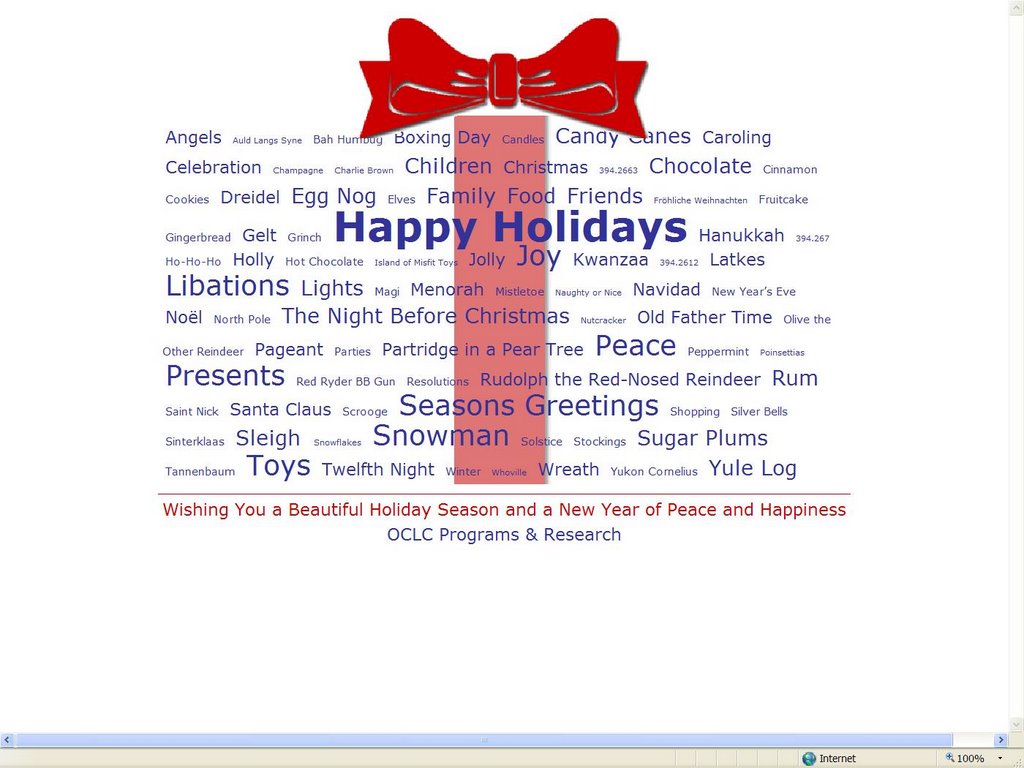
From my OCLC friends, an example of leveraging your assets to new advantage, and in the process proving that bib data can be fun.

Here is the link. For some reason I was drawn immediately to the Island of Misfit Toys - but that is a story for another time. Merry Christmas.

Wednesday, December 20, 2006

Jack the Ripper

No, I haven't solved it but I did think it funny that on the NBC news on Monday, Brian Williams reported on the UK prostitute murder case by saying the crime wave 'conjured up memories of Jack the Ripper'. Now I don't know about you, but I'm thinking that there can't be too many people left who can remember Jack the Ripper. And even if there arem have they been interviewed? Regardless, it is always good when England makes the network news over here since it is generally about something we are really proud of like a good series of murders, football hooligans, cravs, Nazi attired members of the royal family (this one is not that frequent it must be said) and the puppy prime minister.

Monday, December 18, 2006

Predictions for 2007

There are any number of people offering media predictions for 2007 and it is a fun exercise which can also be a useful tool for strategic planning. Consultants use a tactic called ‘scenario planning’ to generate discussion and thought focused on issues impacting a business. In sessions I have managed, I have placed up to ten ‘scenarios’ or predictions on the walls of a conference room where each member of the group is given instructions to vote on the likelihood of each scenario without speaking to the other participants. The scenarios reflect a combination of the existing status-quo and an extrapolation or exaggeration of anticipated market change. Each scenario should be plausible and represent a challenging future environment in order to generate legitimate discussion.

A red dot placed on the scenario means it will never happen and green means the participant agrees it will happen. The scenarios can be anything that the facilitator decides could be relevant to the company but should be done in consultation with someone at the company. (The scenarios are not shared before the meeting). Additionally, they can be absolute; ‘this will happen’ or more general ‘over the next five years…’

As the group completes the ‘voting’ the facilitator has the group examine each scenario in detail and will encourage the group to think about the implications of each scenario in a few dimensions; technology, human resources, competitors, etc. The outcome of this exercise is a better understanding of the company’s challenges and an understanding of the company's possible weaknesses (or strengths) relative to the scenarios the group thinks most likely. A document should be prepared from this seminar session and this document can become a material part of the development of a strategic plan. Even discussion of those scenarios the group does not believe are likely can be useful in challenging the executives to closely examine their assumptions.

This is an exceptional exercise in encouraging senior management to examine, understand and interpret what is going on in the wider world as a fundamental requirement of their daily responsibilities. It can be the case that management develops a bunker mentality and is subsequently blindsided by events that they should have anticipated.

My predictions below are not fully thought out scenarios for a number of reasons – they are not specific for one thing – but nevertheless they are fun to think about. As an editorial comment, I emphasize that I have no inside information on the veracity of any of these.


Predictions for 2007:

  • NYTimes will eliminate the Saturday print edition of the newspaper. It will also create local web news sites for every major metropolitan city in the US and will stream video from their owned broadcast television stations, classified advertising will be free. The company will also launch a citizen’s paper: The New World Times. NYT will create suite of news gathering tools – web services – and make available to ‘citizen journalists’ content and research traditionally only available to professional journalists.
  • YouTube tv: Just like America’s funniest home videos we will see a TV show based on original YouTube video content. It will win its’ night by 10% and will be turned into a weekly Saturday night talent show.
  • Using cell phones’ camera as a barcode reader will lead to an explosion of mobile in-context/ in situ mobile advertising – followed in 2008 by RFID based in-store advertising (with software for cell phones). Mobile advertising will surpass 5% of all ad dollars spent by agencies by end 2007. (Web currently at 20%)
  • Google launches product placement advertising program. Based on similar key word algorithms advertisers will bid for placement in movies, television, other broadcast, sports, etc. prior to production and/or live telecast. Program will represent 10% of all fall 2007 upfront spend.
  • FCC will hold hearings on standards related to product placement advertising in late 2007 as the market explodes.
  • Apple will think about buying Disney and Electronic Arts but will buy Tivo and SlingBox. Apple will also launch a Beatles version of the I-Pod including the entire Beatles catalog plus video/movies. The Beatles I-Pod will retain the tradition Apple artwork (Green apple front, cut away apple on the back).
  • Yahoo will by EA and within six months launch a social network gaming site based on EA content.
  • No-one will buy Netflix
  • Social Media in Education: Several major US colleges will teach various social science coursed entirely in simulation. The courses will not be taught in traditional lecture form but entirely within the software simulation.
  • News Corp will buy Dow Jones and Financial Times and sell Harpercollins and Hachette will by Harpercollins.
  • EBay will by Linden Labs (Second Life). Within six months they will integrate Ebay selling tools into SecondLife enabling virtual store fronts, sales assistance and virtual trading. Will launch program with major retailers and create first Second Life mega-mall in cooperation with Westfield. Ebay also launches SecondLife media placement agency to handle all media inventory on SecondLife.
  • T Mobile buys Skype from Ebay.
  • Linden dollars will be included in the Feds M1 currency calculation.
  • Neil Young’s Living with War wins the Grammy for best Rock Album.

Saturday, December 16, 2006

Judith Regan Fired

Well I can't say I expected this; my immediate reaction was where will she end up? Which publishing house will hire her to bring her special type of salacious - but profitable - publishing to their bottom line. Perhaps no company will since the OJ affair and recent news about an apparently grotesque novalization of Mikey Mantle's life have irreparably savaged her reputation. America is replete with second acts and I am sure she will show up some where. Nevertheless, for the short term she is evidence of the adage 'if you give someone enough rope they will hang themselves.' The word on the street was that she didn't really report to anyone after she moved out to LA.
LA Times

Friday, December 15, 2006

Friday Round-Up

From Grumpy Old Bookman here is a blog article discussing a book by one Steve Webber The Home Based Bookstore. GOB gives the book a ringing endorsement and I link to the blog because it relates somewhat to my blog of last week about charity bookstores. In my blog, I noted that some people have made a living out of setting up online bookstore with Alibris, Amazon and ABE and this book will tell you exactly how to do this and make money. That is, if you have the time and inclination.


Over at institute for the Future of the Book, they note an interview with Harvard University Press and then go on to ask some questions about the 'evolution of authorship'. Here is a quote from their article:

...the immediacy that the Internet provides facilitates collaboration in a way
no meeting of minds in a cafe or railroad apartment ever had. This facilitates a
communality that approaches that of the oral tradition, now we have a system
that allows for true universality. To make this work requires action,
organization, clarity of purpose, and yes, a new rhetoric. New ways of
collaboration entail a novel approach.

You may have noticed that many book related bloggers are putting together their lists of books read in 2007 blogs. Here is an exceptionally well written one from The Millions. In keeping with the blog name, he also reflects on just how many books you could read in a life-time and this calculation becomes depressing when thought of in the context of how many books there are in print. The Bowker Global Books In Print product has 15mm titles (predominantly English) of which more than 50% would be in-print. In the last few weeks, I have been adding to my librarything collection all the books I have read but don't currently have copies of. I am quite depressed that I am only at about 500 titles. I can't believe that I have not read more books than this especially since - as The Millions suggests - I began reading big people books at 13 (Wilbur Smith, Alistair McLean, Ian Fleming).

A lot of people are doing predictions for 2007 and this is how rumors get started. Google buys a publisher - I think not.

This short article in New York magazine about Walter Mosley caught my eye because Mrs. PND has many times commented to me that to all the young girls in the gym I am the creepy old guy. That's nice; I guess that makes her Mrs Creepy Old Guy.

Thursday, December 14, 2006

Divergent Activity

What Kind of Reader Are You?
Your Result: Dedicated Reader

You are always trying to find the time to get back to your book. You are convinced that the world would be a much better place if only everyone read more.

Literate Good Citizen
Obsessive-Compulsive Bookworm
Book Snob
Fad Reader
Non-Reader
What Kind of Reader Are You?
Create Your Own Quiz


Thanks to Ted's Thoughts for the link.

Tuesday, December 12, 2006

Lost News

In my very first post on this blog I commented on the vast difference in reporting on the US network's national news broadcasts and the BBC. Last night, I sat minding my own business with NBC on in the background when all of a sudden the BBC news came on and it was like I was in a different universe. Yesterday was the day that Kofi Annan decided to present his last speech as UN Secretary General. He chose to deliver this speech in Independence, MO. Why, because that is the birth place of President Truman and the location of his library. Truman was a strong supporter of the United Nations.

In his speech, Annan strongly rebuked the policies of the United States saying "no nation can make itself secure by seeking supremacy over all others." In his comments afterward, he denied that the speech was directed at President Bush but it is clear from the rest of his speech that this was a justifiable conclusion. Annan wants the US to own up to its position as a world leader and be true to its own ideals which in the past five years we have selectively ignored. It was a damning speech but it wasn't on NBC. As I have stated before, I believe the network news shows should proffer an international view that leads to greater understanding and comprehension of international issues. It doesn't look like NBC even sent a reporter.

Just when I thought the contrast couldn't be any worse, the next story on BBC was about the startling lack of basic knowledge of key congressional leaders regarding international facts and issues. The story is titled, "Al-Qaeda Confuses US Congressman" which is worrying enough. The editor of Congressional Quarterly had occasion to ask certain members things like, who is Sunni and who is Shiite, what is the difference, what is Hezbollah and a number of other things. He specifically mentioned Silvestre Reyes who is the incoming House Intelligence Committee chair. You may say he is just gearing up, but in fact he has been on the committee for many years. Perhaps, NBC doesn't think this is a story however, when there is so much wrong information circulating about our foreign affair forays - Saddam supported 9/11 terrorists for example - one would think that NBC and others should jump on this story as evidence that even our leadership isn't sufficiently educated about the facts. That being the case how can we expect the electorate to know what's going on?

Monday, December 11, 2006

Monday Whip Round: Litblogs, Morality, Aggregators

This is an excellent article from The Australian newspaper in guess where. The author Genevieve Tucker takes a long look at the development of lit blogs and reflects - just a little - on activity in Australia. She sees the development of lit blogs as reflecting the desire of readers and book lovers generally to converse about their reading experiences and notes that declines in traditional media attention (newspapers) has sped the growth of these blog sites. In conclusion she says the following:

Above all, readers of books who also enjoy reading blogs are conscious that they are drawn to the most highly powered technology in their homes and offices to talk about the simplest cultural technology there is, one that can be picked up, kept for many years on a shelf, borrowed and lent and returned to at will without needing to be refreshed or substantially remodeled. It is this poignant attachment to old technology, together with a well-balanced sense of the rich possibilities offered by new media, that is probably closest to the heart of blogging about books and writing.
In this article about moving the traditional publishing model into the 21st century we hear of a new approach from a company named thefrontlist.com.


The process is straightforward: After posting an extract from a completed work on The Front List, a writer is allocated five works to critique while his or her extract is, in turn, read and annotated by five other authors. Marks are given out of 50 - based on five set criteria, which vary according to genre.
The purpose is to provide real feedback to authors wishing to have their books published by a traditional publishing house. thefrontlist.com is attempting to bridge a gap between publishers who do not accept unsolicited manuscripts and agents that are inundated with so many submissions there is little chance they can offer constructive feedback. As most realistic and unemotional publishing practitioners know, the odds are heavily stacked against a first time author. In my view this experiment with not work mainly because I think they will find that the 'population' that may make use of this type of site can't edit. (I also found Mrs Dalloway dull).

Speaking of Virginia Woolf; Book World is reading her dairies and she can't put them down!


Here is a magazine you don't skim every day; American Thinker (no comments!). This article reflects on the morality of current publishing given the O.J. Simpson, James Frey and Kaavya Viswanathan issues of the past 12 months. The author leaves us with this rather damning comment:


And therein lies the dilemma faced by the contemporary book publishing industry: where a Maxwell Perkins could nurture, cajole, develop, and protect his stable of writers, and do so with the intention of adding valuable intellectual products to the culture, publishers today have been forced - both by the interest and tastes of the marketplace of readers and the uncertainties of publishing economics - to go in directions earlier editors and publishers might have thought untenable and inappropriate. They have been forced to transform the profession of publishing from one in which ideas were generated and preserved for society's good into a process where the pursuit of profits overshadows this primary, seemingly nobler purpose. That tension shows no sign of subsiding, which means that the hard choice between "culture and mammon" will no doubt continue to have repercussions on the business of bringing books to life.

I guess we have a lot of work to do - or perhaps we continue to cater to what the audience want or expects....


Since I read this article by Scott Karp I have been thinking about it a lot. I don't agree with all of it but it a very interested view point on data/content aggregators and content creators. There is a under current of negativity associated with the 'aggregator' business model which I don't agree with. Here is his opening paragraph:

Can anyone think of a content business meaning a company that produces original content that has scaled dramatically in recent years? I can't. Look at the businesses that have scaled Google, MySpace, YouTube all platforms for content, but not producers of content. Compare those to original content businesses like Weblogs, Inc., Gawker, TechCrunch, Paid Content they are successful at their scale, but that scale is still tiny compared to the scale of the aggregation businesses. Even portals like AOL and Yahoo are much more aggregators of content than original producers of content.
It is worth a read and I might attempt my own view at some point.


Lastly I hesitate to comment on the Ashes test other than to link to thiarticleaticle about a job offer for a "waitress" to help fetch and carry for a bunch of English blokes at the Melbourne test in a few weeks. It will all be over by then and this waitress is going to be a very tired girl.

Tuesday, December 05, 2006

USS Intrepid


Despite the tow line, the USS Intrepid looked pretty magnificent floating down the Hudson this morning. For those who don't know, the ship has functioned as a private Museum for twenty four years on the West side of Manhattan. It is going south to New Jersey for a refurbishment and will make the return journey in two years. The ship saw action in WWII, survived kamakazi attacks and served in Korea and Vietnam but it was the river mud that almost had it beat. The first attempt to move the ship last month failed but they got it right this time. Nice day today; just a bit cold.

Monday, December 04, 2006

Monday Round-up

I liked this blog post by Tomassina at Book Info.net. I mentioned sports books in my last post and here she looks at the big advances paid to some celebrity 'authors' for their life stories. (I like the sound of 'comeuppance'). Notably they include books by sports stars. On top of this, she also reflects on the comprehension level of some of today's popular titles. Apparently, Mitch Ablom's book could be read with ease by a 9 year old. Humm...is that why is does so well at Starbucks.

Martha Stewart has too large a role in our house for my comfort but she does seem to have done well on the web. The company announced that over 30% of company revenues are internet related.

Over at Eoin Purcell's blog he notes that Penguin are allowing punters to design their own covers for some Penguin classics titles. Interesting and innovative.

Debate continues over the accuracy of Wikipedia and comparative studies on this subject are occasional. In this blog article from The Future of the Book, I think the authors strike the right note. The 'accuracy' debate is not a simple one and many other factors are at play. Not least the fact that most wikipedia entries are collective and as such may not compare well with a single perhaps better organized and edited view point. As the article points out in the soft sciences where opinion and interpretation play a significant role the collective can provide a challenge to (perhaps) the more dogmatic or prevailing view. Does this make the wikipedia entry wrong...the debate continues.

Saturday, December 02, 2006

England: Rugby and The Ashes

With the week spent in England, I was able to witness first hand the first Ashes test and the England South Africa game at Twicks. The Ashes has been highly anticipated; the Assies are full of bravardo and brio as is typical and every English fan knows we are going to get our ass kicked. As the game went on we all knew when Petersen was out in the second innings what little hope we collectively held was vaporized. .....but wait, I go to bed last night with England at 330/3 and this morning they have declared at 550 and got on Assie wicket. Dare we believe?

I have sat in the stands at the Melbourne Cricket Ground (MCG) many times which is were my father is going to be on December 26th. Back in 1975, I sat with my cousin with a Denis Amiss sign drapped over the rail in front of us. I have no idea why we picked Denis but he was a fine English batsman. We had painted the sign in big black letters on a sheet which when we lifted it off the patio had left an imprint of AMISS in the stone. Certain adults were not amused and it was a bugger to get out.

England's world cup victory ranks as one of the best sporting events I have ever witnessed. (MU over Beyern Munich in the 1999 Champions League final is number one). I have never been a rugby fan and I only remember playing it once when I got whacked in the teeth and immediately thought this is not for me. Watching this team in the last two years had been painful and the South Africa match was a good example. They snatched defeat from the jaws of victory late in the first half when they were in control a few minutes from the half and a fumbled catch gave the initiative to SA and they never scored another point. South Africa are not a particularly strong team. The coach had to go and he is now out. (BTW, I can't beleive he is two years younger than me. See, that's what Rugby does to you).

Along the sporting line, I heard of a book award program I had not been familar with. William Hill sponsors this award program and this year it was won by Gary Imlach for 'My Father And Other Working Class Football Heroes'.
The book features the story of Imlach's attempts to secure for his late father,
Stewart - who played in the 1958 World Cup finals and was an FA Cup winner with
Nottingham Forest in 1959 - the official cap from the Scottish FA to which
Imlach believes he is entitled but which he never received and is still being
refused.

Other nominated titles included books about Marco Pantini, Abebe Bikila, The Berlin Olympics and Chelsea FC.

Not unsurprizingly, there are no sports 'biographies' nominated.

Friday, December 01, 2006

Weekly Update

Never has the phrase You can't make this stuff up been more appropriate. As we arrived in the UK last week there was heavy news reporting about the last days on Litvinenco. (At this point barely a ripple on the US networks). Unless the authorities were keeping it quiet, the whole radiation thing only started to come out after the poor bloke was dead. My thoughts firstly were how did the stuff get here? Well, now BA are finding the stuff in multiple planes and this is weird not because it may have been transported via plane but why as many as three planes? I can see two planes - outbound and in-bound but what's with the third? Perhaps more than one carrier just to double the chances that some would reach the intended target? If so, where's the extra? My second subsequent thought was that this guy lay in hospital for three weeks before he died and we then found out he had radiation poisoning. What does this say about London's readiness to identify a more serious outbreak of anything? On this kind of schedule we will all be dead.

Back to publishing...

Deals:
The Houghton Mifflin deal was agreed this week with executive positions announced. As the news reports pointed out the equity firms which purchased the company a few years have made a very nice return on thier investment. More from The Australian on the riches brought forth.

Proquest have completed the divesture of their electronic parts catalog business to Snap-On tools. I suspect Snap On sees a huge opportunity in building a e-commerce business based on this data. Coupled with the large community represented by the Proquest sales channel of over 33,000 dealers. Proquest recieves mostly cash for the deal. Earlier this year Proquest announced some accounting irregularities but stressed they did not impede the business.

Wolters Kluwer announced better than expected results this week and this article from Forbes on publishing deals notes that the WK educational unit may be put up for sale. Apparently they have had some expressions of interest. I have heard this unit has been a little problematic for them; generally legal, tax, regulatory, medical and nursing titles.

Other News:
Indigo books announced a program with iUniverse which is similar to the program iUniverse has with Barnes & Noble. The program enables iUniverse authors to have a presence on front of store displays. The titles have to meet certain commercial criteria.

For the aging generation - thankfully not me yet - Harpercollins has launched a 'luxe' large print program. Named HarperLuxe, they aim to raise the standard of typical large print titles. Look for others to follow-on. I always liked the large print publisher market which used to be 'dominated' by GK Hall and Thorndyke. When Macmillan was collapsing I had a thought of acquiring G.K. Hall. A little issue of money reduced this to little more than a thought.

I had a hand in this implementation at Bowker - made the go ahead decision and signed the contract. On occaision I demo the interface; however, it sits behind a subscription wall so it is not easy to get to. To get an idea what this interface looks like go here and type 'suspense' in the search box. By the way, Queens Public is one of the more innovative library systems in the nation and also has one of the most diverse population served.

If you were doubting your sartorial sensibility then this article from The Age (my one-time home newspaper) on a flood of new titles for those needing a refresher on 'manners' and 'dress code'. That would be me. I am closer to the loin cloth type - see the article.

There were a few best of lists this week but here is a different take from Forbes magazine which asked a list of reputable media types what books mean to them and the title of the last significant book they read. I liked the gorgeous Suzanne Somers the best.

New York Times best of 2006. and the Kirkus' reviews of said titles.
Publisher's Weekly (Glad to see George Pelecanos and Cormac McCarthy on their list)
Amazon.co.uk (Interesting selection - click on fiction for more)
Amazon.com (I just started The Emperors Children which is on this list)
The Observer - The Great and the Good note their best 2006 picks.

Thursday, November 30, 2006

Dead Barbie On A Beach in Costa Rica

This is the last of three travel articles on a trip Mrs PND and I took to Costa Rica. Links to the others are at the bottom.


There is a rage mixed with disbelief as the view along the crescent of sand is dotted with colorful plastic jewelry. Every conceivable color is represented and in all forms of mass production from buckets to sandals to nylon rope. Netted collections of twigs, branches and leaves hold this detritus from our civilized world until it runs ashore. And make no mistake - this excrement has no business being here in this spit of wilderness pointing out into the Pacific Ocean.

And, yes, tossed up on the beach was dead Barbie. Entirely pink but not anatomically correct it may nevertheless be the subject of an intense manhunt in some bedroom in Santa Monica. The sheer amount of plastic material, both whole and ground into small pieces, is hard to describe and the hotel workers labored for three days to collect the material and truck it off. Mini color-dotted pyres sprang up along the beach as they struggled to catch up with the constant influx of new material from the sea. It was likely to go on for a week pushed ahead by some massive storm out to sea: This didn’t matter to hotel management - they had to get the beach back in pristine shape. At least until the next tide. I did notice that of the 20 or so workers, there didn’t appear to be any managers.


My fascination with this mess took me along the beach. We are infrequently confronted by our impact on our environment and this was a first for me. We had just spent the past three days in a protected ecological reserve and that experience made the contrast with what we saw on the beach all the more marked. As I walked the length of the beach I was mindful of my step. Thoughts of medical waste washed up on New Jersey beaches caught in my mind and wouldn’t you know it? There was a syringe still connected to its needle sitting happily just above the waterline. Thankfully lonely amongst the plastic bottles, buckets and foam bottle holders, I carefully picked it up and placed it in one of the garbage bags the workers were filling.


Needless to say, few people were venturing into the sea that week although the beach on the bay side of the hotel was protected from the scrum of scum. Care had been taken in the construction of the hotel so as to destroy as little of the jungle as possible but while this is a beautiful location, an eco-lodge it is not. Designed for rich, pampered phobia-ridden tourists, there is just enough ‘nature’ to enable them to return to Upper Saddle River where they can tell their friends about the monkeys they saw from their bedroom lanai. How about a hike up the volcano or a visit to the small local town? Nope, that would be too much trouble and we only came for the sun.


Make no mistake - I recognize Mr. and Mrs. PND are similar (although we are often horrified at the closed mindedness of some of our fellow pool dwellers) in nature to all the other attendees at this ecological Disney experience. On the other hand, the hotel has enabled some lucky Costa Ricans to crawl into a sort of lower middle class. Engaging in a conversation with the hotel staff produces startling support for the hotel and the opportunity it affords. All enjoy the opportunity to practice their English and in a country where over 95% of the population is literate (can we say the same?), your average Costa Rican is going to come across as being quite “with it”. The hotel is hard to get to and I think management discourages personal transport, so staff catch regularly scheduled coaches to the hotel. One worker told us she is up at four every morning to catch the bus and not home until past six at night. She just loves her job, though.


We can escape all we want to places like this, but it doesn’t take long to realize how interconnected we all are. It was bad enough that we were quietly sitting reading at the pool when two couples sidled up near us and started to discuss shopping at the Short Hills Mall. The ecological disaster that greeted us on the beach got me wondering what it must be like to live downstream from a very large waste pipe. Sadly the producers of the waste in the pipe (me included) rarely, if ever, see the results of their activities. I wonder, had the weather been a little nicer, would I have been more upset that I couldn’t tan on the beach or horrified about the scum? I guess if I didn’t think the experience disturbing, I wouldn’t still be thinking about it.


Hiking in the Clouds
Zipping Through Costa Rica

Customer Service

I admit to a degree of impatience with shoddy service. At the same time I do fight the English tendancy to put up. Often I have an internal conversation with myself that generally ends in '...you'll be disgusted with yourself tomorrow if you don't do something about this..' Generally by then I am pissed which doesn't help. Anyway over the past two weeks, I have felt a little awash in the Bermuda Triangle of customer service.

I checked into a Holiday Inn recently and on leaving the desk I asked if my room had a connecting door. I hate them. Happily the receptionist said "When you get up there if your room has one just come back and I'll put you in another room." Sure enough I was back at the desk five minutes later. By then she had seemed to have found the floor map.

Mrs PND and I travelled to the UK last week. British Airways used to have one of the best in-flight services going. Coming and going we noted the total mediocrity of the service. Periodically the flight attendants seemed to forget we existed. I never got offered breakfast and for some reason the crew moved four from economy into business class - a significant bonus for them no doubt - and in the process spent more time addressing their needs than the rest of the paying travellers. Return wasn't much better but it was prefaced by a standing room only arrival in the executive club lounge. Staff couldn't give a rats arse.

While in the UK, I walked into a Starbucks near home at 5:45pm to access my email only to realize the place was closing. This was apparent because rather than waiting to clean up after they were closed (at 6pm) all the chairs were on the tables and they were mopping up. No staff were available to serve. The next day I went down to get a coffee at 8:20am, paid for my grande and then realized (together with the clerk) that they had forgotten to put the coffee on! This is Starbucks - that's what they do!

In Hatchards on Monday I was picking up books I had paid for over the phone and rather than have someone bring them to the front desk they had me up and down the stairs doing my own research on where someone may have put the three books in question. I ended up in the mail room on the top floor. As I left someone asked if I had found everything I needed. Christ.

I might be a whiner but over the same period, I can't think of any occasion where I have witnessed good or exceptional customer service. No one cares anymore.

Tuesday, November 28, 2006

Publishing Supply Chain Part Two

Structural flaws in our business will increasingly cause a decrease in the amounts of productive capital invested in our business. Publishers we are weighed down by the inefficiencies within the publishing business and unless we adopt more flexible processes and work more collaboratively with our partners in the supply chain business growth will be stunted.

Our industry continues to benefit from a technology-driven period of change based in part on Y2K and ERP system implementations. IT infrastructure is now more flexible and provides information far surpassing the data and analytics available in years past. Today’s systems are also leveragable; their implementations allow even further opportunities for efficiencies within the organizations where they exist and this has helped drive cost and process efficiencies.

Recently, the President of a large trade publishing house commented that his company had maintained their operating margins over the past five years by squeezing more and more cost out of their operations but he couldn’t see that continuing in the ensuing years. Other publishers have begun to understand that cost structures have been cut about as much as they can and effort needs to be focused externally to achieve margin improvement. Creating efficiencies in the supply chain is the only area where sustainable expense and cost savings can be found.

The elements exist for publishing companies to understand and proactively manage their supply chains. Data warehouse structures now support sophisticated analytical reporting across a broad range of metrics, including the development of models for projecting the sales of new titles based on past performance of an authors previous titles or predicting sales of a new title against titles with similar characteristics. Publishers using the data currently available to them have generated incremental operating improvements from their use but there remain significant gaps in data supply.

Supply chain problems manifest themselves in operational statistics that would not be tolerated in most other businesses. Order fill rates averaging 85% are common; meaning we may be loosing as much as 15% of potential revenue. Counter intuitive to this fill rate percentage, inventory levels are often excessive - absorbing cash, capital expense, and operating costs due to personnel, obsolescence, damage and shrinkage. At fault is a lack of knowledge of key supply chain data elements. For example, most publishers (with a few exceptions) can not see day-to-day demand and stock positions across the supply chain. If this information were available to publishers, they could be far more educated about inventory, printing and supply decisions.

The low fill rates above are not for want of trying. There is plenty of inventory with the publishers, wholesalers and retailers. Nevertheless, a publisher’s annual inventory turns of less than of 1 is common. And let’s not forget returns which average between 25 - 40%. Efficiencies can and have been made within organizations with better planning and forecasting tools. For example, while at Price Waterhouse I was involved in a project which increased inventory turn at a large trade publisher saving them $120million/year; however, this only got them to a turn of once per year. To really drive inventory down and turn up, the publisher needed to know where their inventory was in the supply chain, what was selling and what projected demand was for all their titles down to the level of the locations that held the inventory – stores, wholesalers, retail warehouses, etc.

Access to retail sales data and stock information at each level in the supply chain would enable publishers to make their operations more efficient. Retailers would be able to manage their inventory effectively but most importantly all participants would be better placed to satisfy customer’s requests resulting in improved fill rates. Publishers don’t want to be caught unable to fulfill a title and incorporate a high safety stock level into their printing decisions. Intuitively, better knowledge would lead to more effective distribution and therefore less returns and less need for high safety stock levels. The ripple effect is considerable; high inventory turns means less warehouse space, fewer returns means less freight and postage, processing and write-offs.

Publishing needs to adopt an “Intelligent Publishing Supply Chain” (IPSN) model governed by the demand of the final consumer. This drum beat will set the pace for the entire supply chain and is based on information flow and access across the supply chain. Obviously, a main component of this information flow is demand information at all stages of the supply chain with full collaboration between trading partners. To be effective in driving supply chain efficiencies publishers, retailers and wholesalers will need to establish collaborative practices and common standards across the industry. This will require a significant change in approach and perspective for all the players but the benefits will accrue to all parties. Collaboration across the supply chain is the only meaningful opportunity which will result in increased sales, reduced inventories, and reduced supply chain costs.

What might this IPSN look like? That is for my next post on this subject.

Supply Chain Part One.

Friday, November 24, 2006

Ziping Through Costa Rica (Number 2)

You have the feeling that things are spiraling out of control, but you are of two minds as to whether to stop it. The process itself seems to be controlling matters and, while you have had time to think about your actions, there is something in the back of your head reflecting on the ease with which you seem to have put your life in danger. Those thoughts ran through my head as Luis, our guide, placed the pulley over the zip wire and told me to lift my feet off the platform. Mrs. PND is no wimp; she upped and went first and was now 200 feet away-- speeding 50 feet above the canopy to the second of 15 platforms we would visit in the next hour. Our two guides had clearly come to a conclusion about us immediately and, for whatever reason, they decided we would just get on with it. Hence, the rather cursory and matter-of-fact instruction, which sounded more like he was practicing his English than anything else. He gave the impression he expected us to pay about as much attention as we would to a flight attendant.

The first platform is a short drive from the head office and small gift shop and, once up the hill, we were led to a location short of the first platform. Our instructions were simple and presented in decent English—place your arm behind you, pressing on the wire to slow yourself and never grab the wire in front (otherwise you risk mangling your fingers). Then one of the boys attached himself to the practice wire suspended in front of us between two trees and showed us how it worked. We then got up from our seats, thinking we would then get the chance to practice on the training wire. Not so. We went straight to prime time.

Per instruction, up go the feet with knees bent in front of you and you are off-- flying like Peter Pan above the sea of green Monteverde rain forest. It was very cool and we still can’t really believe we did it. There are 15 platforms at Selvatura and a multi-bridge cloud walk. I had reviewed Fodor’s list of zipwire tours but decided based on the recommendation of our hotel, and I think we made the right choice. Most of the ziplines are 30-100 meters long; however, the longest is 400 meters, and runs parallel to one of the suspension bridges we walked across later that day. The wire looked more impressive from the bridge than it did when we sped across, given its height above ground - perhaps 100 feet - and the enormous distance between the platforms at either end.

Since it was just the two of us, we able to enjoy the company of the two boys and Mrs. PND was able to try her Spanish --I think the boys liked her. One had better English than the other and told her it was easy to learn English because Americans keep using the same words over and over again. I thought that comment was rather amusing.

Selvatura is located a very bumpy 20-minute ride above Santa Elena, and their mini-buses pick up customers anywhere in town. Ecology provided the genesis of the zipline tour when scientists recognized that they could study plant life and animals more effectively if they were suspended above or within the canopy. So, for purely scientific reasons--not at all for fun --scientists began zipwireing across nature preserves; word got out and a tourist attraction was born. In Santa Elena, there are at least 10 zip-line tour operators but none of them could be better than Selvatura. Any guide book will have listings and recommendations on each of the better operators. Obviously, safety is a major concern because these tours are a strong attraction for eco-tourism. It wouldn't do for tourists to start falling out of the sky and, at least according to Fodor’s there haven't been many accidents.

The zipline tour lasts about 60 mins. and I think I got to platform 10 thinking we were done. I was already impressed with the length of the tour but, as a parting gift, Selvatura offers something they call the “Tarzan Swing.” Tarzan has no redeeming or scientific value and is designed only to make you scream like an idiot as you step off a small platform and free-fall 30 feet over a ravine. It is really a mini bungee jump. Again, the fearless Mrs. PND went first. Not ever having bungee-jumped, the sensation of nothingness as you fall forward is exhilarating and terrifying at the same time. This wasn't even that high--and I would do it again. When we got back to the hotel, the desk clerk asked in reverent tones, “Did you do the Tarzan?” I think she was impressed, although she might have been worried about my age...

Like the day before, we were eating lunch by 1:30 (this time at Pizzeria Johnny), feeling very satisfied with ourselves. Selvatura also has a 1.5-mile trail which includes 8 suspension bridges through the cloud forest, but we had to rush this since we would have had to wait 2 hours for the next shuttle bus to Santa Elena. We needed our lunch and we needed to get on the road to the beach.

Travel Edition: Hiking Above the Clouds

Monday, November 20, 2006

Top Ten Reasons Beckham Should Stay and Ali G.


Selena Roberts wrote last week that David Beckham should come to the US and give up playing at Real Madrid. I'm not sure this is a good idea. Here are my top ten reasons why. (And if you need to ask who David Beckham is then don't bother reading on).
  1. Who will he play with when all the good players are in Europe. Kiss good bye to Freddy.
  2. He is still only one free kick from redemption for England
  3. Naming his next child Brentwood - or perhaps Malibu - would be too much
  4. 10 Boring players are is still a boring team
  5. Heaven can wait: Buy a team and play when he turns forty
  6. He couldn't carry England how will he carry MLS
  7. Playing for MLS he will get about as much action as the ref....at least on the field
  8. Posh
  9. There will be less admin assistants for the rest of us; ask Rebecca Loos
  10. We don't want David in the Movies.
That's it other than the following Ali G video.
Ali-G Interviews Posh Spice and David Beckham

Friday, November 17, 2006

Berlitz: Improve your English


I used to work for Berlitz and they were a very conservative organization who relied on yellow pages and newspaper advertising to generate sales leads. Internationally, the company tended to be a little more adventurous particularly in Germany and Japan. Here is a link to some new style advertising that shows you can teach an old dog some new tricks.

Friday Update: Deals, Deals, Deals

Given all the hype about private equity interest in publishing and media it is interesting that two huge deals come somewhat out of the blue. Wiley has purchased Blackwell which will fit very well with that company and both will be able to leverage their collective expertise around the world. Both Wiley and Blackwell have strong positions in the UK and International markets but Blackwell will definitely get a boost in the US and Australia/New Zealand. This combination will also better support their growth into the Asian and Indian markets. I think it is a perfect deal for both. Obviously, the fact that Blackwell were for sale is not as much a surprise as hearing of the Reader's Digest sale. In the case of Blackwell they have suffered through some family issues and had reorganized about a year ago with new management directed to get the company into shape.

Reader's Digest has been under pressure for a number of years with a declining market and reduced direct marketing effectiveness. In the past five years or so they have restructured and infused the organization with new management and new thinking which has started to bear some fruit. No telling where this company would have been if it remained on the same path it was seven or eight years ago. The wonder now will be whether RD embarks on an acquisition process to further strengthen its revenue base.

Wiley: Press Release
Blackwell: Oxford Mail
Readers Digest: New York Times

Monday, November 13, 2006

Reading Challenge

So I thought this would be easy...thanks to So Many Books here is notice of a challenge issued by Overdue Books to read five books currently on your bookself. As I noted recently, I did a dumb thing and rearranged the books I have purchased but not read and they numbered over 30. So the challenge is read five books by January. Here is my gang of five;

The Road - Cormac McCarthy. Just picked it off the shelf

The Emperors Children - Claire Massud

The God Delusion - Richard Dawkins

The Big Over Easy - Jasper Fforde

The Power of the Dog - Don Winslow